







You’ve got a stack of onboarding videos due this quarter, more contributors joining the project every month, and a Filmora workflow that feels slower with each new video.
Filmora alternatives are video tools that replace Filmora’s timeline editing, screen capture, or export workflow. Depending on what your team needs to produce, they might offer traditional editing, text-based editing, screen recording, or AI-generated presenter video instead.
Skip the basic video editing tour. Focus instead on which tool matches your next onboarding video, your budget, and the skill level of the people building it.
That decision gets easier once you see the real tradeoffs side by side.
Key takeaways
- Filmora’s paywalled AI features push corporate trainers and marketers toward dedicated alternatives.
- No single tool fits every use case, so match the editor to the specific video you need to produce.
- Camtasia Editor fits training and branded content best through AI captions, Camtasia Audiate text-based editing, and Screentelligence cursor tools.
- DaVinci Resolve and Adobe Premiere Pro offer high-complexity editing power suited to teams with dedicated video production skills.
- Descript and Synthesia reflect a shift toward text-based editing and scripted avatar video, though Descript helps creators edit conversations and Synthesia generates presenter-led content rather than teaching people how to do things, which remains Camtasia Editor’s core strength.
Why are professionals moving away from Filmora?
Stability concerns, restricted exports, limited team licensing, and manual accessibility work make regular business video production harder to scale, pushing professionals toward alternatives. Each of these creates friction that adds up fast for a team producing video every week rather than occasionally.
User feedback across review sites and forums points to a recurring pattern of stability and performance complaints, rather than isolated incidents tied to one setup or one workflow. That kind of recurring friction matters more for trainers and business teams than for casual editors, since a crash mid-project costs a production day you may not get back.
Captioning adds another layer of frustration: You finish a client-facing onboarding video, only to find that generating accurate captions requires a paywalled feature or a manual transcript workaround before you can publish.
For corporate L&D teams, that’s not a minor inconvenience. Captions and transcripts are often a compliance requirement, and treating them as an afterthought slows down every video you need to ship at scale.
What should you look for in a Filmora alternative for training and business video?
The best Filmora alternative for training and business video combines efficient editing, accessible output, clear screen capture, reusable branding, and a buying model that works across a team.
Start with your actual workflow: define whether you’re recording live software demos, narrating slides, or editing sit-down interviews, since that determines which editing model saves you the most time.
Next, confirm caption and transcript support. Training content often has to meet accessibility requirements, so a tool that generates captions and transcripts automatically saves hours compared to adding them by hand.
From there, check screen recording clarity and whether the tool lets you save styled callouts, titles, and lower thirds to a shareable library. Consistent branding across contributors matters more once more than one person is producing video.
Review team purchasing requirements: licensing structure, admin controls, and seat management all affect cost and setup as you scale beyond a single editor. For a broader look at how AI features factor into this decision, see this comparison of AI video editors.
Finally, weigh feature depth against your team’s real editing experience. A powerful tool with a steep learning curve can cost you more time than it saves.
Crystal-clear screen recording
Why settle for blurry screen content? Camtasia Editor’s screen recorder captures everything at up to 4K!
Free Download
Filmora alternatives at a glance
Each of these Filmora alternatives fits a different workflow and skill level. Compare Camtasia Editor, DaVinci Resolve, Adobe Premiere Pro, Shotcut, Descript, and Synthesia below by best fit, pricing model, and defining feature.
| Name | Best For | Pricing |
| Camtasia Editor | Corporate trainers, L&D teams, and instructional designers who need to produce consistent, captioned, on-brand training and customer education videos at scale without a dedicated production team. | Camtasia offers a free download with watermarked exports, paid Essentials, Create, and Pro subscription plans starting at $179.88 per year. |
| DaVinci Resolve | Video professionals and small studios who need cinema-grade color grading and audio post-production and are willing to accept a steeper learning curve to get it for free. | The standard version of DaVinci Resolve is free with no watermark; DaVinci Resolve Studio adds advanced features for a one-time $295 perpetual license fee. |
| Adobe Premiere Pro | Teams already invested in the Adobe Creative Cloud ecosystem who need professional-grade editing tightly linked to design and motion graphics work. | Premiere Pro is sold as a Creative Cloud subscription, available as a single-app plan or bundled into the All Apps plan. |
| Shotcut | Budget-conscious creators comfortable troubleshooting open-source software who need a genuinely free, watermark-free timeline editor. | Shotcut is free to download and use with no tiers, subscriptions, or watermarks, sustained by its open-source community. |
| Descript | Podcasters and narration-heavy video creators who want to fix mistakes and tighten pacing by editing text instead of scrubbing a timeline. | Descript offers a limited Free plan, and paid plans starting at $16 per user per month (billed annually). |
| Synthesia | L&D and enablement teams that need scripted, presenter-led training or compliance videos localized into multiple languages without filming a live spokesperson. | Synthesia offers a limited free plan; paid plans start at $14 per month (billed annually). |
1. Camtasia Editor: Best for training, education, and branded business video
Camtasia Editor is the strongest fit for teams turning screen-based knowledge into accessible, polished training video for employees and customers without hiring a production specialist. It records screen, camera, system audio, and microphone in one session, then places each on its own editable track. That structure is what makes repeatable training video possible: you can clean up narration, swap a camera take, or adjust screen audio without touching the rest of the project.
The Camtasia suite is recognized for its intuitive interface and professional results, with features that support accessibility, review workflows, and text-based script editing without a separate tool:
- Camtasia Audiate lets you edit narration by deleting words from an auto-generated transcript, cutting the matching audio and video in sync, a workflow most timeline editors don’t offer natively.
- Screentelligence adds context-aware features like Smart Focus and cursor path editing.
- Camtasia Snagit makes it easy to turn a recorded step-by-step process into a document or video with Step Capture.
- Screencast lets you share drafts with reviewers who can leave timestamped comments without needing an account.
Camtasia Editor isn’t built for cinema-grade color grading or full-screen scripted explainers built around an avatar clone. AI avatars work well here paired with screen content, kept secondary so they support the lesson rather than compete with it.
2. DaVinci Resolve: Best free alternative for advanced color correction
DaVinci Resolve is the strongest choice when advanced color grading and audio post-production matter more than a fast learning curve.
- Blackmagic Design built it around a node-based Color page, which lets you chain individual grading nodes together instead of stacking layers the way consumer editors do.
- The Fusion page adds visual effects and motion graphics inside the same application.
- Fairlight handles multitrack audio mixing with channel-level control most training-focused editors never touch.
Resolve’s standard version is free, with no watermark and full-resolution exports. DaVinci Resolve Studio adds features like extra noise reduction and HDR grading for a one-time perpetual license of $295.
That power comes with tradeoffs. The interface assumes familiarity with professional color and audio workflows, and heavier projects benefit from a dedicated GPU. If you’re a trainer or marketer producing routine screen-based lessons, expect a steep ramp-up before Resolve feels efficient.
3. Adobe Premiere Pro: High-powered editing inside the Creative Cloud ecosystem
Adobe Premiere Pro is the strongest choice for production teams that already work in Creative Cloud and need deep editing tied to design and motion graphics work. If your team also produces graphics in Photoshop or builds motion effects in After Effects, Premiere Pro lets you round-trip projects between those apps without exporting files at every step.
- Multi-camera editing and sync are built for footage-heavy production: sync several camera angles on one timeline and cut between them without manually aligning clips.
- Adobe Firefly’s generative AI tools are also built into the app for tasks like extending clips or generating b-roll.
- The native connection to After Effects and Photoshop is Premiere Pro’s real differentiator over Filmora, especially for teams handling complex, design-driven video rather than straightforward training content.
That depth comes with an onboarding cost. A trainer or marketer without a production background will spend more time learning Premiere Pro’s interface than they would with an editor built around simpler, training-focused workflows.
Access requires an active Creative Cloud subscription, sold as a single-app plan or bundled into the All Apps plan, with separate pricing for individuals, businesses, and students and teachers.
4. Shotcut: A free, open-source option for budget-conscious editors
Shotcut is a practical choice when a genuinely free, watermark-free timeline is the primary requirement. Every export is watermark-free, Shotcut has a single free version instead of separate tiers or subscriptions, and the project stays open-source rather than commercial software with a sales team behind it.
The editor works natively with mixed formats through FFmpeg, so you can drop clips of different resolutions and frame rates onto the same timeline without converting them first. That native handling extends to hundreds of video, audio, and image formats.
Practical strengths include:
- Built-in screen, webcam, and audio capture, so you don’t need a separate recorder before editing.
- Broad codec support that skips the import-and-convert step most editors require.
While Shotcut has no AI-powered editing, team licensing structure, or built-in accessibility tooling for captions or transcripts, it can be a solid fit for an individual or small team with minimal budget and patience for a leaner interface.
5. Descript: Text-based editing for transcript-driven workflows
Descript is best for podcasters and narration-heavy creators who want to edit conversations through a transcript instead of building detailed screen-based instruction on a timeline. Descript treats the transcript as the timeline itself, so a project opens as auto-generated text rather than a strip of video clips.
Deleting a word in that transcript deletes the matching audio and video at that exact point, and dragging a sentence to a new position moves the footage with it.
Studio Sound noise removal, automatic filler word removal, and Overdub (which clones a narrator’s own voice from a short recording so a misspoken line can be corrected by typing rather than re-recording) round out Descript’s toolset for cleaning up recorded conversations.
6. Synthesia: AI-avatar video generation for scripted explainers
Synthesia is best for teams that need a scripted, presenter-led video generated purely from text. Type a script, choose an avatar, and the platform generates a finished video.
Synthesia solves a different problem than a screen-capture editor solves. Camtasia Editor supports AI avatars, a feature built into a screen recording workflow rather than a standalone presenter format. Synthesia builds the avatar as the full frame, generating presenter-led content rather than teaching someone how to complete a task on screen.
That distinction has its limits. Synthesia isn’t built for screen-recorded software training, detailed on-screen annotation, or step-by-step instruction that depends on showing an actual interface.
Match the tool to the video you actually need to make
That step-by-step software walkthrough with 15 callouts and a cursor that needs to be perfectly readable at 1x speed doesn’t need a color grading suite or a timeline built for multicam interviews. It needs accurate captions, a way to fix a script typo without re-recording, and cursor highlighting that keeps a new hire’s eyes exactly where they should be.
If you’re building anything repeatable this week — a new employee onboarding series, an updated product demo, or a documentation refresh — standardize your callout styles and caption workflow now, before the next 10 videos pile up. That consistency is what turns a one-off screen recording into a training library people trust.
Download Camtasia to start building repeatable training, onboarding, or branded business video today.
Go from screen recording to polished video
A screen recording is just the start. Camtasia’s editor helps you add the callouts, animations, and edits you need to create a truly professional video.
Free Download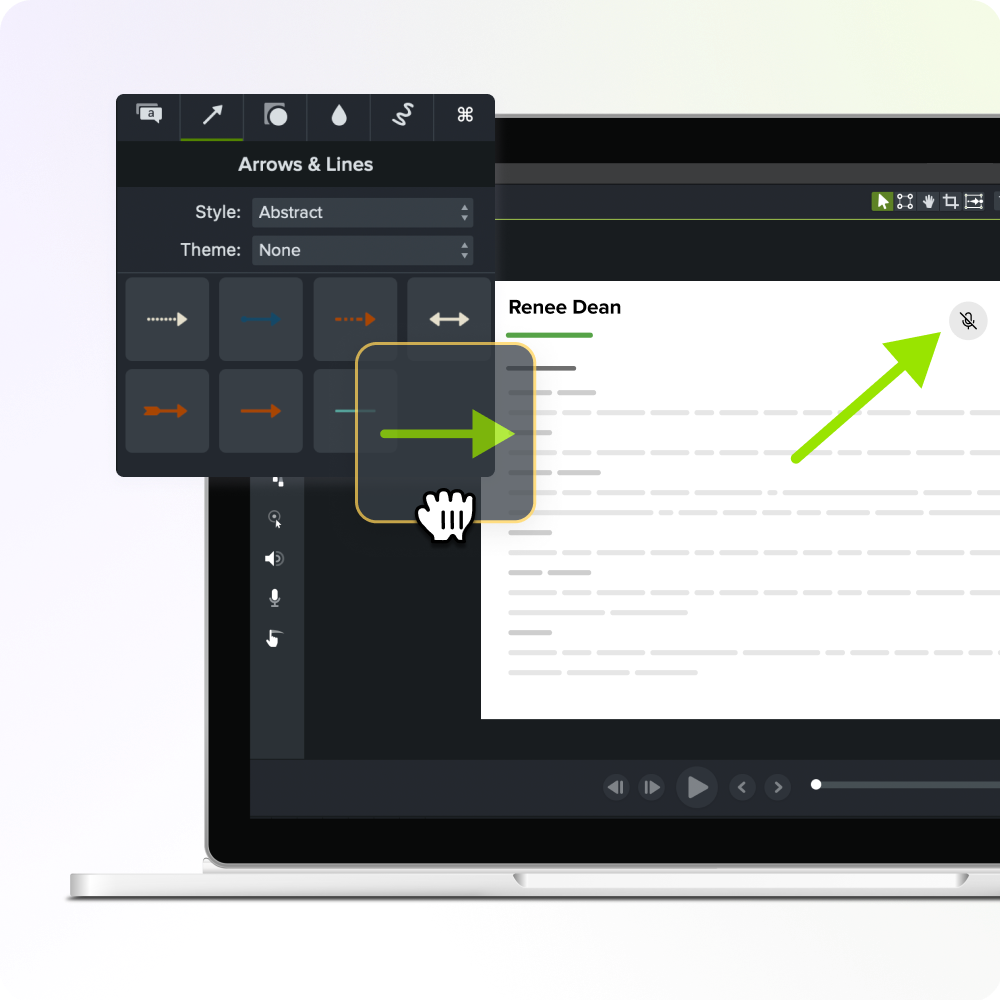
Frequently asked questions
Can I import my existing Filmora project files into a different video editor?
Most alternatives can’t open native Filmora project files directly because each editor uses its own proprietary project format. Export finished Filmora videos or raw footage separately, then rebuild timelines, captions, and branding in the new tool. Test the migration on a small project first to estimate the time cost before committing your full library.
Do I need a powerful computer to run Filmora alternatives like DaVinci Resolve or Premiere Pro?
Professional-grade editors like DaVinci Resolve and Premiere Pro generally demand more RAM, GPU power, and storage than lightweight tools. Screen-recording-focused editors may run more comfortably on standard business laptops, but requirements vary by product and project. Check each product’s current minimum system requirements before switching, especially if you edit 4K footage regularly.
Is a free Filmora alternative enough for a team producing regular training videos?
Free plans can work for occasional or single-user projects, but they may not include the licensing, brand consistency, accessibility, or administrative features a team needs at scale. Teams producing regular training content should evaluate shared templates, reusable styles, captions, admin controls, and export restrictions before relying on a free tier. A paid plan may become necessary once production extends beyond one creator’s occasional use.
How long does it typically take to get comfortable with a new video editor after switching from Filmora?
Ramp-up time varies, but expect roughly one to two weeks of regular, hands-on practice to get comfortable with a new editor’s interface and shortcuts — the exact timeline depends on the tool’s complexity and your prior editing experience. Guided templates and transcript-driven workflows can shorten the adjustment period. Professional suites with deep color, audio, and effects systems generally take longer for non-specialist users.
Is there a Filmora alternative built for team or enterprise use?
Yes, several Filmora alternatives are designed for team or enterprise use through business licensing, administrative controls, and reusable brand resources. Look for volume licensing, centralized user management, shared templates or style libraries, and accessibility features rather than relying on single-seat consumer plans. Independent enterprise recognition can provide another signal, but buyers should still verify that the current plan supports their specific deployment and governance requirements.
Share