








One person understands the legacy billing workflow well enough to keep it running. Every new hire who touches that system gets walked through it by hand. Every support agent stuck on the same edge case pings that same person. Every rollout of a new billing tool needs their sign-off before anyone trusts it.
What that billing expert’s organization is missing is a way to scale their knowledge: to capture what they know once, in a form that trains employees, onboards new hires, and supports customers without pulling the expert back in every single time. That’s the discipline this article is built around.
The billing expert isn’t a bottleneck because they’re bad at their job. They’re a bottleneck because their expertise never left their head in a form anyone else could use. Multiply that person across a support team, a product team, and a training team, and you get an organization that can’t grow faster than its handful of experts can talk.
Fixing that starts with knowing where knowledge actually lives right now. Some of what your experts know is already documented somewhere useful. Most of it isn’t.
Before you can capture anything once and reuse it everywhere, you need a plain way to tell those two categories apart, and a way to decide which gaps to close first.
Key takeaways
- A single captured recording can serve as training, onboarding, and customer support content at the same time, without pulling the original expert back in.
- Live training and one-off chat answers may feel efficient, but neither produces a reusable asset the next person with the same question can find.
- Knowledge that only exists in one person’s head is the highest-risk category for an organization, since it disappears the moment that person leaves.
- Capturing an expert’s reasoning, not just their steps, is what separates a durable training asset from a checklist that breaks under new conditions.
- Auditing which questions repeatedly route back to the same one or two people reveals exactly where uncaptured expertise is creating the most risk.
What scaling organizational knowledge actually means
Scaling organizational knowledge means capturing an expert’s know-how once, in a reusable form, and putting it to work across training, onboarding, customer education, and support. The expert doesn’t have to personally repeat it for every new audience.
That’s a different job than adding more expert hours. Scaling means the same captured content handles more volume, adapts to more variation in who’s watching and why, and holds up over time as a durable asset.
This work carries enough weight that Gartner published its first Magic Quadrant for customer service knowledge management systems in 2026. That recognition confirms the problem is real.
Why asking experts to repeat themselves fails
Repeated explanations consume more expert time each time demand grows, so what they really scale is interruptions. An expert who answers the same question five times has spent five times the effort with nothing left behind.
An organization with a captured asset in place answers that same question zero times, because the person asking never has to reach the expert at all. That gap shows up in three places: live training sessions, one-off chat answers, and tacit knowledge.
Live training sessions have a hard ceiling
Live training only reaches the people who show up for that specific session, so growing headcount just means scheduling more sessions.
You’re coordinating across time zones, blocking the trainer’s calendar against everyone else’s, and running a repeat session for the three people who missed the first one. Each new hire cohort adds another round of the same logistics.
None of that work grows the underlying knowledge. It multiplies the coordination cost of delivering the same explanation again, which is the opposite of the consistent, repeatable training output your program needs as headcount grows.
Build your next training video with Camtasia
Record your screen or camera. Then, use the video editor to add polish and clarity.
Learn More
One-off Slack answers vanish after they’re sent
A one-off Slack answer solves the problem in front of you and nothing else. The expert types out a clear answer, the requester says thanks, and the exchange scrolls out of view within the hour.
Three weeks later, someone on a different team hits the same question. They can’t search for an answer buried in a private thread, so they do the only thing left. They ask the expert again.
That’s the pattern worth breaking. A recorded walkthrough stays put and answers the next person without pulling the expert back in.
Tacit knowledge leaves when the expert does
Undocumented context disappears the moment an expert leaves or moves to a different team. Whatever they knew about why a process works, which exceptions matter, and how to handle the edge cases goes with them.
The scale here is worth taking seriously. Knowledge management research estimates that employees carry roughly 90% of an organization’s knowledge in their heads, undocumented, and separate research on turnover shows it depletes specific critical skills faster than others.
That’s the risk behind the discomfort you feel when expertise sits with one or two people: a single point of failure.
What capturing expertise actually looks like
Capturing expertise means preserving a process, decision, or demonstration in a form other people can use after the original interaction ends. Before capture, that knowledge exists only for as long as the conversation lasts. After capture, it’s an asset someone can open next week, next month, or after the expert has moved on.
Three scenarios cover most of what’s worth capturing: a process while it’s happening, the reasoning behind a decision, and a live demonstration.
Recording a process while it’s happening
Capturing a process means recording the expert while they perform and narrate the actual workflow. Writing it up from memory afterward loses too much.
Click order, the exact menu path, that one setting someone toggles without thinking about it. These disappear the moment an expert tries to describe the process instead of doing it. Real-time capture keeps the visual sequence intact, which matters most for procedural, software-driven work.
Camtasia Editor records screen, camera, and audio together in one session, then splits each onto its own editable track for later refinement.
For a faster path, Camtasia Snagit’s Step Capture builds a numbered how-to guide automatically while the expert works, and that guide can move directly into Camtasia Editor’s timeline to become video (requires Camtasia Editor 2026.2.0+ and Camtasia Snagit 2026.3.0+).
Capturing the reasoning behind a decision
Preserving the judgment behind an expert’s decisions means recording why they chose one path over another. Procedures alone can’t reconstruct judgment. Exceptions, workarounds, and the reasons for skipping a standard step live in someone’s head, and that’s the part a checklist can’t capture.
Record the process first, then stop and ask the expert to explain any exception or alternative they considered. Attach that explanation directly to the recording so viewers get the why along with the how.
This reasoning layer is what keeps the asset useful when conditions change. A rote checklist breaks the moment something’s different.
Turning a live demonstration into a lasting asset
A live demonstration only delivers value the moment it happens, unless someone records it. Recording it turns a one-time walkthrough into content anyone can revisit on their own schedule.
Keep the live Q&A in the recording too. The questions attendees ask often cover the exact gaps a new viewer will have later.
If the demo ran over Zoom, Camtasia Editor’s Zoom integration pulls the cloud recording directly into the timeline, with screen, camera, and audio split onto separate tracks. But that footage won’t get Screentelligence-powered cursor effects like highlighted focus areas. Those only apply to demos recorded natively in Camtasia Editor.
Do AI Voices and Avatars Improve Learning?
Discover what the data reveals about learning outcomes.
Get the Full Report
Where one captured recording goes next
One source recording can feed several audiences without asking the expert to explain the process again for each one. Once you capture it, adapt the same footage instead of recapturing the expertise from scratch.
Three destinations make sense for most organizations: employee training and onboarding, customer education and support, and software adoption.
Feeding employee training and onboarding
An expert’s walkthrough recording can become a standing onboarding asset for every new hire who joins after it. Before capture, each cohort means rescheduling the expert to teach the same steps again. After capture, new hires open the recording on their own time and get the same walkthrough without pulling anyone off their real work.
Keep the segments short and chunked by task. When the process changes, you can replace just the affected clip. That structure also cuts down on repeated questions to the original expert, so they spend less time on repeat training duty and more on the work only they can do.
Powering customer education and support content
An internal walkthrough recorded for a coworker can become customer-facing tutorials or support documentation without pulling that expert back in. Trim the recording, swap in customer-facing language, and cut the internal shorthand. That adaptation step is far faster than starting from scratch.
Save video for workflows with real complexity, like multiple steps, on-screen motion, or a user interface (UI) that changes over time. A one-line answer that solves the question doesn’t need a video at all.
For the how-to steps, pair the video with a screenshot-based job aid using callouts to mark each click. Customers can scan it later to find one step fast.
Speeding up software adoption for new users
A recorded walkthrough of a specific software workflow gets a new user productive faster than any live repeat session because they watch the exact clicks and settings. A written manual makes them reconstruct those steps on their own.
To keep that recording useful as the software changes, build it with Simplified UI (SUI) graphics and record in small, chunked segments. Both choices let you swap out one piece when an interface updates.
If the workflow still holds, a jump cut between segments is fine. Jump cuts are typically only noticeable when there’s a camera feed on screen anyway.
Auditing where your organization’s knowledge actually lives
A simple two-column list shows you exactly where scaling organizational knowledge breaks down: one column for expertise still stuck in someone’s head, another for knowledge already captured and reusable. Running this audit takes three steps:
- List what’s stuck.
- List what’s captured.
- Compare the two lists to see where expert dependency creates the most risk.
What’s still stuck in someone’s head
Knowledge is still stuck in someone’s head when only one or two people in your organization can explain a given process, decision, or question. Start a list of every one you can find, and if you can’t name a backup person on the spot, that’s your answer. The knowledge lives with them.
Trace your recurring questions back to who keeps answering them. If the same person fields the same question every month, that’s not a coincidence. It’s a signal that no one has captured the answer anywhere else.
Check the live-only touchpoints first. Recurring training sessions, live product demos, and one-off Slack threads that get re-answered every time are where undocumented expertise hides in plain sight.
What’s already captured and reusable
Start a second column and list every recording, documented walkthrough, or training asset that already exists in your organization, then test each one. Ask if it’s current, findable, focused on one task, and usable by someone who never worked with the original expert.
A recording that sits buried in someone’s downloads folder, shows an interface replaced last quarter, or runs 45 minutes covering six unrelated tasks fails that test even though it technically exists. A short, current clip stored where a new hire can search for it and use it on their own passes.
Anything that fails belongs back in your first column. It’s still an unresolved gap.
What’s revealed when you compare the two
The highest-priority capture targets are the knowledge gaps that generate frequent repeat requests and depend on a single expert with no backup. Lay your stuck list next to your captured list, and those gaps jump out immediately as the items with no match on the captured side.
Rank those gaps by repetition. If three people asked the payroll system question this month, that knowledge pays off the moment you capture it. A question nobody’s asked in a year can wait.
Flag anything tied to a single expert with no backup. If only one person can walk through a process and no one else could step in tomorrow, that’s a single point of failure. Move it to the top of your list, regardless of how often it comes up.
What gets easier once capture is the default, not the exception
Making capture the default habit instead of a special project turns every new recording into an addition to your team’s library, so training, onboarding, support, and adoption content all get faster and cheaper to produce.
AI-assisted production removes the biggest bottleneck: The expert doesn’t have to become a video editor.
But it doesn’t replace the expert’s judgment. It removes the production drag around it, so the person who knows the process spends time teaching it once, well, instead of repeating it forever.
Start with the next thing an expert would otherwise have to repeat
Pull your audit and find the item with the most repeat requests and the fewest backup people, then capture that one thing this week.
Look at your expert’s calendar for the next scheduled explanation, that Lunch and Learn they’re scheduled for or the walkthrough they’re about to give a new hire. Record it right then, while they’re already doing the work.
That single recording becomes the asset. The next time someone asks, you send a link instead of booking your expert’s time.
Repeat this every time your audit turns up another high-frequency, single-point item. Small, steady captures build the reusable library faster than any large rollout ever could.
Turn captured expertise into a reusable asset
That billing expert walking every new hire through the same workflow isn’t a training problem to solve once. It’s a pattern that repeats every time someone new joins the team, every time a customer gets stuck on the same step, every time support fields the same ticket.
An expert repeating themselves more often doesn’t scale expertise. Capturing what they know once and putting it to work everywhere it’s needed (onboarding, documentation, customer education, support) does.
Camtasia Editor turns a screen recording into a finished, reusable training or documentation asset, without hiring a production team.
Pick the one explanation your expert is about to repeat, and start your first capture in Camtasia Editor.
Faster video creation with Rev
Make videos as easy as click, click, done! Camtasia Rev is so fast it’s like magic!
Learn More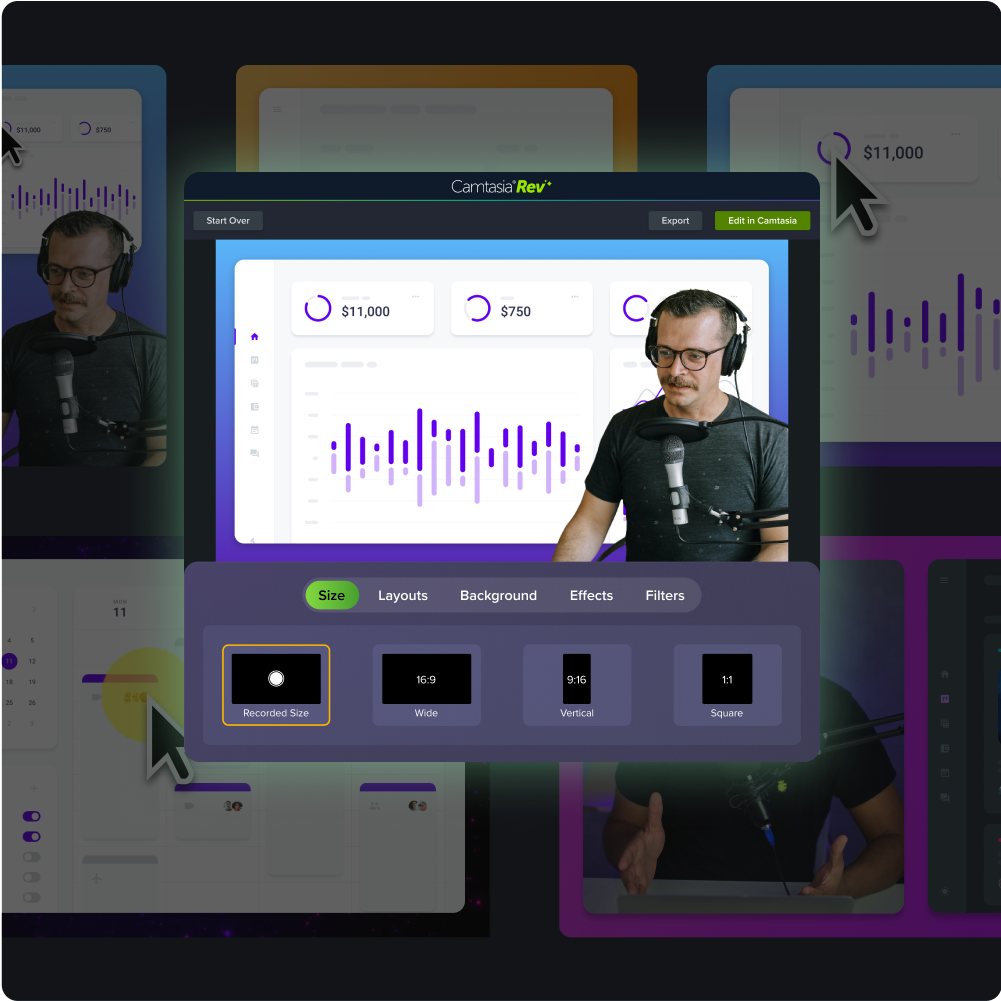
Frequently asked questions
How do you know if your organization’s knowledge-scaling efforts are actually working?
Track how often the same question gets asked live versus answered by an existing captured asset. A steady drop in repeat questions to your experts signals that captured content is doing its job. Onboarding time, support ticket volume, and software adoption speed are also worth watching, since each tends to improve as expertise gets captured and reused.
Is scaling organizational knowledge the same thing as adopting a knowledge management system?
Scaling organizational knowledge and adopting a knowledge management system are related but not identical. A knowledge management system is software that stores and organizes information. The platform alone doesn’t create reusable expertise; capturing it in the first place does. Scaling organizational knowledge is the discipline of capturing what an expert knows before it reaches any system, so there’s something valuable to organize.
Who should be responsible for capturing an organization’s expertise?
Capturing expertise works best as a shared responsibility between the subject matter expert (SME) and whoever manages training, documentation, or learning and development (L&D) content. The SME provides the knowledge and reasoning, while a trainer or instructional designer handles turning that raw material into a polished, reusable asset. This division keeps experts from becoming reluctant video editors and keeps captured content consistent across the organization.
Can someone other than the original expert update a captured knowledge asset later?
Updating a captured knowledge asset doesn’t require pulling the original expert back in, as long as the asset was built for reuse. Chunked segments and SUI graphics let a trainer refresh a small piece of the asset without a full re-record. This is one reason update-friendly capture habits matter more than production polish when you’re trying to scale knowledge over time.
How long does it take to see results from a knowledge-capture initiative?
Results often appear within weeks, since you’re capturing one recurring question or process at a time rather than launching a large initiative. The first payoff usually comes from the single most-repeated item you capture, which stops re-taxing your expert almost immediately after it’s recorded. Broader gains in onboarding speed, support deflection, and software adoption tend to compound over months as the library of captured assets grows.
Share