









This standard allows instructional designers and educators to use diverse tools to author and deliver online course content. SCORM is short for Sharable Content Object Reference Model.
SCORM compliance is a critical part of e-learning content creation. This article explains everything you need to know:
- e-learning
- e-learning management systems (LMS)
- SCORM Files
- SCORM-compliant content creation
- Camtasia: The best SCORM-compliant video editor
Key takeaways
- SCORM is short for Sharable Content Object Reference Model.
- You may also see this written as ‘Shareable Content Object Reference Model’ — ‘Sharable’ is the correct, original spelling used by ADL.
- A SCORM package contains a manifest file and learning materials.
- An LMS can use SCORM to track completion status, quiz scores, responses, and time spent.
- Camtasia can export a project as a SCORM-compliant ZIP file.
Why use SCORM?
This standard lets you create and reuse content across different courses and platforms. It provides detailed insights into learner performance by tracking time spent, scores, and completion rates.
e-learning providers use SCORM to ensure their content works with Learning Management Systems (LMS). This helps in several ways:
- Educational institutions give students consistent access to courses and assessments.
- Corporate and government training programs deliver standardized training across various departments and locations.
- Third-party creators build seamless content for any customer’s LMS.
What is an e-learning platform?
E-learning, or electronic learning, is a way to deliver education through digital platforms. While often linked to online courses, it can include virtual classrooms and immersive experiences. E-learning platforms provide online courses to students. They host the content, organize it into courses, and track how users engage with it.

What is a learning management system (LMS)?
E-learning platforms that are full-featured learning management systems (LMS) include:
- Authoring tools
- Course structuring
- Assessment capabilities
- Analytics to assess learner progress.
SCORM-compliance enables LMSs to import, launch, and track standardized courses.
| Comparison | LMS | SCORM |
| What it is | A platform for delivering and managing learning | An e-learning content standard |
| What it does | Hosts, organizes, launches, and tracks learning | Standardizes how packaged content communicates with a compatible LMS |
| How they work together | Imports and launches a SCORM package, then tracks learner activity | Provides the package structure and run-time communication the LMS uses |
Why is a standard important for LMS platforms?
SCORM-compliant courses work on different learning management systems (LMS). This makes it easy to share, reuse, and integrate content. One tool can create content, and another can host it.
Learning professionals can scale online courses without worrying about platform limits. This standard also helps track learner progress and results, giving organizations essential data to improve training.
Do all LMS platforms support SCORM?
Most modern LMS platforms are SCORM-compliant.
Tip: Verify the version(s) supported before investing in one.
Popular LMS platforms include open-source Moodle, Blackboard, and Canvas. These systems support SCORM out of the box, though which version(s) each supports can vary.
What is a SCORM file? What is a SCORM package?
The standard defines how to organize e-learning content for LMSs. E-learning content is packaged into SCORM files (also called SCORM packages.)
Run-time communication occurs between the LMS and the file during a learning session. This data exchange enables the LMS to interpret the course content and track user progress, including:
- Quiz scores
- Time spent
- Completion status
- Responses to individual quiz questions
Each zip file contains all the components necessary for delivering an e-learning course on an LMS:
- Manifest file – provides the data to import, launch, and manage the course. This XML file describes the content structure, sequencing rules, and metadata.
- Learning materials – training resources such as text, images, videos, quizzes, and interactive elements.
- Sharable Content Objects (SCOs or learning objects) – the smallest units an LMS can track individually. A single course may span multiple zip files.
What are the different SCORM versions?
Four versions of SCORM are widely available. Each version aims to ensure compatibility across LMS platforms, though not every LMS supports every version.
Version 1.2
The original version remains the most widely supported and simplest to implement, making it a common default for enterprise training.
Tip: SCORM 1.1 had limitations and was quickly replaced.
Version 2004 2nd Edition
Adds more advanced sequencing and navigation features, offering greater flexibility for course designers.
Version 2004 3rd Edition
Largely a set of improvements to the sequencing specification to tighten the details.
Version 2004 4th Edition
Contains further enhancements to the sequencing, plus new features for navigation.
How to create SCORM content
Products like Articulate Storyline, Adobe Captivate, and iSpring Suite enable compliant content creation, but are expensive.
One challenge is that these tools aren’t built for video production. You typically need a second tool to capture screen content and edit videos. Interactive videos keep users engaged and are an important part of online course creation.
Camtasia Editor is the market-leading video editor and screen recorder for corporate training and higher education. Camtasia enables creators to add interactivity and quizzes within a video to not only increase engagement but also to track learning via SCORM.
Crystal-clear screen recording
Why settle for blurry screen content? Camtasia Editor’s screen recorder captures everything at up to 4K!
Free Download
Crystal-clear screen recording
Why settle for blurry screen content? Camtasia Editor’s screen recorder captures up to 4K, hardware permitting. Free Download
| Tool | Screen Recording | Video Editing |
| Articulate Storyline | Basic features | Limited capabilities for simple edits |
| Adobe Captivate | Capabilities for simulations and demos | More features, including interactive videos with branching and quizzes |
| iSpring Suite | Basic features integrated with PowerPoint | Basic features for enhancing PowerPoint with interactive media |
| Camtasia | Full-featured screen recorder with the ability to capture screen, camera, microphone, system audio, and mouse cursor data | Full-featured video editor |
Camtasia: Best Video Editor for LMS Integration
Use Camtasia Editor to create engaging e-learning videos and tutorials.
With Camtasia Editor’s advanced e-learning features, you can:
- Require a viewer to watch a specific percentage of your video to complete the course.
- Add interactive quizzes.
- Require the viewer to answer a specific percentage of questions correctly to pass.
How do you create and export SCORM content in Camtasia?

Export your SCORM-compliant video recordings and upload them directly into an LMS:
- Create your video tutorial in Camtasia Editor.
- (Optionally) Use quizzes and interactive elements to enhance learner engagement.
- Export your project as a SCORM-compliant zip file that integrates smoothly with your LMS.

Whether you’re building corporate training or academic courses, Camtasia makes it easy to produce and deliver e-learning content.
FAQs
What is the Experience API (xAPI)?
The Experience API, also known as xAPI or Tin Can API, is a newer alternative standard. xAPI supports various learning experiences, including informal learning and real-world performance.
While xAPI offers advanced capabilities, it is only sometimes compatible with older LMS systems. SCORM remains the standard for now because of its simplicity and established legacy infrastructure.
What are the limitations of SCORM?
Users express some frustrations with the standard and seek options to improve flexibility and learner experience:
- File Size – SCORM itself has no size cap, but individual LMS platforms set their own upload limits, so large files can be rejected or cause buffering issues.
- Flexibility – Some designers prefer custom solutions over industry standards because they offer more flexibility and learner engagement.
- Newer Standards – Others want to switch to newer standards like xAPI for more features.
- Authoring Tools – Specific tools may require extra customization, plug-ins, or add-ons, such as screen recording and video editing software.
Is SCORM a file type?
SCORM is a standard, not a single media file type. E-learning content is packaged into SCORM files (also called SCORM packages). Each ZIP file contains the components needed to deliver an e-learning course through an LMS:
What platforms use SCORM?
SCORM content is used with compatible learning management systems. Most modern LMS platforms are SCORM-compliant. Popular LMS platforms include open-source Moodle, Blackboard, and Canvas. These systems are compliant so that they can use packages without extra changes.
Before investing in an LMS, verify which SCORM version or versions it supports.
How do you create a SCORM file?
Create a SCORM file by packaging course content for an LMS. The package includes a manifest file plus learning materials such as text, images, videos, quizzes, and interactive elements. In Camtasia, create your video tutorial, optionally add quizzes or interactive elements, and export the project as a SCORM-compliant ZIP file.
Create e-learning content today.
SCORM standards are essential to e-learning, helping to share and track content on different platforms. And while older and less refined, SCORM stands as a useful tool in every learning designer’s toolkit.
Camtasia makes it easy to create content that keeps learners engaged while meeting industry standards.
Ready to make SCORM-compliant video projects? Try Camtasia today to build interactive e-learning courses that integrate with almost any LMS.
Go from screen recording to polished video
A screen recording is just the start. Camtasia’s editor helps you add the callouts, animations, and edits you need to create a truly professional video.
Go from screen recording to polished video
A screen recording is just the start. Camtasia’s editor helps you add the callouts, animations, and edits you need to create a truly professional video.
Free Download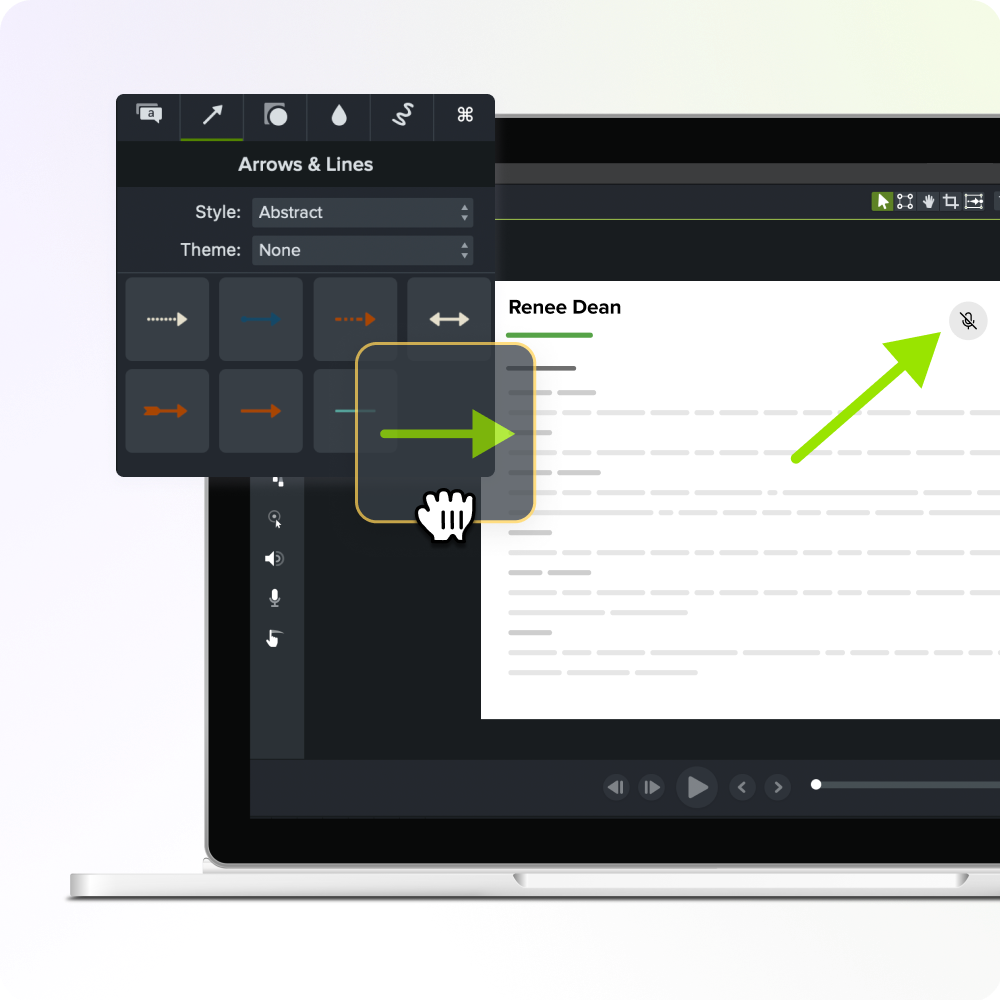
Share