







Screen recording has moved beyond a simple utility and into a specialized pillar of workplace communication. For years, the real barrier to high-quality training content was editing time, not the recording itself.
Corporate trainers and instructional designers often found themselves buried in hours of post-production cleanup: masking background noise, aligning captions, or manually zooming in on tiny interface elements.
AI-powered screen recording tools have changed this. By combining video capture with intelligent automation, these tools handle the heavy lifting of audio engineering and video editing. Features like automatic transcription, noise removal, and smart editing suggestions let you create polished screen recordings even without video production skills or dedicated editing time.
Key takeaways
- AI-powered screen recording software eliminates manual editing tasks like captioning, noise removal, and filler word deletion, cutting production time by hours per video.
- Camtasia offers the most complete AI ecosystem for teams that need professional-quality training videos, with features like text-based editing, AI voices, and automatic translations.
- Free options like OBS Studio require technical setup and third-party AI plugins, making them better suited for power users than beginners.
- The right screen recording software depends on your primary use case. Evaluate ease of use, AI editing features, and sharing options before committing to a platform.
What can an AI screen recorder do for your workflow
To understand the value of an AI screen recorder, you have to look at the friction points of traditional video creation. In a standard workflow, the recording is only 10% of the work. The other 90% is spent trying to make that recording usable.
One-third of leaders spend an average of one hour per day resolving collaboration issues, highlighting the urgent need for tools that reduce friction rather than add to it. Using AI shifts that balance by automating the post-production tasks that typically require specialized skills.
Faster turnaround and accessibility
In a training environment, accessibility isn’t optional. With the U.S. Department of Justice’s ADA Final Rule now in effect, digital training materials need to meet specific requirements. AI-enhanced tools generate highly accurate captions in real time, so you can skip manual transcription entirely.
Professional audio without a studio
Poor audio is one of the fastest ways to lose a learner’s attention. AI now enables sophisticated noise removal that identifies the frequency of your voice and isolates it from keyboard clicks, hums, and distant sirens. AI editing features can normalize volume automatically, so learners aren’t constantly adjusting their audio mid-video.
Editing at the speed of thought
A significant leap in recent years is the move to text-based editing. Instead of hunting through a waveform to find where you stumbled over a sentence, you can look at a transcript. Delete the sentence in the text, and the AI makes a frame-accurate cut in the video. This lets non-editors produce clean, tight content without ever touching a traditional timeline.
Consistent quality
AI standardizes videos by applying the same polish (captions, cleaner audio, and smoother edits) no matter who created them or their level of technical expertise.
Looking for professional screen recording software?
From simple screen captures to polished video editing, TechSmith has everything you need to create professional-quality content.
Learn More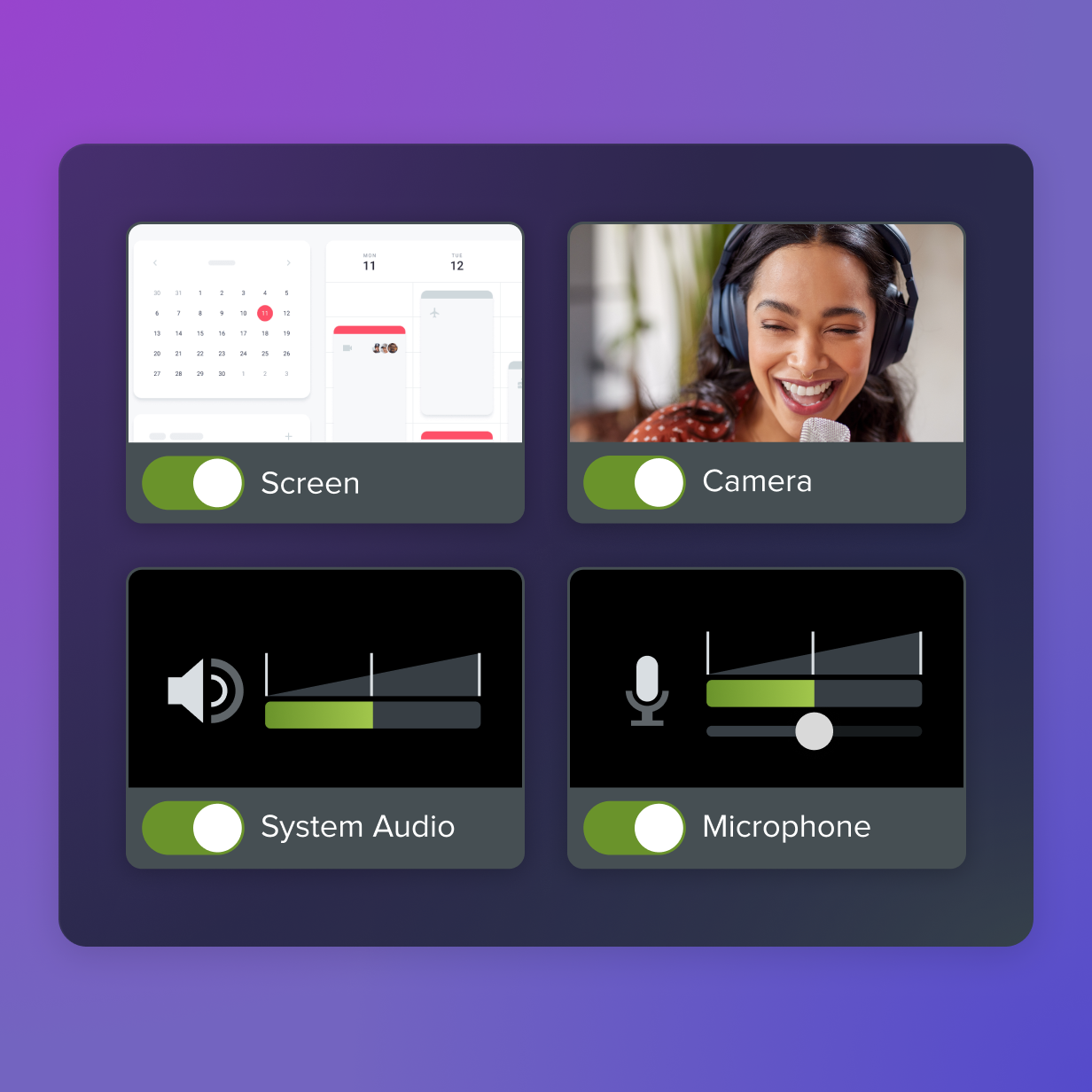
Top 5 AI screen recording tools
| Tool | Primary strength | Learning curve | Best use case |
| Camtasia Editor | Professional training | Low (intuitive) | Scalable, branded L&D content |
| ScreenPal | Quick walkthroughs | Very low | Individual creators and internal comms |
| Descript | Audio-first editing | Medium | Podcasts and transcript-heavy videos |
| OBS Studio | Total customization | High (technical) | Streamers and power users on a budget |
| Movavi | Basic polish | Low | Occasional users with entry-level needs |
1. Camtasia Editor: Professional screen recording and editing
For building a library of training videos, tutorials, and branded content that looks as professional as the company it represents, Camtasia Editor is the industry heavyweight. It’s purpose-built for workplace communication, so the training feels like an intentional experience rather than a random screen grab.
Camtasia Editor captures metadata, not just pixels. For trainers, that distinction matters. Because it records the screen, camera, and system audio on separate tracks, you have total control in post-production. The AI-powered toolset then refines that raw footage, offering features like AI-generated captions.
- Text-based editing with Camtasia Audiate: Pairing Camtasia Editor with Camtasia Audiate lets you edit your video like a Word document. You can rearrange sections, spot filler words, and remove them with a single click.
- Reusable templates and brand assets: Camtasia Editor includes reusable templates and brand assets for consistent output across multiple creators.
- Smart focus and guided attention: One of the hardest parts of screen recording is showing a learner where to look on a busy screen. Camtasia’s AI analyzes cursor movements and clicks, automatically applying “Smart Focus” zooms that guide the viewer’s eye exactly where it needs to be.
- AI background noise removal: Even if you’re recording in a cubicle, the AI strips away environmental distractions, making your microphone sound like it was recorded in a professional sound booth.
Best for:
Camtasia Editor is built for teams that need polished, repeatable results. If you’re focused on building a library of assets using collaborative video editing software, the ability to use shared templates and brand assets ensures that, whether the video is made by an IT admin or an HR lead, the quality remains consistent.
But Camtasia Editor is also just one part of the full Camtasia suite of tools. Bundle it with Camtasia Snagit and Camtasia Audiate for a comprehensive solution at one cost-effective price.
Go from screen recording to polished video
A screen recording is just the start. Camtasia’s editor helps you add the callouts, animations, and edits you need to create a truly professional video.
Free Download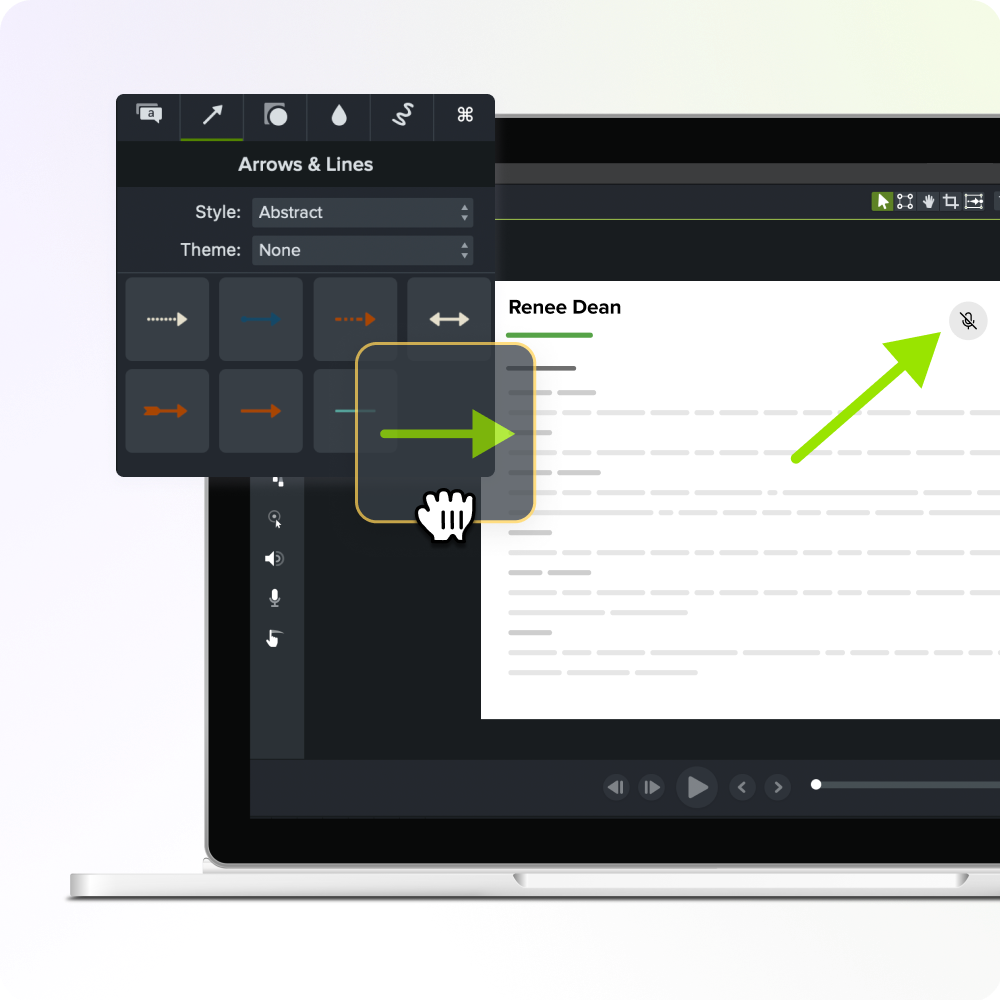
2. ScreenPal: Simple recording and quick edits
ScreenPal is a beginner-friendly tool for users who need more than a basic “record and share” link but don’t want to manage a complete editing suite. It’s designed for speed, allowing you to make quick edits and export or share without needing advanced editing skills.
ScreenPal provides automatic captioning for accessibility and basic speech-to-text tools that make it easy to generate a searchable index for your videos. While it doesn’t offer the deeper editing controls of more advanced suites, it includes:
- One-click polishing: Simple tools to clean up audio and apply basic filters.
- Built-in asset library: A built-in collection of stock images and music to help brighten up a dry tutorial.
- Pricing: ScreenPal offers an affordable entry point for individuals or small teams.
- Onboarding: Lower barrier to adoption compared to more advanced platforms.
Best for:
ScreenPal works well for individual creators or small teams who want quick tutorials and walkthroughs without complexity. Its editing tools are best suited for simple projects — longer or more complex ones may need Camtasia or Descript. Teams building scalable training workflows or producing highly polished content will want more than what it offers.
If you’re searching for a Loom alternative with more depth for structured, multi-chapter employee onboarding, you’ll likely need the features of a full product suite.
3. Descript: Text-based edits and transcripts
Descript is an “editor first, recorder second” platform. It works well for teams that prefer editing with words rather than timelines. Treating the transcript as the editing interface means deleting or rearranging text edits the video directly. It also removes filler words and long silences with a single click, and includes helpful AI editing features like:
- Overdub (AI voice cloning): Said the wrong date in a recording? You can type in the correction, and Descript’s AI generates a clone of your voice to say it in the video.
- Studio sound: This feature uses generative AI to completely rebuild your audio, removing echo and background noise and replacing it with a studio-quality reconstruction of your voice.
Best for:
Descript is strongest with audio-heavy projects and transcript-driven workflows. Teams that want to test before committing can start with a free tier; paid plans unlock more advanced AI features.
Descript’s screen recording controls are solid, but it’s primarily an editing tool. If your training requires precise cursor movements, specialized annotations, or complex callouts, you may need to record in a tool like Camtasia Editor before importing into Descript for the final edit.
4. OBS Studio with AI plugins: Free option for technical users
OBS Studio is the most powerful free option available. The tradeoff is longer setup time and significant technical overhead. Out of the box, OBS is a blank slate. The AI power comes from third-party plugins that add features like noise suppression, scene detection and auto-switching, and background removal.
Technical users can use specialized AI plugins for real-time background removal or noise suppression, giving recordings a polished look during the live recording process. OBS produces raw recordings, so it typically requires separate editing software to finish the final output. With OBS, you get:
- Control vs. convenience: OBS is highly capable but demanding. You have control over every pixel, but there’s no “easy” button, so you want to choose it for control, not convenience.
- Onboarding hurdles: For a corporate team, the learning curve can be steep. Constant configuration and troubleshooting can eat into production time.
Best for:
OBS Studio is a strong choice for technical users, streamers, or budget-conscious creators comfortable managing their own plugin updates and scene transitions. Teams that need fast onboarding or built-in AI features will find it frustrating.
5. Movavi screen recorder: Entry-level screen recording software
Movavi is a beginner-friendly option for basic recording plus light editing. It offers a clean, intuitive interface: get in, record, and get out with straightforward capture controls. Movavi aims at ease of use over professional depth, and it delivers on that promise.
Movavi includes entry-level AI features like basic noise removal. It handles the most obvious errors in a recording — like long pauses or a background hum — without requiring the user to have any editing knowledge.
- Simplicity at scale: It’s an affordable entry point for small teams that only need to record a few times a month.
- Enhancement tools: Movavi offers auto-enhance for quick cleanup and simple effects and transitions.
- Growth potential: Movavi is more limited than Camtasia or Descript. Users often outgrow it once they need more scalable features like those found in the Camtasia Product Suite.
Best for:
Movavi is a good choice for individuals or small teams with occasional recording needs who don’t require advanced workflows. It can also work for those who need high-quality screen captures without a recurring subscription.
How to choose the right AI screen recording software for your team
Recent research emphasizes that intentional design — how humans and machines interact — is now the primary differentiator in realizing AI’s value in the workplace. The right tool is the one that aligns with your intention: how your organization produces and updates knowledge.
Team size, workplace requirements, and use case all factor in. Focus on what saves time and reduces friction in production.
As you evaluate your options, move beyond the feature list and consider how each tool handles adoption, automation depth, and security.
Prioritize ease of use and onboarding time
If the software is too hard to learn, your teams will revert to sending long, confusing emails instead of helpful videos. Evaluate how many steps it takes to turn an idea into a completed project.
A tool that feels intuitive to a non-technical user is a better investment than a complex tool with features that never get used. Camtasia Editor is designed to produce polished results without requiring deep video production experience.
Check built-in AI editing and caption features
AI feature depth varies widely, depending on the tool. Some automate end-to-end cleanup while others only cover basics. Identify your team’s biggest time-wasters. Is it fixing audio? Adding captions? Trimming mistakes? Match features to recurring tasks, not the other way around.
- Captions: Look for tools that offer one-click transcription and high-accuracy audio-captioning with easy manual correction.
- Audio: Prioritize tools that handle background noise automatically and normalize volume.
- Editing: If you want to save time, look for text-based editing, script support, and filler word removal, like what you’ll find in Camtasia Audiate.
Confirm sharing, privacy, and security options
This is the most overlooked part of the selection process. Many AI tools are cloud-based, meaning your recording uploads to a server for processing. If you’re recording sensitive payroll data or internal software code, you need to confirm the tool meets your company’s security requirements.
Sharing needs vary by organization, but desktop-based processing is often preferred by IT admins because it keeps data on the local machine. Enterprise teams should confirm compliance with internal IT policies before adopting cloud-based tools.
Camtasia Editor offers flexible support options and local processing for teams in stricter security environments.
Crystal-clear screen recording
Why settle for blurry screen content? Camtasia Editor’s screen recorder captures everything at up to 4K!
Free Download
Level up your team videos with Camtasia‘s full AI suite
AI-assisted screen recording puts professional quality within reach, regardless of who’s behind the keyboard. Camtasia Editor handles the technical side so your teams can focus on the content itself.
Camtasia Editor combines professional recording, AI-powered editing, and intuitive workflows in one platform. Even if your teams don’t have a video production background, they can still create training content that looks and sounds professional.
But it’s just one part of Camtasia’s full suite of products designed to simplify professional video creation from beginning to end. So explore the full toolset — from screen recording and video editing to audio production and sharing, it’s built to work together.
Build your professional training library with the Camtasia Product Suite.
FAQs
Do AI screen recorders work on locked corporate devices?
Most cloud-based AI screen recorders require browser access and may be restricted on locked devices, so it’s best to confirm what your IT team allows. Desktop applications like Camtasia Editor can be easier to approve when installed with the right admin permissions.
What is an AI screen recorder?
An AI screen recorder is software that captures your screen while using artificial intelligence to automate editing tasks, like generating captions, removing background noise, trimming filler words, and suggesting edits. Instead of manually polishing recordings, AI handles much of the post-production work for you.
What’s the difference between a regular screen recorder and an AI screen recorder?
A regular screen recorder only captures video and audio, leaving all editing and cleanup to you. An AI screen recorder adds automation — like automatic transcription, noise reduction, and text-based editing — so you can turn raw recordings into polished, high-quality videos much faster.
Can I fix mistakes if the AI mislabels something in my recording?
Yes, most reputable tools let you manually edit captions, transcripts, and other AI-generated outputs after processing. This gives you full control over the final video.
How secure is cloud processing for AI screen recording?
Security varies by provider, so review data handling policies, encryption, and compliance certifications before uploading sensitive content. If confidentiality is critical, consider tools that support local processing or offline workflows.
Share