








Your Learning and Development (L&D) team just learned a policy change takes effect in two weeks, and three onboarding videos reference the old process. The question is not whether to update them, but how fast you can.
Corporate training video production is the process of planning, recording, editing, reviewing, publishing, and updating video-based training for employees. For most teams, the goal isn’t cinematic polish. It’s keeping onboarding, compliance, software walkthroughs, and process training accurate and accessible.
That distinction matters when you’re deciding whether to outsource production to an agency or build the capability in-house. Both paths have costs, but they behave very differently when training content changes often — which is true for most corporate training libraries.
This post gives you a practical framework for comparing the two models across the factors that drive total cost: update frequency, revision cycles, turnaround time, and long-term maintenance. By the end, you’ll have enough to make a confident decision and a clear first step for testing whichever path fits your team.
Key takeaways
- Corporate training video production costs more than agency quotes suggest, because revision cycles, turnaround delays, and update requests can add ongoing operational expense.
- In-house corporate training video production often becomes more cost-effective when teams create onboarding, compliance, or process videos that need frequent updates.
- Modern AI tools and screen recording workflows can help L&D teams produce polished training videos without the steep learning curve of traditional editing software.
- Short, focused training videos are usually easier to maintain, easier to reuse, and better suited to fast-changing workplace knowledge than high-production content.
- When corporate training video production moves in-house, teams gain more control over content freshness, brand consistency, and the speed of learner support.
Why the build-vs.-buy question matters more than ever
The build-versus-buy decision for training video production is a choice about who controls your update cycle. Training content changes quickly. Policies shift, software UIs change, onboarding processes get revised. Delayed updates create operational risk.
When an HR team needs to revise onboarding after a policy change, waiting two weeks for a vendor turnaround means new hires follow outdated steps.
If your team updates training content more than occasionally, turnaround speed is part of your cost.
What corporate training video production involves before you choose a model
Production means more than recording. It includes planning, capture, editing, review, captioning, publishing, and ongoing maintenance. Map your current workflow and note which steps your team owns versus those handled externally.
A compliance module requiring legal review and captions before your learning management system (LMS) upload illustrates the full workflow. The question is whether your team owns that workflow or rejoins an external queue every time something changes.
The full production lifecycle you must budget for: From script to distribution
Every training video passes through nine distinct stages, and each one costs time or money.
- Needs analysis
- Scripting
- Storyboarding or visual planning
- Recording
- Editing
- Subject matter expert (SME) review
- Accessibility checks (captions, contrast)
- LMS upload and metadata tagging
- Scheduled updates
A software walkthrough, for example, needs SME sign-off, accurate captions, and correct LMS metadata before it can go live. That’s three separate review cycles before a single learner watches it.
If you decide to build in-house, this step-by-step guide to creating employee training videos is a practical starting point.
Which training video types change most often?
Start by identifying your highest-change category. Update frequency matters more than any other factor when comparing costs.
- Compliance: Frequently updated. Policy language changes trigger full re-records.
- Onboarding: Moderately updated. Role changes and new tools require regular revisions.
- Software walkthroughs: Frequently updated. Renamed fields or moved navigation break these fast.
- Safety: Moderately updated.
- Product training: Moderately updated.
- Manager coaching: Usually evergreen.
- Microlearning refreshers: Varies.
Build your next training video with Camtasia
Record your screen or camera. Then, use the video editor to add polish and clarity.
Learn More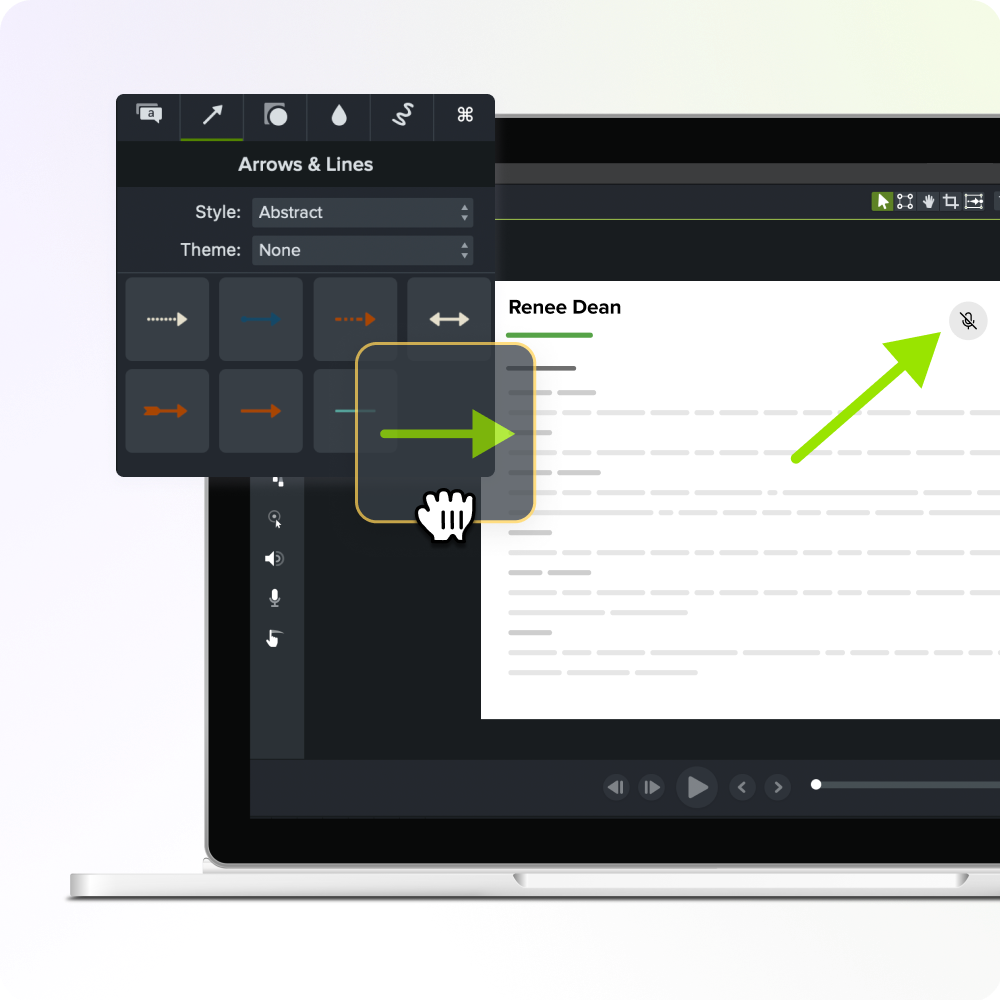
The real cost of outsourcing to a production agency
The agency quote is never the full cost. Paid revision cycles, SME coordination time, and scheduling lag add up fast.
Before signing a contract, ask three questions: How often does this content change? How many internal reviewers are involved? How quickly must a critical update ship?
A compliance correction rarely waits two weeks for a vendor turnaround.
Per-video fees and revision cycle costs
Agency quotes typically bundle discovery, scripting, production, editing, captions, and delivery into a single per-video fee, but that price rarely covers what happens next.
Even minor changes can trigger another billable round. A policy update that rewrites one sentence, a new screenshot after a UI change, or a single terminology correction can restart the entire revision cycle: new edits, new stakeholder review, and another invoice.
Action: Pull your last two outsourced projects and count how many “small changes” generated a separate charge.
Localization and future updates are usually scoped separately too, so the original quote understates true cost significantly. What looks like a fixed fee is often the first of several.
Turnaround time as an operational expense
A two-week agency turnaround carries a measurable business cost. When a product release changes a support workflow overnight, employees who can’t access updated training follow outdated steps, slowing ramp time and increasing errors.
Internal teams can publish a corrected screen recording the same day. Agencies often require the request to go back through their production queue.
Action: Estimate what one week of stale onboarding or compliance content costs your team in support tickets, rework hours, or delayed productivity. That number is your baseline for comparing turnaround models.
The content freshness problem: When agency videos go stale
Stale training content creates significant operational risk. When a navigation label changes, a safety step gets revised, or a new onboarding form replaces the old one, any video showing the previous version actively misleads employees.
Agency production timelines can leave those inaccuracies live for weeks. A renamed field in your CRM can generate a wave of support tickets before a correction ships.
Audit your existing library: Identify which videos change most often and note how long outdated versions remained published. That gap is your compliance and retraining exposure.
The real cost of building in-house production capability
In-house production has upfront costs, but they’re predictable and reusable. Separate one-time setup expenses from ongoing per-video effort to see how the marginal cost drops over time.
An L&D team building a quarterly onboarding library pays for software and templates once, then updates content without restarting an external production workflow every time a policy changes.
Software licensing vs. per-project agency fees
Annual software costs are easier to forecast. Agency invoices are not.
A typical in-house toolkit covers these categories at a fixed yearly rate:
- Camtasia Editor: screen recording and editing
- Camtasia Audiate: transcription, translation, text-based editing, and AI-generated narration and avatars
- Screencast: centralized review and stakeholder feedback
Every outsourced revision can restart the billing cycle. An onboarding team producing 10 short videos with quarterly updates will keep paying those agency fees every quarter.
Before committing either direction, price one year of software plus a basic microphone against two or three recent outsourced projects. Include revision invoices, not just the original quote.
See the full employee training cost framework to map every budget line.
The learning curve: How steep is it really in 2026?
There’s a learning curve, but it’s much shorter than it was even two years ago. Templates, automated captions, and text-based editing remove most of the technical barriers that once required a specialist.
An instructional designer can now open a saved template in Camtasia Editor, use transcript-based editing in Camtasia Audiate to cut outdated narration, and publish an updated process video without manually editing the timeline.
Start with one pilot project (a short software walkthrough works well) and measure how long it takes a non-specialist to reach an acceptable result.
When outsourcing is still the right call
Some projects genuinely belong with a production agency. A polished annual culture film, an executive keynote-style launch video, or a complex live-action shoot with specialized crews and sets requires expertise that most L&D teams don’t need to replicate internally.
This article focuses on routine corporate training video production, where update speed matters more than cinematic polish. Apply a simple test: If a video will rarely change and needs high-end live-action production, outsourcing is likely the better fit.
When in-house production wins decisively
In-house production wins most clearly when volume is high, updates are frequent, and consistency matters across many videos. Ask yourself whether your training library behaves more like a growing system than a one-off project. A distributed L&D team managing onboarding, compliance, and product updates across multiple departments almost always answers yes.
High-volume onboarding and compliance content
When the same training structure repeats across every new-hire cohort or annual compliance cycle, reusable templates make each video cheaper and faster to produce than the last.
In Camtasia Editor, save a master template with your intro slide, caption styles, user styles, and standard annotation callouts. Then apply it to every new module without rebuilding from scratch.
Start here: Identify which onboarding or compliance modules run on a fixed schedule and standardize those first. That’s where template reuse pays off fastest.
Frequently updated process and product training
Screen-recorded training can be updated faster than an agency workflow. When a CRM interface changes or a revised SOP needs to reach employees the same day, waiting for a vendor turnaround is not an option.
Use Camtasia Online for quick browser-based captures when speed matters most. When a module needs tighter editing or callouts, send it to Camtasia Editor for additional editing before republishing.
Patch what changed. Re-record only the affected segment. Ship it today.
Branded content at scale across a large L&D team
Scale means keeping many creators visually aligned while producing more videos. When regional trainers each build their own modules independently, the result looks like multiple training systems instead of one.
Before delegating production across departments, create a shared brand kit in Camtasia Editor that standardizes fonts, colors, callouts, title cards, and lower-thirds. That single step keeps every video consistent without paying for consistency project by project.
Make great educational videos
Create engaging videos that drive student success with Camtasia’s easy drag-and-drop editing.
Free Download
How AI has changed the in-house production equation
AI removes the repetitive editing tasks that used to make in-house training video production feel too slow for small teams.
Automated captions eliminate manual transcription. Noise cleanup fixes imperfect audio without a sound engineer. Text-based editing in Audiate lets you cut filler words by deleting them from a transcript, and the AI-generated edit updates the timeline automatically.
A two-person L&D team, for example, can open a microlearning module, trim a script change in Audiate, regenerate captions, and publish the same day.
Start here: Identify your single most time-consuming editing step (captions, filler-word cleanup, or narration fixes) and test AI on that step first.
Start building your in-house training video capability today
For recurring corporate training, in-house production consistently delivers faster updates, tighter control, and lower long-term cost than agency dependency. The math shifts once you account for the full production cycle, including revision work, scheduling delays, and the cost of outdated training.
Outsourcing still makes sense for high-production projects with stable content, such as a flagship onboarding film, a product launch video with motion graphics, or a one-time executive message. For recurring training that changes often, building in-house usually delivers better long-term value.
If you’re considering the switch, start with one module your team updates at least twice a year, such as an onboarding module or software walkthrough. Compare the review time, staff hours, and publishing speed against your last outsourced project. If the results support bringing more production in-house, Camtasia Editor gives your team the screen recording, editing, templates, and collaboration tools to build a repeatable workflow without relying on an outside production queue.
Start your free trial of Camtasia Editor and run that pilot today.
FAQs
How much does it cost to produce a corporate training video?
The cost of a corporate training video depends most on update frequency, review cycles, and whether you’re paying once for software or repeatedly for outside production. Agency work often looks straightforward on paper, but change requests, SME review time, captions, localization, and turnaround delays can raise the total cost quickly. In-house production does require setup costs, including software, light equipment, and staff time, but the marginal cost of each additional video usually drops once templates and workflows are in place. For teams that update onboarding, compliance, or software training often, maintenance costs usually matter more than first-project polish.
What is the difference between outsourcing and in-house training video production?
The main difference is control. Outsourcing gives you external production capacity, but every edit, update, or localization change usually has to go back through an outside queue. In-house production gives L&D teams direct control over scripts, captions, branding, review timing, and publishing, which becomes more valuable when content changes often. For recurring workplace training, speed and update ownership are usually the deciding factors.
What are the different types of corporate training videos?
Most corporate training programs use onboarding, compliance, safety, process, product, and skills training videos, often supported by short microlearning refreshers or manager coaching content. Screen recordings are usually the best fit for software walkthroughs and step-by-step process training because they show the exact workflow employees need to follow. Live-action or scenario-based videos work better when employees need to observe physical tasks, interpersonal behavior, or role-play situations. Shorter, focused modules are also easier to update and reuse than longer all-in-one videos.
How do you make an effective employee training video?
Start with one learning objective and show only the steps, decisions, and visuals the learner needs to complete that task correctly. Effective training videos are clear, focused, and easy to follow, with clean audio, readable on-screen text, and captions built in from the start. In Camtasia Editor, templates, annotations, cursor effects, and captions can help keep training consistent and easier to maintain.
What is the best software for creating corporate training videos?
The best software for corporate training videos helps non-specialists record screens, edit quickly, standardize branding, add captions, and publish without a steep learning curve. Camtasia Editor fits that workflow well because it combines screen recording, timeline editing, reusable templates, and polished output in a tool built for workplace training. Camtasia Audiate supports text-based editing, transcription, and AI-generated narration, while Screencast simplifies sharing and centralized review. For many L&D teams, the right choice is the tool that reduces update friction, not the one with the deepest professional editing feature set.
Share