








Most process documentation fails before anyone reads it. The SOP exists, the steps are written down, and the knowledge base has a page for it. But employees still ping a coworker to ask how to submit an expense report or update a CRM record, because opening a dense text document mid-task takes longer than just asking someone who knows.
Improved process documentation closes that gap. For L&D teams managing software walkthroughs, onboarding workflows, and procedures that change every time a vendor ships an update, the format you choose matters as much as the content you write.
This post gives you a practical decision framework: when video makes a process easier to follow and maintain, when a written checklist or SOP still wins, and how to build either format so employees use it.
Key takeaways
- Improved process documentation often starts with choosing a video for software tasks that are easier to show than explain in a long written SOP.
- When interfaces and workflows change often, short process videos are easier to update and more likely to remain useful over time.
- Text and checklists still matter for improved process documentation when employees need quick-reference steps, searchable details, or compliance records they can scan fast.
- Research suggests that improved process documentation is more effective when words and visuals appear together, especially for multi-step procedures that depend on screen context.
- A practical video documentation workflow quickly captures the process, then uses Camtasia Editor to add annotations, callouts, and a cleaner structure.
Why so much process documentation goes unread
Documentation fails when employees can’t scan it, trust it, or use it when they need it. The result isn’t a formatting problem; it’s an adoption problem, and it’s a costly one. One widely cited workplace productivity survey found that employees spend roughly five hours a week waiting for information from colleagues instead of finding it themselves, time that adds up quickly when the fix is usually just a faster way to access what’s already been documented.
Think about your expense reporting SOP or CRM update guide. Employees skip it and ping a coworker instead because the instructions are dense, the screenshots are outdated, and reading takes longer than asking a coworker.
That’s the diagnosis worth running on any unread page in your knowledge base: is it a scanability problem, a trust problem, or a moment-of-need access problem? Each one points to a different fix.
The gap between creating documentation and employees using it
Most process documentation goes unread, not because employees are careless, but because finding and interpreting dense instructions takes longer than asking a coworker.
Consider a new hire trying to set up their access in the company’s ticketing system for the first time. The official SOP exists, but it’s three pages long, written for someone who already knows the interface. They guess, submit the wrong request type, and someone else has to redirect it.
Every repeated question like this represents an interruption, an inconsistency, and a slower ramp time for new hires. If your documentation takes longer to interpret than asking a person, employees will skip it.
What Mayer’s Multimedia Learning Theory tells us about text-only SOPs
Mayer’s Multimedia Learning Theory is straightforward: people learn procedural tasks more effectively when words and relevant visuals appear together. For screen-based workflows, that pairing matters.
Consider an employee configuring a new automation trigger in a marketing platform. The SOP describes each step in prose, but the menus, toggles, and confirmation screens never appear. The employee guesses, misconfigures a field, and asks for help.
The fix: Pair each written step with a screenshot showing the screen state at that moment. Employees see what to expect before they click, which reduces errors and repeated questions.
When a written procedure fails the people it was written for
Employees don’t ignore SOPs because they resist documentation. They ignore them because the format no longer matches what they’re looking at on screen.
A written step like “update the record status” breaks down when a UI update renames that field. The employee searches, guesses, or asks a colleague until someone updates the instructions to match what’s actually on screen.
Format mismatch, not employee resistance, is usually the problem.
When video beats text for process documentation
Use video when correct execution depends on seeing the sequence rather than reading it. A multi-step software task like configuring permissions in a new HR platform requires an interface context that numbered text steps rarely capture well.
Apply this quick filter to any SOP in Confluence or SharePoint: Would a wrong click cause an error? If yes, record it. If the task is a simple checklist with no UI dependency, a text document is faster to scan and easier to search.
Text still wins for compliance records, quick reference, and searchability. Video and text work best together.
Multi-step software walkthroughs where UI context is essential
When a workflow requires clicking through multiple screens in a specific order, text instructions consistently fall short. A new employee following a written expense submission guide still has to guess which field to click, which dropdown to choose, and what the confirmation screen looks like.
Video removes that guesswork. In Camtasia Editor, use callouts, cursor effects, and zoom-and-pan to direct attention to the right field or button at the right moment.
Quick test: Could a new hire complete your CRM update or purchase request workflow from your current documentation alone, without pinging a colleague for help?
If the answer is no, video is the right format. Learn more about using video to improve SOPs and reduce repeated support questions.
Build your next training video with Camtasia
Record your screen or camera. Then, use the video editor to add polish and clarity.
Learn More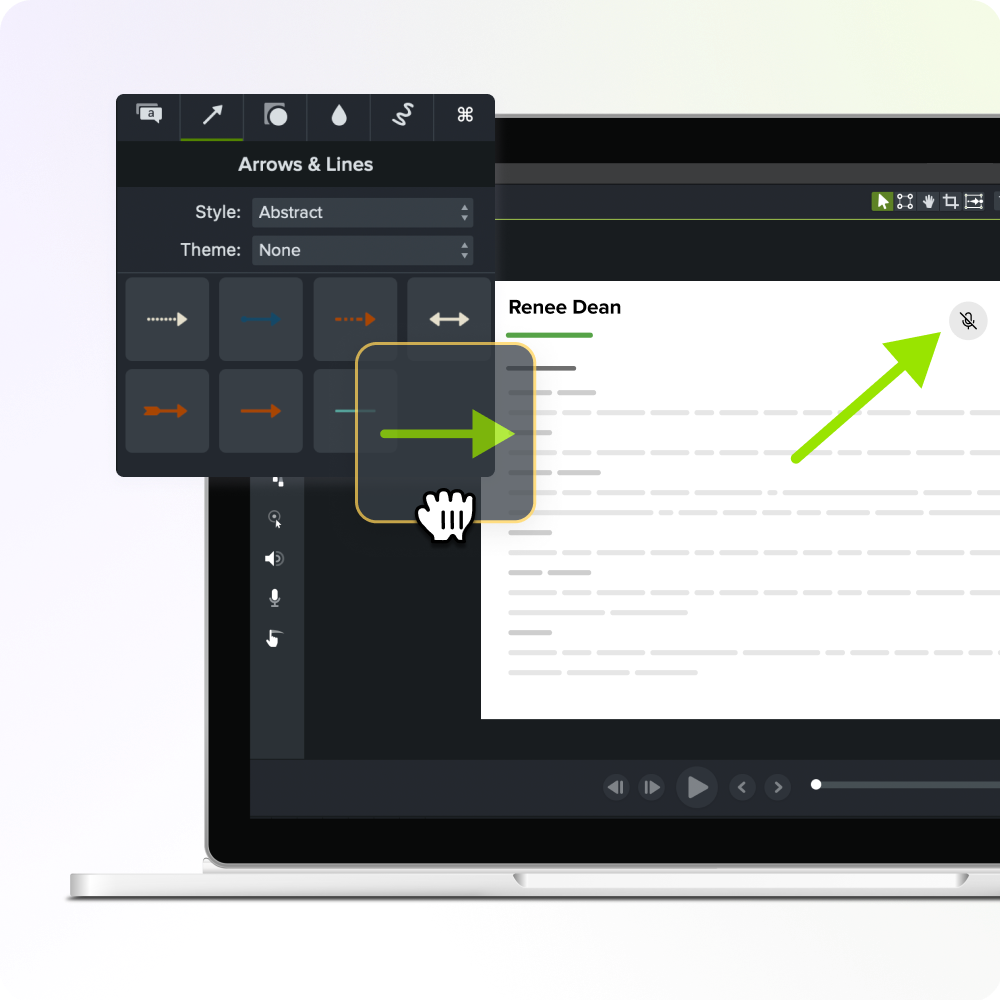
Processes that change frequently due to system or interface updates
When your CRM or HRIS ships a quarterly release, screenshot-heavy documentation becomes outdated overnight. Re-recording a short walkthrough is often faster than updating every annotated screenshot in a written guide.
Re-record only the changed task segment, rather than rewriting the full manual. Use Camtasia Online to capture a quick, browser-based walkthrough the same day the update rolls out. Then refine that recording in Camtasia Editor when you need a polished, reusable version with callouts and branding.
Example: If your learning management system updates its course-enrollment flow, a two-minute re-recorded walkthrough keeps staff accurate without a full documentation overhaul.
Capturing SME knowledge before expertise leaves the organization
When a key employee transitions out of a role, their process knowledge often disappears with them. The same workplace productivity research cited above also found that a substantial share of institutional knowledge is unique to the individual in the role and not shared with coworkers. This means a departure can eliminate a chunk of how that job gets done, not just a name on an org chart.
Waiting to document it later means reconstructing a workflow from memory and secondhand notes, both of which introduce gaps the original expert would never have made.
The fix is urgency, not process: Capture the live task before that expertise walks out the door. Ask your SME to record their screen and narrate the workflow once, whatever it is: a month-end close, a specialized system setup, an internal approval chain. While it’s still fresh and accurate, route that raw recording through Screencast so your training team can leave timestamped comments and validate the sequence asynchronously without pulling the SME into another meeting.
The capture and edit steps themselves work as described in the next section. What matters here is timing: this is the workflow you reach for the moment you learn that someone with unique process knowledge is leaving, not something to schedule for later.
Onboarding distributed or remote teams at scale
Remote hires can’t wait for a trainer to be online in another time zone. Short process videos solve this by providing the right instruction when someone needs it.
Start with one swap: Replace a repeated live walkthrough with a reusable task video and a searchable companion checklist. For example, record a two-minute screen capture showing how to submit an expense report, then share it in your onboarding portal.
A new hire can replay that video the moment they hit the submit button, with no scheduling required. Learn more about how video documentation improves onboarding outcomes for distributed teams.
When text and checklists still win
Some process documentation works better as text. Employees need to skim, search, print, or pull up a quick reference mid-task. Video slows that down.
Credible training teams choose the right format per task. For a compliance checklist or SOP that needs to be audited, a searchable document wins every time.
Practical model: Pair a short walkthrough video for first-time learners with a printable checklist they can reference later. Learn once, reference always.
Quick-reference steps employees need to scan, not watch
If employees keep a document open beside their screen while they work, that task belongs on a checklist, not in a video. A daily order verification checklist or a password reset procedure is faster to scan than to watch.
Pair each checklist with an optional short video for first-time learners. Experts get speed. Newcomers get guidance.
Practical action: Open Camtasia Snagit and use Step Capture to record your next walkthrough. It automatically converts each click into a numbered step, giving you a formatted, scannable guide in minutes.
Compliance records that require a searchable paper trail
Regulated teams need text as the official record. An ISO 9001-aligned quality procedure must retain exact approved wording, version history, and sign-off trails that auditors can search and verify.
Video cannot fulfill that role. Use it to support training by showing employees how a procedure works in practice, but keep the controlled document separate as the authoritative source of record ownership and approval.
How to build a video-based process document that gets used
Process videos are used when they’re easy to follow, easy to update, and easy to find when someone needs them.
Start by recording the real task once, live, in the software. Then open Camtasia Editor to trim dead air, add callouts to highlight key clicks, and cut scope to a single task per video.
For example: Record one software walkthrough, edit it down to under three minutes, and publish it to your team’s documentation system with a clear title like “How to submit a purchase request.”
Plan your first update before you publish. Set a calendar reminder to re-record whenever the interface changes.
Need to show your screen?
Skip the downloads. Use Camtasia online to record your screen, camera, and microphone right in your browser for free.
Start Recording
Capture the process first, polish it second
Record the real workflow before anyone writes a single bullet point. A live walkthrough preserves the expert’s actual sequence, terminology, and edge cases — details that rarely survive the translation to a formal outline.
Practical starting point: Ask your subject-matter expert to complete the task once, in real time, while you record. For example, have them submit an expense reimbursement or update a CRM record exactly as they do it daily.
If your SME resists installing software, use Camtasia Online, which runs in the browser with no setup required. Once the session is done, export the project to Camtasia Editor to trim, structure, and annotate it.
Raw capture gives your training team accurate source material. Reconstructing a process from notes afterward almost always introduces gaps.
Add annotations and callouts to guide the viewer’s eye
Viewers shouldn’t have to hunt for the next click. Callouts in Camtasia Editor mark exactly what matters — a required field, a warning banner, a submit button — so attention lands in the right place immediately.
Add one visual cue per step. Layering multiple effects at once competes for attention rather than directing it.
If you’re recording directly in Camtasia Editor, SmartFocus complements callouts by automatically adding zoom and pan movement to keep the active area centered on screen, useful when your recording captures a wide interface.
The goal is shorter search time, not decoration. One well-placed callout does more than five overlapping effects.
Keep videos short and scoped to a single task
Aim for two to five minutes per video, each covering exactly one task. If you’re capturing in Camtasia Online, this lines up naturally with its five-minute scene limit: long enough to cover one task, short enough to force focus.
A broad onboarding overview is hard to search and harder to update. Split it instead: one clip for submitting a reimbursement request, one for requesting system access, and one for routing an approval.
When a process changes, you update one short video, not re-record an hour-long session.
Plan for updates before you record
Good governance prevents your video library from going stale. Before you publish a single asset, assign each video an owner, a review date, and a consistent file name.
For example: Every software-task video in a shared training repository should list one named owner and one scheduled review date so that when the interface changes, someone is accountable for the update.
If narration changes frequently, use Camtasia Audiate to edit audio by editing text rather than re-recording from scratch. Any AI-generated voice-overs should be disclosed to learners.
Apply this naming convention today: [Topic]-[Version]-[OwnerInitials]-[ReviewDate].
Start documenting processes your team will follow
Pick the one process that generates the most repeated questions: expense reporting, CRM updates, or a recurring software task. Document that first. Don’t overhaul your entire library. Format should follow friction: when a process lives on a screen, changes frequently, or keeps generating the same support tickets, video is the way to go. When people need to scan, search, or verify compliance, text is the best format.
Choose the format employees will actually open. A short screen recording with annotations gets watched. A long PDF SOP gets ignored. One well-made video for your highest-friction process builds more trust with your team than a complete documentation overhaul that never ships.
This week, record that one process. Add a few callouts to guide the eye, put it next to your existing written steps, and see which one your team reaches for first.
Start your free trial of Camtasia Editor and turn your next process capture into a video your team will actually watch.
FAQs
When should process documentation be a video instead of a written SOP?
Video works best for multi-step software tasks where clicks, menus, and screen changes matter to correct execution. A short walkthrough reduces guesswork because people can see the sequence rather than reconstruct it from text alone. Keep the written SOP for searchable steps, owners, and compliance details.
What makes process documentation get used by employees?
Useful process documentation is scoped to a single task, written in plain language, and easy to access when needed. For software workflows, short videos with captions, annotations, and clear step names may help employees follow the process without having to reread a long document. That format also makes updates easier because you can replace one task video instead of rewriting an entire manual.
How do you document a process you’ve never been involved in?
Start with a process map, then ask a subject matter expert to perform the task while you record the screen and narration. Camtasia Online is useful here because an expert can quickly capture the real workflow in a browser before anything gets polished. After that, use Camtasia Editor to trim detours, add callouts, and keep each video focused on one job.
How do you keep process documentation up to date when software changes?
Break documentation into short, task-based videos so that a small interface change affects only one asset, not your whole library. Version owners, review dates, and consistent naming make updates faster for both video and text. If narration changes often, Camtasia Audiate may help you update the script and voice-over without rebuilding the full edit.
Can video replace written SOPs and checklists?
Not usually. Text still works better for quick reference, searchable compliance records, and steps employees need to scan in seconds. A practical system uses both: video to show the work and text to confirm the exact steps, scope, and ownership.
Share