









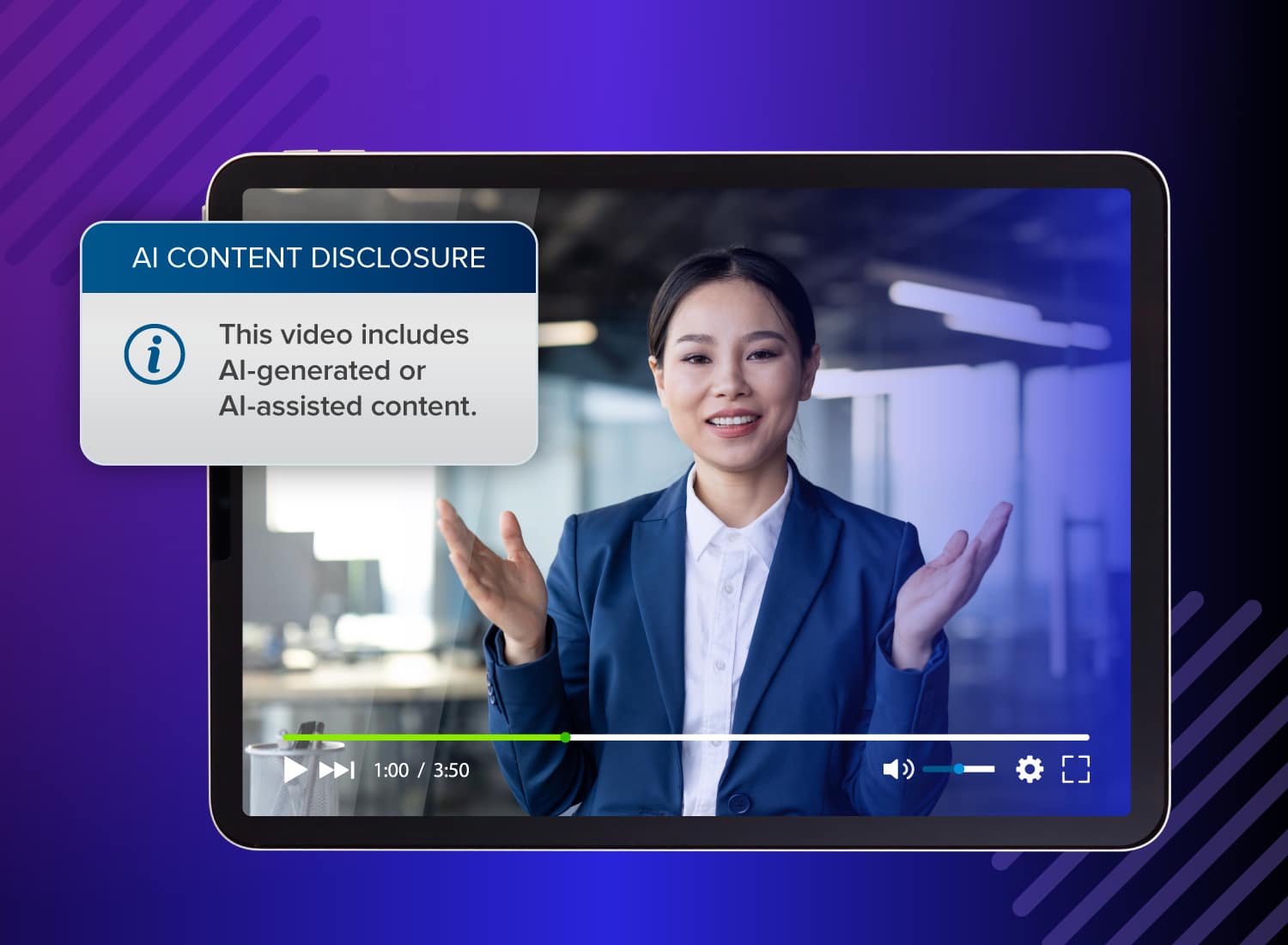
The EU AI Act’s Article 50 goes into effect on August 2, 2026, and one question is on business leaders’ minds: what qualifies?
For global L&D teams, using artificial intelligence (AI) in training videos is one pressing version of this question: does using AI in training videos trigger disclosure requirements? Or just stronger internal documentation?
This article will help you understand the consequences of landing on the wrong side of Article 50 and what various global video platforms are changing to steer clear of violations. We also give you a workable decision framework for how to treat various types of content, including internal libraries, public distribution, and AI-assisted editing.
Disclaimer: This content provides an overview on the AI regulatory landscape and is not intended to be legal advice. Laws and regulatory expectations are evolving and may vary by jurisdiction. Consult your legal team to determine how regulations apply to your organization.
Key takeaways
- Under the EU AI Act, training videos may need disclosure when AI creates or realistically alters the content, not when AI only supports routine editing.
- For L&D teams, the key distinction is simple: AI-generated media can trigger transparency duties, while AI-assisted tasks like captions or cleanup often do not.
- Internal training content may not follow the same disclosure path as public videos, so teams should review audience, distribution channel, and jurisdiction together.
- YouTube, Vimeo, and state laws can add their own AI video disclosure rules, which means compliance often depends on where your training content appears.
- A practical audit trail should log each AI tool, its role in production, and the final disclosure decision for every video in your library.
What the EU AI Act actually requires for video content
Article 50 of the EU AI Act lays out “transparency obligations for providers and deployers of certain AI systems,” targeting transparency for synthetic media.
While the act doesn’t explicitly define this term, you can think of it as covering AI-generated content, like video from Veo 3, deepfakes, synthetic audio (Camtasia Audiate, Synthesia), generated text (OpenAI’s ChatGPT, Gemini, etc.), or any other models where the output is substantially or wholly AI-generated.
Where organizations use synthetic media, they must disclose it in specific, machine-readable ways.
Using AI tools within standard video production workflows (where the video itself is real, not generated) falls outside the new EU legal obligations.
For example, if you’re creating a software training video capturing your own screen content or editing a video call recording into a reusable asset, you’re working with real media, not synthetic media. Using a tool like Camtasia to automatically generate captions from your video’s audio does technically mean you’re using AI, but not in a way that turns the video from authentic to synthetic.
That said, L&D teams need to watch both legal obligations under Article 50 and platform-specific policies. Each platform is free to set its own policies, which may be stricter than the EU’s new regulations. If you host a training video on an external platform, you may need to comply with that platform’s policies, even if stricter than the EU’s legal requirements.
Article 50 isn’t a ban on using AI or synthetic content, including in workplace learning materials. Instead, it clarifies when businesses must disclose the use of AI, and how transparency needs to work.
Article 50 and the August 2, 2026 compliance deadline
Article 50 has a firm compliance deadline of August 2, 2026. Organizations with a presence in the EU should prepare now because the act applies to existing content, not just new content. Before you distribute existing or archived training content, you may need to review it for compliance.
What counts as synthetic or AI-generated content and who the obligation falls on
Some synthetic content is immediately obvious — social media images and AI-generated video of animals doing things that defy the laws of physics, for example. But many real-world use cases in non-marketing business contexts (including L&D contexts) will be a little more nuanced.
Here are a few examples where L&D teams might create content that qualifies as synthetic:
- AI-generated virtual presenters: If a generative AI avatar rather than a real person is doing the talking, that’s synthetic content.
- Cloned or AI-generated voices: If an AI-generated voice (whether generic or impersonating a well-known voice) is speaking, you’re in synthetic territory regardless of what that voice is saying.
- Generated or fabricated content: If video contains generated demonstrations or illustrations that could appear authentic, like software workflows or demonstrations, it must be disclosed as synthetic.
According to the Act, ownership and obligation for disclosure falls on the deployer or distributor. In other words, if you’re publishing the video, you’re responsible — so it’s always best to check with your legal team to ensure you’re in compliance.
AI-generated vs. AI-assisted: The distinction that matters most for L&D teams
A good general rule for L&D teams and anyone else creating video content for training, enablement, or marketing is this:
AI-generated outputs create disclosure risk. AI-assisted edits to non-AI-generated outputs usually don’t.
If you’re using AI for efficiency enhancements to content you’re creating, then you’re likely safe from violating the EU AI Act. Adding an AI disclosure is typically not required.
A few L&D examples of AI-assisted work:
- Using AI to turn spoken audio into on-video captions
- Using AI to transcribe spoken audio into a written script
- Using AI to remove background noise from audio
In each of these, you’re applying AI to content you already have; the AI isn’t generating anything from just a prompt.
Of course, L&D teams can and do create AI-generated work, too. In those cases, compliant disclosures are a must.
A couple of examples where AI-generated work might show up in L&D:
- Using a synthetic presenter (a generated human avatar and/or voiceover)
- Fabricating a realistic scene, including video backgrounds and overlays, using GenAI tools
Keep training videos accurate. Avoid “AI slop.”
Build training content faster without sacrificing quality. The HUMAN Framework is a 5-step strategy for integrating AI effectively.
Get the Guide
What qualifies as AI-generated content under current definitions
AI-generated content for the purposes of the EU AI Act is media substantially created by AI with realistic people, voices, scenes, or events.
In the EU AI Act framework, content that viewers could reasonably mistake as real or non-AI-generated seems to get the most scrutiny.
In training contexts, avatar-led modules or videos would likely qualify. So would cloned narration (a realistic human-voice narrator that is not actually human) or simulated employee footage.
There may be good reasons to use these elements instead of recording live presenters, employees, or actors. The key is understanding that doing so triggers disclosure requirements.
What qualifies as AI-assisted editing and why it is treated differently
AI-assisted editing is work where humans still author the message and create the visuals. AI tools simply assist by making the process faster, more productive, or more polished.
AI tools may remove noise, add captions, or cut and edit video based on a human’s edits to the video transcript edits, all of which are available in Camtasia Editor or Camtasia Audiate.
YouTube sees a distinction between videos that contain “photorealistic and meaningfully AI-altered or generated content” and those with unrealistic or only slightly altered content. The first category receives an automatic prominent disclosure label, while the second gets a small notice in the expanded description (and only when creators disclose AI use).
Do internal training videos carry the same obligations as public content?
Internal training materials don’t seem like public content, but distribution context is what matters. A video intended for internal use but hosted on publicly accessible sites (YouTube, Vimeo, etc.) is public content.
Before you assume an LMS video sits outside disclosure duties, map out the video’s intended audience, access methods, and any reuse paths. It’s possible that third-party services like onboarding portals, partner academies, or recruiting pages can classify an “internal” video as an external asset.
The same goes if a previously internal asset gets repurposed for customer education. Once the public can access it, the safest play is to assume it carries public-content obligations.
How the EU AI Act defines the scope of covered content
The act has two focuses: deployed AI outputs and transparency. The scope of covered content depends on:
- The output itself: what type of media, how much realism it contains.
- Transparency: where the business distributes the content
For L&D teams, a conservative workflow is best. Whenever teams repurpose existing internal content for external use, the content should be flagged and reviewed.
Moving forward, it’s a good idea to internally flag newly created media that would be within disclosure scope if made public (like instruction with embedded synthetic presenters).
Platform and jurisdiction-specific disclosure rules for distributed training content
Disclosure requirements start with the law, which has the power of enforcement and penalty. But different platforms and localities (like U.S. states or potentially EU member nations) may add separate expectations for distributed training content.
The sections below give you a quick overview of channel- and jurisdiction-specific disclosure rules. Consider these before publishing the same module to multiple platforms or audiences.
YouTube rules
YouTube requires AI disclosure on videos with realistic content generated or substantially altered by AI. The platform recently launched a tool that automatically detects such usage, focusing on significant photorealistic AI use. For these, the disclosure notice is front and center.
It does this three ways: the platform evaluates content dynamically, looks for content created with other Google/Alphabet/YouTube tools like Veo and Dream Screen, and screens for C2PA metadata that discloses AI use.
Google states that content that is unrealistic, animated, or slightly altered gets a much less prominent AI note lower down in the description. It doesn’t appear that Google automatically applies these, relying instead on creator disclosures.
L&D takeaway: Review any content you plan to upload to YouTube, including public webinars, tutorials, and thought leadership videos.
Vimeo rules
Vimeo also expects AI disclosure for videos that contain realistic synthetic or altered media, which it defines as footage that:
- Portrays a real person saying or doing something they did not
- Alters footage of an actual event or location
- Creates a lifelike scene that did not actually occur
Vimeo explicitly calls out AI editing tools as not requiring disclosure:
- Obvious special effects
- Audio with removed background noise and improved clarity
If you host training libraries on Vimeo and those libraries can be shared outside the firewall, then your Vimeo content is likely subject to EU AI Act disclosure rules (as well as Vimeo’s own rules).
L&D takeaway: Check account-level distribution settings for content you intend to keep strictly internal. A private review link can still expand access.
California AI Transparency Act
California’s regulations add more disclosure pressure around content that supports recruiting, advertising, or public education. This is true even if the asset began its life as an internal-only training module.
If you use synthetic presenters or realistic cloned voices in California-facing content, coordinate with counsel to determine the appropriate disclosure steps.
New York synthetic performer disclosure law
New York’s synthetic performer disclosure law took effect on June 9, 2026. Under this law, mere AI use does not trigger disclosure, but using a synthetic performer, clearly defined as one “intended to create the impression that [it] is engaging in an audiovisual and/or visual performance of a human performer who is not recognizable as any identifiable natural performer.”
L&D takeaway: This law is narrower and more explicit than others. If you use AI-generated human avatars in content distributed to New York audiences, it applies.
Tips to document AI tool usage across a training content workflow
Disclosure readiness starts with documentation. If you don’t know whether AI touched a video, you can’t label content consistently.
The right approach for L&D teams is creating a repeatable log. As production decisions happen across scripts, narration, editing, review, and publishing, team members should have a clear and unambiguous location to log any AI use.
The HUMAN Framework can help here, steering teams toward authenticity, audience focus, and well-established review processes.
Build your next training video with Camtasia
Record your screen or camera. Then, use the video editor to add polish and clarity.
Learn More
What to log at each stage of production
Create these fields in your AI production log:
- Asset name
- Audience
- Channel
- AI tool
- Feature used
- Human approver
- Disclosure decision
- Review date
It’s crucial to differentiate tools and features clearly. For example, Camtasia Audiate is one tool, but production teams may use it for only one or two of its features (narration, avatars, translation, and transcription).
Additionally, these features may not always create the same end state. Consider tracking whether AI merely enhanced the output versus when AI changed meaning, voice, or identity.
Building an audit trail that demonstrates responsible AI governance
Make sure to store all disclosure log details together, including logs, approvals, source files, and disclosure screenshots. This way teams can prove what changed, who approved it, and what audience it was presented to.
Consider using an existing governance model that supports documentation, accountability, and review discipline, like ISO/IEC 42001 or NIST AI RMF.
Build your AI disclosure practice before the deadline arrives
Don’t wait until August to start moving on AI disclosure. Instead, start building your AI disclosure practice immediately. Use this simple action plan to get started:
- Classify content by type and audience.
- Document AI use by tool and type (substantial or supportive).
- Confirm distribution channels and check specific guidelines for each.
- Escalate realistic synthetic media as early as possible.
The Camtasia Suite supports L&D teams that need to create video training content at scale. Some AI tools in the suite improve your workflows and clean up your outputs without requiring disclosure, while others can create realistic synthetic media that does require disclosure.
Get started with AI-powered video editing today: Explore Camtasia Suite now.
FAQs
Do training videos need AI disclosure under the EU AI Act?
If a video includes realistic AI-generated or AI-manipulated people, voices, events, or scenes, disclosure will likely be required by August 2, 2026. Article 50 focuses on synthetic content that viewers could mistake for real, not routine editing help inside tools like Camtasia Editor.
What is the difference between AI-generated and AI-assisted video content?
AI-generated content is substantially created by a model, while AI-assisted content uses AI to speed tasks like scripting, captions, cleanup, or edit suggestions. That distinction matters because current rules and platform policies usually target realistic synthetic outputs, not productivity features such as noise removal or automatic captions.
Do internal training videos carry the same AI disclosure obligations as public content?
Internal distribution does not automatically remove the obligation, because the main test is often whether the content is realistic synthetic media. Your legal team should also check where employees view it, because platform rules and local laws may still apply to workplace libraries.
Do the New York Law or California AI Act impact me if I’m not based in those states?
Potentially yes. Both laws focus on where content is distributed and who views it, not where the organization producing it is headquartered. If your training videos reach employees, recruits, or learners in New York or California, the relevant rules may still apply. Teams distributing content across a national or global workforce should confirm local deadlines and scope with counsel before publishing videos that include realistic synthetic presenters, cloned voices, or AI-generated actors.
Which platform rules matter for AI-generated training videos?
YouTube and Vimeo generally require disclosure when a video uses realistic synthetic or altered media that could be mistaken for real footage or speech. Teams with global audiences should also review state laws, including California transparency rules and New York’s synthetic performer law, before publishing.
How should businesses document AI tool usage in a video workflow?
Log the tool name, model or feature used, who approved it, what content it changed, and whether a disclosure decision was made. For training libraries, keep version history, source files, prompts when relevant, export dates, and reviewer notes in a shared record. Frameworks like ISO 42001, NIST AI RMF, and C2PA provenance metadata may help you build an audit trail that scales.
Share