






Your team just recorded a software walkthrough with three presenters, and Descript’s transcript editor keeps flattening their separate audio into one track you can’t untangle. You need consistent branding across every module in your onboarding library, and hand-editing captions one video at a time won’t get you there before the next cohort starts.
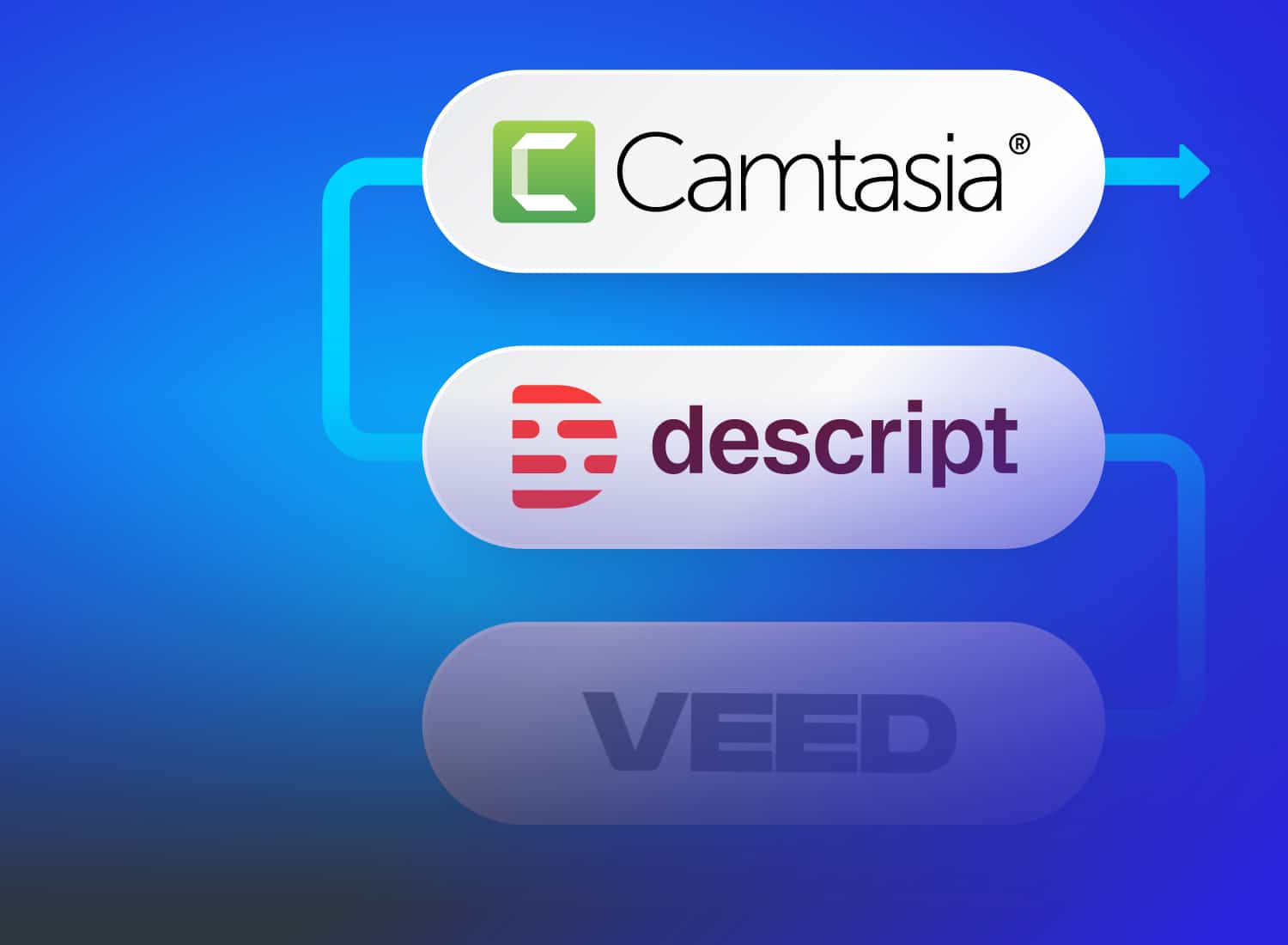
Descript alternatives replace or supplement that transcript-led workflow when it can’t keep up with training production demands. The right one depends on whether your team needs deeper multi-track screen capture, reusable branding, avatar-led localization, or enterprise video delivery. You’re comparing tools against your actual production checklist: capture quality, accessibility, team consistency, and cost at scale.
The eight options below fit different training formats, so you can match the tool to the video you’re making.
Key takeaways
- Camtasia offers the strongest overall fit for learning and development (L&D) teams that need branded, scalable, screen-based training video production.
- Synthesia best serves multilingual, avatar-led compliance training without recording live presenters or re-shooting footage.
- Vyond suits animated, scenario-based soft-skills training where authentic screen recordings aren’t the priority.
- Multi-track screen, camera, and audio capture matters more for training video than Descript’s transcript-first editing.
- Panopto is a hosting and delivery layer that complements a video editor rather than replacing it.
What is a Descript alternative?
A Descript alternative is a video or audio platform that replaces or supplements Descript’s transcription-led recording and editing workflow. Some teams swap it out entirely. Others keep it for quick conversation edits but bring in a second tool for the parts of L&D production it wasn’t built for.
Many L&D teams move to a dedicated alternative when they need stronger, enterprise-level features, like:
- Separate screen, camera, system-audio, and microphone tracks they can edit independently
- Reusable branded templates multiple creators can apply consistently
- Specialized formats like animated compliance scenarios and avatar-led localization that fall outside transcript editing entirely
What should L&D teams look for in a Descript alternative?
L&D teams should evaluate Descript alternatives on multi-track capture, editing accessibility, captioning, relevant AI features, reusable branding, collaboration, learning management system (LMS) compatibility, security, and cost at scale.
Start with your training format, which determines everything else. Check whether the tool can record screen, camera, and audio in one session and let you edit each track independently. Confirm editing is accessible to non-specialists and that captions meet accessibility requirements, not just style preferences.
Transcript editing, avatar generation, animation, and production AI each solve different problems:
- Transcript editing speeds up narration cleanup.
- Avatars can help localize and standardize content.
- Animation handles scenario-based soft skills.
- Broader AI tools remove production bottlenecks without replacing trainer judgment.
This distinction is covered in more depth in this guide to AI training for employees.
Look for shareable style libraries so callouts and titles stay consistent across trainers. Weigh LMS compatibility, SCORM or xAPI support, governance, and per-seat cost as your library and team scale.
Descript alternatives at a glance
The best Descript alternative depends on your training format: branded screen tutorials, browser-based clips, avatar-led localization, animated scenarios, lightweight recordings, high-production content, or an enterprise video library.
The eight options below (Camtasia, VEED, Synthesia, Vyond, ScreenPal, ScreenFlow by Telestream, Adobe Premiere Pro, and Panopto) are organized by use case rather than treated as interchangeable editors.
| Rank | Name | Best For | Pricing | Top Feature |
| 1 | Camtasia | Corporate trainers, customer education, and L&D teams that produce a high volume of branded, screen-based tutorials without a dedicated video production team. | Free full-featured download available with watermarked exports; paid Essentials, Create, and Pro subscription tiers remove the watermark, with volume discounts starting at 10 licenses. | Multi-track screen, camera, and audio recording |
| 2 | VEED | Marketing and content teams that need fast, browser-based caption and brand-kit application without installing desktop software. | Free plan available with watermarked exports; paid plans start at $12/month billed annually. | Auto-generated subtitles and captions |
| 3 | Synthesia | Global L&D teams that need one script translated into dozens of languages with a consistent on-screen presenter. | Free plan includes limited monthly video minutes and stock avatars; paid and enterprise plans scale to unlimited video creation with custom avatars. | 160+ language AI avatars |
| 4 | Vyond | Instructional designers building animated, scenario-based soft-skills or compliance training rather than screen-recorded tutorials. | Plans start at $58/month (Starter, billed annually). | Vyond Go text-to-video generation |
| 5 | ScreenPal | Educators and lightweight corporate communicators who need quick, watermark-free screen captures without a steep learning curve. | Plans start at $4/month (Solo Deluxe, billed annually). | Automatic transcripts, captions, and chapters |
| 6 | ScreenFlow (by Telestream) | Mac-based trainers who need simultaneous multi-app audio capture and no-green-screen background removal. | Licenses start at $199 (one-time purchase), with an optional Stock Media Library add-on at $99 per year. | Multi-app simultaneous audio capture |
| 7 | Adobe Premiere Pro | Video production teams that create high-value, brand-critical training content that justifies a full professional NLE workflow. | Sold via Creative Cloud subscription, with separate pricing tracks available for businesses and students or teachers. | Team Projects collaborative editing |
| 8 | Panopto | L&D and IT teams that need a searchable, secure video hosting and knowledge-management layer rather than an editing tool. | Quote-based | AI-powered search and summarization |
1. Camtasia: Best overall for branded training videos at scale
Camtasia is the strongest overall Descript alternative for branded training videos at scale, offering independently editable screen, camera, and audio tracks plus repeatable visual standards for high-volume production across multiple creators. It’s built around instructional content rather than conversation editing, so the workflow matches how L&D teams work. It earns consistently positive reviews for its ease of use and robust feature set.
Every recording session captures screen, camera, system audio, and microphone independently so they can be split into their own separate tracks for independent editing. A trainer can swap out a narration take, mute a system alert, or replace webcam footage without touching the rest of the recording and without re-shooting anything.
From there, Camtasia Audiate handles text-based narration editing, so cutting a flubbed line means deleting a word instead of scrubbing a timeline. Camtasia Editor adds automated closed captions, dynamic animated captions for social-style clips, background noise removal, and cursor effects that keep viewers focused on the right part of the screen.
Camtasia Audiate also covers the AI production steps that go beyond transcript editing. Teams can generate AI voices for scripts without recording a presenter, translate narration into other languages for localized training versions, and create AI avatars for standardized on-screen delivery across a course library.
For teams producing at volume, saving customized callouts and titles to a shareable library keeps every creator on brand without rebuilding styles project by project. The setup works best for corporate trainers and L&D teams without a dedicated production department, since it removes the re-recording overhead that slows down high-volume tutorial work.
2. VEED: Best for fast browser-based editing
VEED is the browser-based Descript alternative for teams that prioritize fast captioning and brand-kit application over the deeper multi-track control that structured training production requires. Everything runs in the browser, including subtitle generation and avatar creation, so a team can start editing across laptops without downloads, license keys, or local installs.
That in-browser setup removes a real point of friction for teams that just need to open a tab and start editing on a shared or new machine.
Its AI Brand Kit reads a team’s colors, fonts, and logo and applies them automatically to generated videos, which speeds up output for teams pushing out frequent social or marketing clips. Paired with its subtitle engine, VEED works well when speed and consistent branding matter more than deep editing control. What it doesn’t offer is the multi-track capture depth that structured training production needs.
3. Synthesia: Best for multilingual avatar-led training
Synthesia best fits global L&D teams that need avatar-led compliance and onboarding training without filming a presenter for each language, skipping studio setup entirely. Its avatars support multiple languages with synchronized lip movement, so a single script can become a localized video without a re-shoot in every region.
That workflow differs from a Descript-style approach, which edits a transcript of a recorded human presenter. Synthesia starts with a script, PDF, or slide deck and generates the presenter without a camera or recording session.
Beyond avatar generation, Synthesia’s AI Screen Recorder captures screen recordings in one take, and its Roleplay Sessions feature lets learners practice real conversations with an interactive AI avatar.
For standardized compliance and onboarding content, that consistency matters. Every language version shows the same presenter delivering the same message, which helps global L&D teams avoid the drift that creeps in when different regions record their own versions.
Synthetic presenters won’t feel right for every topic. Sensitive subjects and culturally specific training often need a real person on screen, so weigh authenticity alongside consistency.
4. Vyond: Best for animated scenario-based training
Vyond best fits instructional designers building animated, scenario-based soft-skills and policy training where storytelling matters more than screen-recorded software tutorials. Instead of filming a presenter or capturing a real interface, Vyond builds videos from animated characters, scenes, and props, which makes it a practical choice for role-plays and compliance situations that need to show a conversation or decision point rather than a click path.
Its Vyond Go feature can turn an uploaded document, script, or URL directly into a structured animated video, giving instructional designers a starting script instead of a blank timeline. That’s useful when you’re building a harassment-prevention scenario or a customer-service role-play and need a first draft quickly.
The tradeoff is authenticity. Animated storytelling can’t replace a screen recording when the training goal is to show someone how software behaves.
5. ScreenPal: Best for lightweight training recordings
ScreenPal best fits educators and lightweight corporate communicators who need quick screen recordings and classroom-style instruction without a steep learning curve. Formerly known as Screencast-O-Matic, it keeps that classroom-focused approach. Recording stays simple: capture a screen or webcam, trim the clip, add a basic overlay, and export.
Every recording also gets an automatic transcript, captions, chapters, and a summary according to ScreenPal, which turns a quick capture into a searchable, skimmable resource for students or employees revisiting a process later.
That automated text output covers similar ground to Descript’s text-centric editing, minus the deeper timeline work. If your team’s biggest need is fast turnaround on explainer videos, that tradeoff is worth it. What you give up is depth: branded templates, layered compositing, and multi-creator visual consistency aren’t the focus here.
6. ScreenFlow by Telestream: Best for Mac-based training production
ScreenFlow by Telestream is the Mac-only option for trainers who need polished, multi-app screen-led instruction. It’s built exclusively for macOS, so if your team already works in that environment, you get a focused editor without hunting for cross-platform compromises.
Its multi-app audio capture records independent audio from several running applications during a single recording session, which matters when a tutorial involves switching between a browser, a design tool, and a communication app. On the presenter side, its machine-learning background removal is tuned for Apple’s M1 and later processors, letting someone recording at a desk skip a green-screen setup.
Those two features point to the same use case: a solo Mac trainer producing screen-led tutorials that also feature a talking presenter, without renting studio equipment. Confirm current platform requirements and Apple Silicon compatibility directly with Telestream before citing those specs.
The real limitation is availability. ScreenFlow by Telestream isn’t an option for Windows-based training teams, and that alone rules it out for many mixed-OS departments, no matter how strong the editing tools are.
7. Adobe Premiere Pro: Best for high-production training content
Adobe Premiere Pro best fits dedicated video teams producing flagship, brand-critical training content that warrants professional editing depth and the operational overhead that comes with it. This is the tool for a training video treated as a real production rather than a routine weekly upload.
Full timeline control, professional color grading, and audio mixing give editors the depth to polish that kind of content. Connected apps matter, too: Premiere Pro integrates with After Effects and Audition through Creative Cloud, so titles, motion graphics, and audio cleanup happen in a linked workflow rather than a patchwork of exports.
Team Projects extends that capability to collaborative editing, letting multiple editors work concurrently on the same shared timeline through Creative Cloud. That only works when every collaborator has access to the same underlying media, so shared cloud storage must be part of the plan from the start.
Compare that to the accessibility non-specialist trainers need for routine tutorials, closer to what an AI-assisted video editor offers. Without a dedicated editor on staff, this level of overhead usually isn’t worth taking on.
8. Panopto: Best for enterprise video hosting and learning delivery
Panopto best fits L&D and IT teams that need a hosting, search, and analytics layer for governed, searchable video delivery across an enterprise learning library. It’s a video content management system (CMS) that captures, indexes, and surfaces recorded training across an organization’s LMS and learning library, solving a different problem than the video editors covered earlier in this list.
Its AI capabilities focus on search and summarization inside existing recordings, along with SCORM and LMS integration, so learners can jump straight to the moment they need instead of scrubbing a full video. An AI Video Studio add-on, powered by Elai, can turn a presentation or prompt into a finished video, though the platform’s core value stays in discoverability and governance rather than production depth.
For teams already producing training with an editor, Panopto is the storage and search layer sitting downstream of that work.
Choose the right Descript alternative for your training workflow
The right Descript alternative depends on your training format. A branded onboarding walkthrough with saved callout styles and clean captions needs something different than an avatar-led localization project or a fully animated compliance scenario. Treating them as interchangeable is how teams end up with inconsistent training libraries.
If you’re building a software walkthrough for new hires this week, save your callout and annotation styles to a shareable Library before you record your next module. That habit is what keeps a growing trainer team on brand.
Camtasia Editor is built for repeatable, multi-creator production, with AI-powered captioning and cursor effects that hold up across a growing library. It won’t replace Descript for every workflow, especially fast, script-first editing, but for screen-based L&D content at scale it’s a dependable fit.
Test it against your actual next training project instead of guessing from a feature list: Download Camtasia today!
Need to show your screen?
Skip the downloads. Use Camtasia online to record your screen, camera, and microphone right in your browser for free.
Start Recording
Frequently asked questions
Is there a free Descript alternative for corporate training teams?
Yes, several video platforms offer free downloads, trials, or limited free tiers that a corporate training team can use to test a workflow before purchasing. Camtasia offers a downloadable option with watermarked exports, and VEED and ScreenPal offer limited free options, but all current plan terms, export restrictions, and watermark policies must be verified before publication. Teams producing training regularly should compare paid licensing at their expected seat count rather than choosing on the free tier alone.
Can I migrate existing Descript projects to another platform?
Most video platforms don’t directly import Descript project files because each platform uses its own proprietary project format. You can usually use exported video, audio, and transcript files as source material in another editor, but teams should expect to rebuild timelines, effects, captions, and branding elements. Export and archive the original media before beginning the migration.
Do I need more than one tool to fully replace Descript?
Many L&D teams need more than one tool because video production and enterprise delivery are different jobs. A primary recorder and editor can handle capture, narration, captions, and visual production, while an LMS or video content management platform handles hosting, governance, analytics, search, and learner delivery. Choose the stack around the team’s actual bottleneck instead of trying to make one platform cover every stage.
How should I evaluate a Descript alternative before committing my team to it?
Test each shortlisted platform with a real training project before committing the full team. Check whether it can capture the sources you need, how accurately it generates captions, how easily a non-specialist can edit the recording, and whether reusable branding stays consistent across creators. Confirm licensing costs, security requirements, accessibility documentation, export formats, and LMS compatibility at the expected team size.
Are AI avatar or animation tools accessible for compliance and captioning requirements?
AI avatar and animation tools may include captioning and multilingual voice features, but those features don’t automatically make a training video accessible or compliant. Review caption accuracy, keyboard and screen-reader compatibility, contrast, reading order, and any required audio description support before publishing compliance-critical training. Confirm each vendor’s current accessibility documentation rather than assuming that generated captions or dynamic text satisfy every requirement.
Share