






OBS Studio has earned its reputation as one of the most powerful free recording and streaming tools available. It’s open-source, customizable, and backed by a passionate community. But if you’ve ever spent an afternoon configuring scene collections, troubleshooting audio routing, or hunting for the right plugin just to record a 10-minute tutorial, you already know the trade-off is complexity.
The better question isn’t “What’s better than OBS?” because the answer will be different for everyone. It’s “What tool fits the way I create videos?”
That shift matters. A live streamer juggling overlays across Twitch and YouTube has different needs than a training manager who needs to record a software walkthrough, add captions, and publish it by Friday. And both of those people have different needs than someone who just wants to record a quick product demo from their browser without installing anything.
This guide maps nine practical OBS alternatives to the workflows they serve best, from live streaming and multi-camera production to tutorials, async updates, and browser-based editing. So you can spend less time troubleshooting and more time creating.
Key takeaways
- OBS Studio is excellent for raw capture and streaming, but creators who need built-in editing, polished output, or faster workflows often benefit from purpose-built alternatives.
- The best choice depends on your primary use case: live streamers need multistreaming and overlays, while tutorial creators benefit most from integrated editing and annotation tools.
Why creators look for OBS alternatives
Here’s a scenario that might feel familiar: you download OBS, open it, and immediately face a wall of settings. Then you watch a 20-minute tutorial just to get your microphone working correctly. After that, you realize OBS doesn’t actually edit video at all, so you need a second app for that.
None of this means OBS is bad, because it’s genuinely excellent at what it does. It’s free, open-source, and highly customizable. For experienced streamers who’ve dialed in their setup, it’s hard to beat.
But for many creators, three specific pain points push them toward alternatives.
First, there’s the steep learning curve. OBS expects you to understand concepts like scene collections, source layering, and encoder settings right out of the gate. If you just want to record your screen and talk over it, that’s a lot of overhead, and editing an OBS recording can be complicated.
Second, there are no built-in editing capabilities. OBS captures footage. That’s it. Its video files are flattened, so you can’t edit or move camera video independently once you’re done recording. Trimming mistakes, adding annotations, inserting captions, and adjusting audio levels all require exporting your file and opening it in a separate editor. For someone producing weekly training content, that extra step adds up fast.
Third, there’s plug independency. Features that many competitors include by default, such as noise removal, virtual backgrounds, and automated captions, require third-party plugins in OBS. Managing those plugins means tracking updates, dealing with compatibility issues, and troubleshooting through community forums instead of dedicated support channels.
If any of those factors may be an issue for your workflows, OBS might not be the best tool for you. But there are plenty of alternatives designed to solve these problems.
How to pick the right OBS Studio alternative
Before diving into specific tools, it helps to think about what you’re trying to accomplish. The “best” alternative depends entirely on your workflow, not a universal feature ranking.
Start with your primary use case. If you’re focused on live streaming, prioritize tools with multistreaming support, real-time overlays, alerts, and scene management. If you’re building tutorials or training videos, look for integrated editing, annotation tools, captions, and polished export options. And if you need quick screen recordings to share with your team, speed and simplicity matter more than a deep feature set.
From there, factor in your budget and technical comfort level. Some tools intentionally trade customization for simplicity. This is a feature (not a limitation) if you’d rather spend your time creating than configuring. Others give you granular control over every setting, which is powerful if you know what you’re doing but overwhelming if you don’t.
With that framework in mind, here are nine alternatives worth evaluating.
Top 9 OBS alternatives every video creator should know
This list spans free and paid tools across streaming, recording, and editing. Each one solves specific OBS limitations, while introducing its own strengths and trade-offs. The goal is to find the tool that matches how you actually work.
1. Camtasia Editor
Best for: Trainers, educators, and marketers who need an all-in-one record-and-edit workflow for professional tutorials and training content.
Part of the comprehensive Camtasia Suite of products, Camtasia Editor is built for the workflow that OBS doesn’t cover: recording your screen and then turning that recording into a polished, professional video, without ever leaving the app.
OBS gives you the recording, but the file is flattened, so you still need another tool to edit it. Camtasia Editor lets you record, edit, caption, and export in one place. That integrated approach makes a real difference when you’re producing content on a deadline.
Imagine you’ve recorded a 15-minute software walkthrough for your team. The recording is solid, but maybe there’s a section where you stumbled over your words. Or maybe your cursor is too small to follow easily, or you need to move your camera footage so it doesn’t cover something important. Not to mention, the whole thing needs captions.
Crystal-clear screen recording
Why settle for blurry screen content? Camtasia Editor’s screen recorder captures everything at up to 4K!
Free Download
With Camtasia Editor, you can fix all of that in the same place you recorded it:
- Automated captions handle accessibility without manual transcription.
- Background noise removal cleans up your audio in a few clicks.
- Cursor effects and Smart Focus let you guide viewers’ attention where it needs to be and add emphasis.
- Professional templates keep branding consistent across every asset.
- The Camtasia Audiate integration lets you edit your audio from text, which makes it easier to cut mistakes and repeated phrases.
The full Camtasia Suite is available on Windows and Mac, starting at $179.88 per year for audio and video editing. You can also download Camtasia Editor for free, with full functionality, but note that exports include a watermark unless you purchase a license.
Go from screen recording to polished video
A screen recording is just the start. Camtasia’s editor helps you add the callouts, animations, and edits you need to create a truly professional video.
Free Download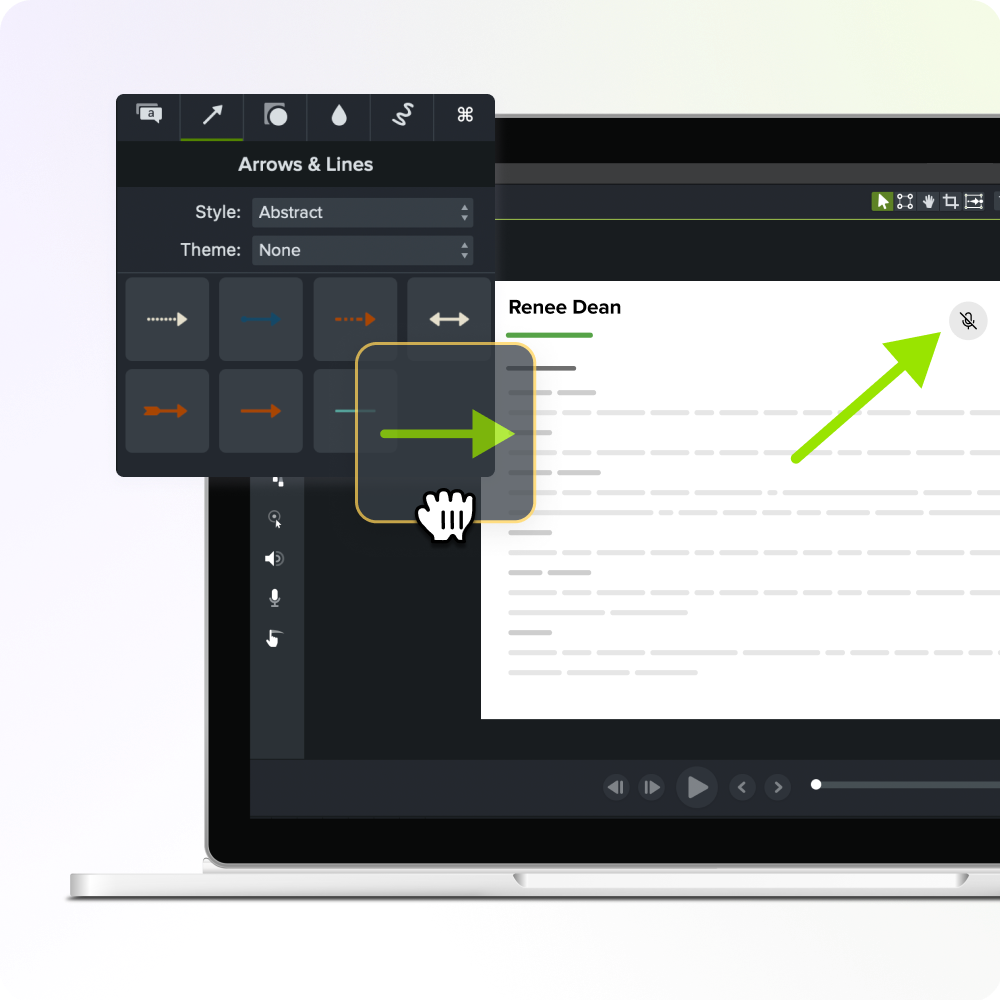
2. Streamlabs Desktop
Best for: Gamers and streamers who want OBS-like power with less configuration.
Streamlabs Desktop takes OBS’s open-source foundation and wraps it in a more approachable interface. If you’ve tried OBS and liked the concept but got lost in configuration, Streamlabs is designed to solve that.
Pre-built themes, one-click overlays, and integrated alerts mean you can go from installation to a professional-looking stream quickly.
While there are free core tools, the Ultra plan costs $27 per month and adds multistreaming to Twitch, YouTube, and TikTok simultaneously — a big advantage for creators trying to build audiences across platforms.
The trade-off here is that Streamlabs is still primarily a streaming tool. It doesn’t include a built-in editor for post-production work, so if you need to polish recordings of your gameplay after the fact, you’ll still need a separate platform.
3. Meld Studio
Best for: Creators who prioritize visual customization and professional production value in live content.
Meld Studio positions itself as the all-in-one platform that makes plugins unnecessary. Streaming, editing, and audio mixing all live in one application, which addresses OBS’s plugin dependency problem.
Instead of needing third-party add-ons, production features like effects, overlays, animated transitions, and alerts are built in, which means fewer compatibility headaches and a more streamlined production process.
Meld is available on both Mac and PC, and its visual-first approach appeals to creators who want their streams to look polished without becoming plugin experts. A free plan is available, and paid plans with more advanced features start at $20 per month.
4. ScreenPal
Best for: Educators and communicators who need quick captures, light polish, and easy sharing on a budget.
ScreenPal keeps things simple and affordable for creators who need basic functionality. With paid plans starting at $4 per month (paid annually), it’s one of the most budget-friendly options for creators who need basic screen recording software with enough editing tools to clean things up before sharing. And there’s a free version available too.
It works across Windows, macOS, browsers, and Chromebooks, so platform compatibility is rarely an issue. Auto-captions, a stock library, and viewer analytics round out the feature set, giving you more polish than a raw screen capture but without the complexity of a full editing suite. Direct uploads to YouTube and Google Drive make sharing straightforward.
The editing tools are basic-to-intermediate compared to dedicated editors, but for the price, that’s a reasonable trade-off.
5. ActivePresenter
Best for: Trainers building eLearning content that requires interactivity and LMS integration.
ActivePresenter occupies a specific niche that general-purpose tools don’t serve well: interactive eLearning content creation. If you’re building training modules that need quizzes or branching scenarios, this is one of the few tools that handles it alongside screen recording. The record-edit-publish workflow includes advanced timeline editing and annotation features tailored for instructional content.
The Standard product costs $249 per license, and the Pro product costs $499 per license (with volume discounts available). Both allow for commercial use, but you’ll need the Pro version for eLearning editing and a few other premium features.
6. Switcher Studio
Best for: Event producers, religious orgs, and educators who need multi-angle coverage without traditional equipment.
Switcher Studio takes a completely different approach by turning your existing mobile devices into a multi-camera production system. Instead of investing in dedicated hardware, you can use iPhones, iPads, Macs, and Android devices as camera sources and control everything from a single interface.
Live camera switching, graphics overlays, and media playback are all manageable from one device, making Switcher Studio a practical option for event coverage, religious services, and classroom recordings.
The Studio plan runs $65 per month (including cloud recording), while the $99 per month Business plan adds collaboration features for larger teams.
7. VEED
Best for: Creators who prioritize speed and accessibility over deep customization.
VEED takes the browser-based approach to its logical conclusion. You can upload, record, edit, and export without installing anything. For creators who work across multiple devices or simply don’t want to deal with software installation, that accessibility is a key selling point.
Automated closed captions in over 100 languages, templates, stock footage, and team collaboration features make it a capable tool for social media content and quick-turnaround projects. The workflow is particularly appealing for remote teams who need to create and review content together without everyone having the same desktop software installed.
The trade-off is that browser-based editing has its limits. Heavy projects or long-form content will feel constrained compared to desktop applications, and AI-powered features are gated behind credit limits that can slow you down on larger projects. Their pricing isn’t publicly listed online either.
8. XSplit Broadcaster
Best for: Streamers who want professional features with less manual configuration than OBS.
XSplit Broadcaster sits in the space between OBS’s raw power and the simplicity of beginner streaming tools. Its interface is more polished than OBS, with scene transitions, a source projector, and integrated chat support that feel more intuitive out of the box.
The freemium model lets you start for free, though premium tiers (starting at $14.99 per month) unlock features like watermark removal and improved encoding quality. It’s worth noting that XSplit is Windows-only, so Mac users will need to look elsewhere.
9. vMix
Best for: Professional producers, broadcast studios, and large-scale event coverage.
vMix is the heavy hitter on this list, built for professional broadcast production and large-scale events. Multi-camera mixing, instant replay, virtual sets, and NDI support put it in a different category than most tools here.
That power comes with both a price tag and a learning curve. The free 60-day trial lets you explore the interface, and the lowest-cost lifetime license is only $60, but full-featured tiers run up to $1,200.
So this isn’t a tool you pick up casually. It’s more of an investment for teams producing live events, broadcast content, or high-end corporate video.
Why Camtasia stands out among other OBS alternatives
The tools on this list each solve real problems, but they solve different problems. For creators whose primary goal is producing polished tutorials, training videos, and educational content, Camtasia addresses the OBS workflow gap more directly than any other option.
The core difference comes down to purpose. OBS is built for live capture and streaming. Camtasia is built for professional tutorial and training production. That’s not a criticism of either tool — it’s a recognition that different workflows demand different solutions.
Here’s how that plays out in practice:
- OBS records raw footage and hands it off — Camtasia lets you record and edit in the same application, giving you independent control over the screen, cursor, and camera video.
- OBS requires plugins for captions — Camtasia automates them with AI.
- OBS gives you no tools for audio cleanup — Camtasia includes background noise removal.
- Maintaining consistent branding across videos requires manual effort in OBS — Camtasia provides professional templates that keep everything on-brand without heavy design work.
- OBS’s cursor is just a cursor — Camtasia’s multi-track recording captures it on a separate track, so you can add highlights, enlarge it, or animate clicks.
For teams that produce instructional content regularly, whether that’s IT training, customer onboarding, product demos, or internal knowledge sharing, that integrated workflow matters. It’s the difference between publishing one polished video a week or spending that same week just trying to learn three different apps.
Camtasia is purpose-built for workplace communication and training. If that matches your needs, explore what Camtasia can do for you.
Looking for professional screen recording software?
From simple screen captures to polished video editing, TechSmith has everything you need to create professional-quality content.
Learn More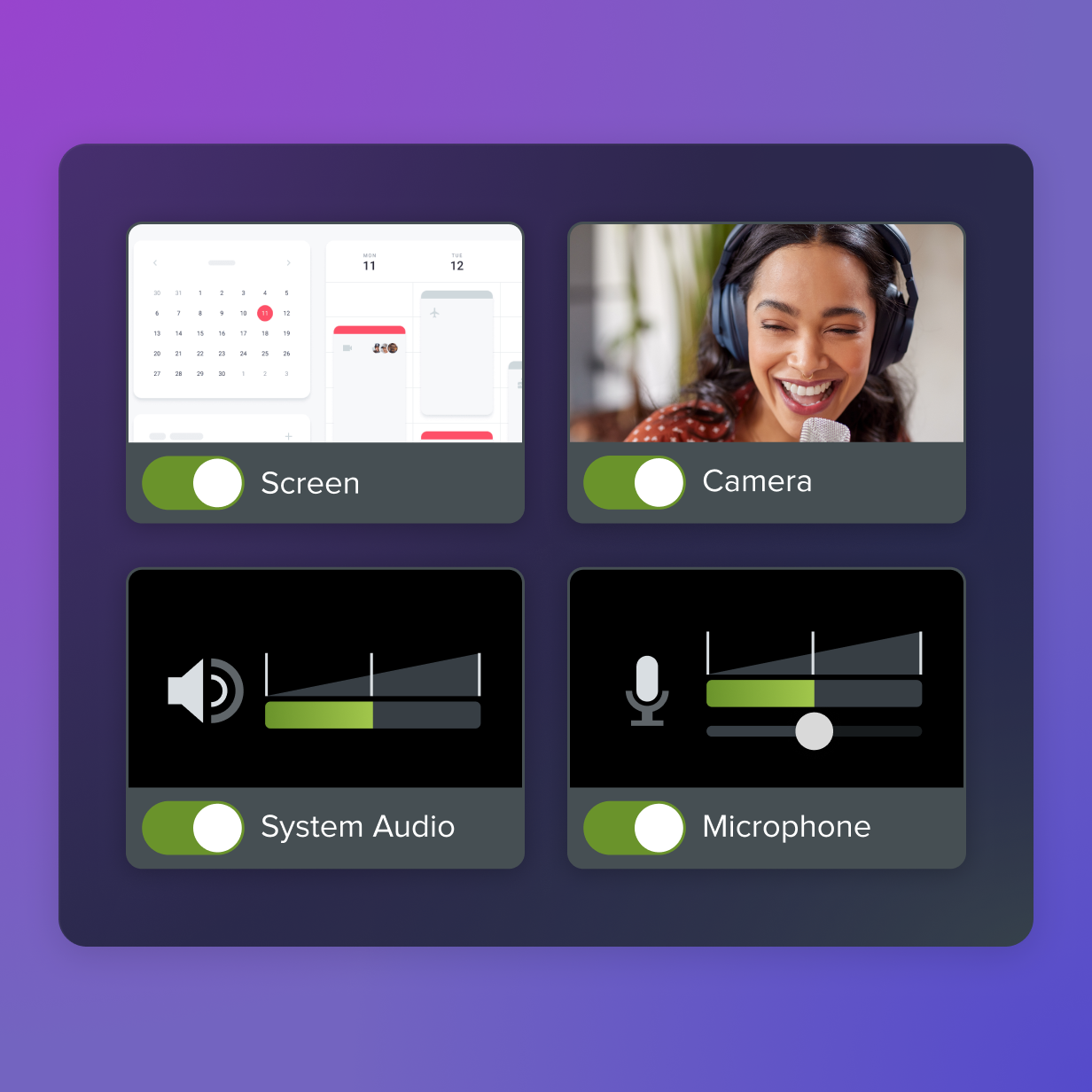
FAQs
Can I switch tools without losing my current scene layouts?
Most OBS alternatives use different project formats, so scene layouts usually need to be recreated, though Streamlabs Desktop can import OBS scene collections because it shares the same underlying architecture. This means if you’ve invested significant time building complex scenes in OBS, you should plan for some setup work when migrating to most alternatives. The good news is that many modern alternatives offer templates and presets that can speed up the recreation process.
Is open-source mandatory for professional streaming?
Open-source tools like OBS offer flexibility and zero cost, but many professional creators use commercial alternatives that prioritize reliability, support, and integrated features that save production time. The choice between open-source and commercial software should be based on your specific workflow needs, technical comfort level, and whether you value community-driven development or dedicated customer support. Professional results come from how you use the tool, not whether it’s open-source or proprietary.
Are streamers still using OBS?
OBS remains widely used by experienced streamers who want extensive customization and a large plugin ecosystem, though many creators now choose alternatives that reduce setup complexity or add built-in editing. The platform continues to be updated and supported by an active community, making it a solid choice for users who have the technical knowledge to configure it properly. However, the rise of user-friendly alternatives has given creators more options that match their specific workflow needs without requiring deep technical expertise.
Can I use streaming software like OBS to make tutorials?
Yes, you can use streaming software like OBS to record tutorials, especially if you’re already familiar with its setup. However, OBS is primarily designed for live streaming and raw capture, so it doesn’t include built-in editing tools for trimming mistakes, adding captions, or polishing your final video. Tools like Camtasia Editor are a better fit for tutorials because they combine screen recording with built-in editing, AI captions, and visual enhancements in one place, making it much faster to turn recordings into clear, professional training content.
Share