








Leadership training videos are a practical, powerful way for modern managers to build real-life leadership skills. But they can do more than teach the basics — they can also address the frustrations many managers face, like feeling unprepared, under-supported, or unsure how to lead effectively.
With a thoughtful approach to training that introduces the right types of videos in the right sequence, managers are better equipped with skills that build stronger teams and contribute to your organization’s success.
So, what type of videos will have the biggest impact? And in what sequence? Let’s look at how you can use leadership training videos to train more effective leaders — and how to build those videos into practical training workflows.
How leadership videos help modern managers lead better
Developing good leaders isn’t easy. While live leadership training has its place, it can be time-consuming, hard to scale, and inconsistent — especially if there are multiple trainers in the mix. Similarly, many core management skills and concepts are abstract, dealing with interpersonal dynamics and requiring emotional intelligence, which can be tough to explore in a classroom and even harder to apply in real time.
Leadership training videos can solve these challenges. While you may invest a little more time up front during production, video training is a resource that can scale almost infinitely and consistently.
Video also gives you a unique opportunity to demonstrate and provide expert modeling, and managers can work through video training at their own pace. For example, a video trainee can pause to reflect or practice a skill, or return later on to revisit complex leadership topics.
Leadership videos can even change your team culture and performance: when your managers and mid-level leaders see quality leadership in action, they can more effectively apply what they see modeled.
Key benefits of video-based leadership training
- Accelerated learning: Visual demos reduce time to skill mastery by 40%.
- Consistency at scale: Every manager sees the same behaviors, regardless of location.
- Reclaimed time: No more having to answer the same questions over and over (74% of employees have to repeat themselves at work).
- Workflow-friendly: Videos can be watched without disrupting daily tasks.
- Measurable outcomes: Track completion rates and observable behavior changes.
- Better absorption and retention: 66% of employees improve quality of output because of visual communication.
Best types of leadership videos for real-world impact
Managers are busy, so rather than focusing on providing a lot of content, focus on the right content. The best leadership videos share three traits: they show specific behaviors, offer practical frameworks, and connect theory to everyday work. Here’s how this translates to content that time-pressed managers need (and will actually watch).
Videos that build trust and improve team dynamics
Businesses thrive on trust, and that runs all sorts of directions: customer to business, sales team to marketing team, and supervisor to supervisee (both directions, or 360 feedback).
So invest in videos that garner trust, both between senior leadership and your management ranks and between managers and their direct reports. Effective trust-focused videos should show how vulnerability, active listening, and follow-through could look in various realistic workplace scenarios.
Video elements to model or include:
- Vulnerability: Leaders make mistakes. Great leaders admit it and/or seek input.
- Active listening: Body language, paraphrasing, and affirmations show that a leader is truly listening to understand.
- Consistency: Clear commitments build trust when managers consistently meet them.
- Recovery: Mistakes are inevitable, and managers must make special effort to rebuild trust.
Training your managers around building trust can help those managers improve relationships with and within their teams. When employees feel psychological safety, they work more confidently and collaborate more openly.
Videos that strengthen emotional intelligence in leaders
Managers in the modern workplace need high emotional intelligence, or EQ. This ability to see and understand emotions helps managers determine how to navigate complex interpersonal situations.
But what should EQ look like in a leadership training video? How can you keep it real?
EQ includes at least four observable behaviors, which your videos should model wherever possible.
- Self-awareness: Recognizing personal tendencies and triggers
- Self-regulation: Keeping your composure when stressors or triggers arise
- Empathy: Putting yourself in others’ shoes and validating their concerns
- Social skill: Doing all of the above in appropriate, socially helpful ways
Video elements to model or include:
- Nonverbal “reading the room” techniques to assess others’ emotions or see how one’s reactions affect others
- Strategic use of various tones, body language, and silence to communicate messages effectively
- Emotional mirroring to boost morale by nonverbally validating how another person feels
- Team responses to leader emotions (positive or negative), showing how a leader’s choices can shape team culture
Videos that teach strategic thinking for leaders
When managers are constantly putting out fires, they miss chances to lead strategically. Help them shift away from the reactive approach with videos that focus on these four types of strategic thinking:
- Systems thinking: How does a decision affect a system? What are the outcomes?
- Critical thinking: Is the status quo the most effective approach? Where are there breaks or ambiguities in the process?
- Creative thinking: What have we not yet considered? What new approaches or ideas could improve outcomes?
- Analytical thinking: What does the data show us?
Here’s another way to look at these types of strategic thinking:
| Thinking Type | Video Focus | Key Demonstration | Application |
| Systems | Cause-effect chains | Mapping decisions | Team impact analysis |
| Critical | Assumption testing | Challenging status quo | Process improvement |
| Creative | Ideation techniques | Brainstorming sessions | Innovation planning |
| Analytical | Data interpretation | Making decisions from data | Performance management |
Practical leadership skills videos every manager should watch
There’s a place for videos that help managers improve over time. But some training videos are designed for more of an immediate payoff, giving your managers tools and resources they can act on right away. Keep the following video categories in mind as you build your training library for leaders:
Communication training videos
Management is built on communication, and nearly every leadership task involves it in some way — from giving feedback to setting expectations, giving direction, and beyond. But improving communication skills doesn’t always need a long workshop, and in many cases, a short video or two is all it takes.
For example, take the power of the pause. You could explain the concept and how to do it well in a long email or training document. But a short video demonstrating it in action is more effective, giving clarity and weight to the concept of a well-timed pause in just a few seconds.
Other communication training video ideas:
- Feedback and confrontation: Contrast the Situation–Behavior–Impact model with personal attacks.
- Mirroring: Demonstrate using body language to build rapport.
- Asking better questions: Show how an open-ended question invites an answer while a directive question shuts the recipient down.
Pro tip: In some cases you can reuse one video for several purposes by adjusting audio or visuals. Camtasia’s multi-track recording makes it easy to update videos to reflect new policies or updated training without recreating the content from scratch.
Go from screen recording to polished video
A screen recording is just the start. Camtasia’s editor helps you add the callouts, animations, and edits you need to create a truly professional video.
Free Download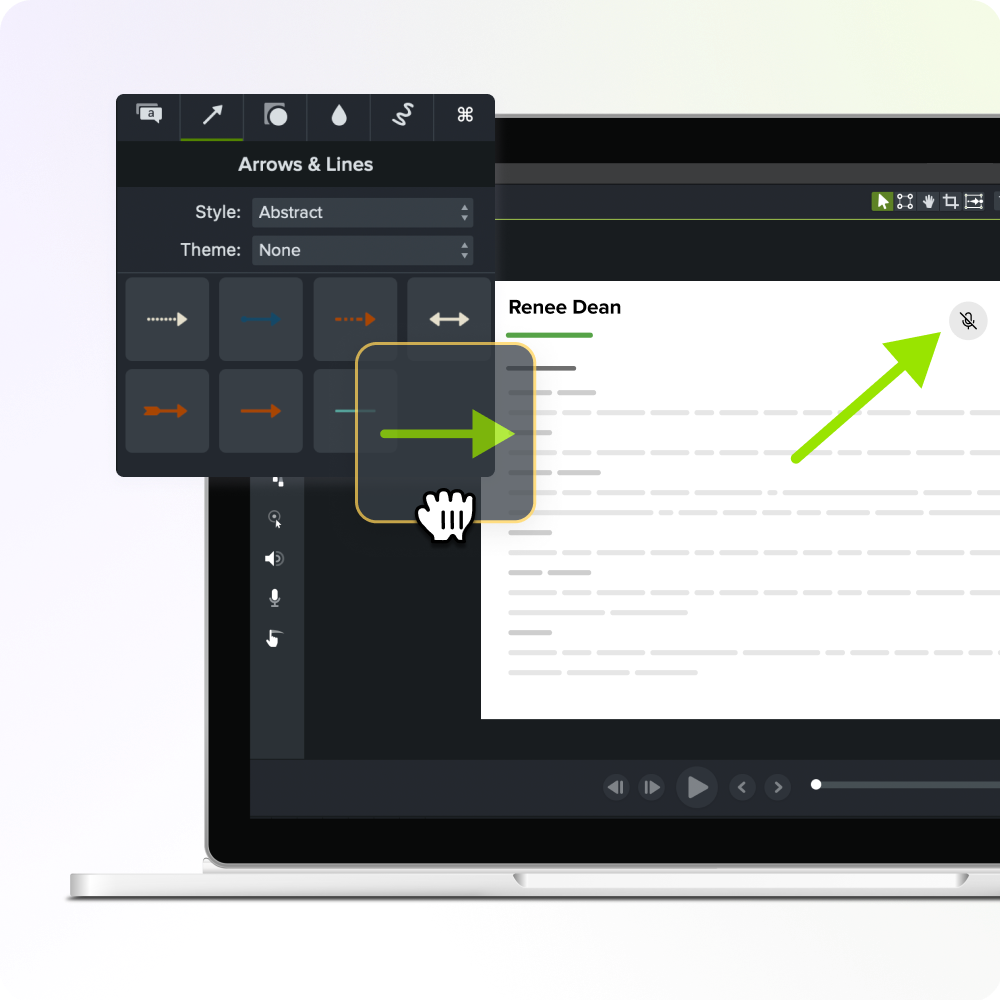
Conflict resolution videos
It’s natural to think of conflict as a bad thing, as a problem to be solved. But what if your managers thought of conflict as a leadership opportunity, not just something to be avoided or ignored?
Conflict resolution videos can quickly teach techniques like these:
- How to spot tension early
- Ways to de-escalate conflict
- Mediation frameworks that foster dialogue
- Tactics that prevent repeat conflicts
Pro tip: Not every video needs the same level of polish. Use Snagit for quick screen recordings, storyboarding, and capturing examples. When you need to create polished walkthroughs or simulations, switch over to Camtasia.
Record your screen with Snagit
Snagit makes it easy to share quick updates and how-to’s by capturing exactly what’s happening on your screen.
Get Snagit
Decision-making videos
Videos can equip your managers with better tools and frameworks for making smarter decisions and prioritizing work appropriately. Consider teaching a fast framework like the OODA loop or showing managers how to triage issues by pressure level and time:
| Pressure Level | Time | Technique | Tool |
| Crisis | Minutes | Triage method | 2-minute drill |
| High | Hours | Rapid assessment | OODA loop |
| Medium | Days | Structured review | Decision tree |
| Low | Weeks | Deep analysis | SWOT analysis |
Tips for using coaching videos to build leadership skills
Some core leadership skills take time to develop, but the right videos can speed up the process. Here are some top tips for using video to build effective leadership skills:
- Build self-confidence: Show how shifting mindset and habits (like positive self-talk) can boost managers’ confidence.
- Help managers motivate early-career teams: Model ways that managers can tie tasks to specific growth goals, recognize team member contributions, and give early-career professionals autonomy where possible.
- Encourage healthy peer feedback: Demonstrate how to seek and act on feedback at the peer level to build trust and foster continuous improvement.
- Clarify what good goal-setting looks like: Illustrate the difference between vague and collaborative goals, and explain how clarity boosts accountability and buy-in.
- Cultivate a growth mindset: Use video to show leaders embracing failure, encouraging experimentation, and modeling curiosity in day-to-day work.
- Promote time and stress management skills: Focus on techniques that explore prioritization, delegation, and boundary-setting techniques to reduce burnout for managers and employees.
- Leading by example: Use scenarios where managers demonstrate all of these skills in real or simulated settings.
Pro tip: Use async video tools like Camtasia and Screencast to allow managers to watch at their own pace and ask questions if needed.
Crystal-clear screen recording
Why settle for blurry screen content? Camtasia Editor’s screen recorder captures everything at up to 4K!
Free Download
How to use leadership training videos in your organization
Good training content can be a powerful force that drives real change, but only when implemented properly. Use these strategies to build video training into real, functional workflows.
Blended learning strategies
Video training alone can be a passive experience: Managers watch the videos, but if they’re not engaged with the training, it may not be effective.
A better approach is blended learning, which combines video content with live and interactive elements where managers can practice the skills they see demonstrated in your leadership training videos. Here’s how you can incorporate it in your leadership training program:
- Blend video with real-time practice: Build out role-plays, group discussions, and action planning exercises for managers to practice their skills.
- Follow a 4-week rollout: Schedule individual viewing, peer feedback, and real-world application across multiple weeks.
- Use reinforcement tools: Use manager roundtables, mentor check-ins, and peer coaching circles to help managers retain learning and continue improving.
Self-paced vs. scheduled leadership training
Video training gives you flexibility in how you deliver content — either on a self-paced basis or as part of a scheduled rollout. Each approach has its strengths, depending on your goals and audience.
- Self-paced videos: Ideal for foundational skills and busy managers who need flexibility. This format allows learners to absorb content when it fits their schedule, and to revisit complex topics as needed.
Tip: Pair with pre-assessments to tailor recommendations based on a manager’s development level.
- Scheduled video rollouts: Better suited for time-bound training programs or when you want to coordinate learning across a team. Scheduling ensures that everyone is working through the same material at the same time, which can support better alignment and accountability.
Tip: Use scheduled check-ins or reflection prompts to keep learners engaged and on track.
- Blended approach: You don’t have to choose just one. Start with self-paced learning to introduce key concepts, then follow up with scheduled discussions, assignments, or practice activities.
Tip: Time the follow-up activities to reinforce application shortly after the initial video viewing.
Start building stronger leaders with video-based training
Modern managers need more than passive theories and vague, disconnected concepts. They need practical guidance and real examples delivered in a flexible package that fits their busy schedules. Video-based leadership training makes that possible. Whether it’s modeling emotional intelligence, improving communication, or building trust, the right videos help managers thrive. And with the ability to scale, repeat, and adapt, video gives your organization a lasting way to consistently develop strong leaders at every level.
If you’ve identified gaps in your leadership development efforts, video training can help you create a program that focuses on high-impact topics like effective communication, emotional intelligence, and workplace trust. With TechSmith’s Camtasia, Snagit, and Screencast, it’s easy to create professional video content that’s consistent, engaging, and meaningful. Want to turn leadership training into interactive videos that help develop better leaders? Explore TechSmith products now.
Need to show your screen?
Skip the downloads. Use Camtasia online to record your screen, camera, and microphone right in your browser for free.
Start Recording
Share