






Your team just recorded a five-minute software walkthrough, and if you use Adobe Premiere Pro, now you’re staring at a timeline built for feature films rather than training videos. That mismatch sends a lot of trainers and course creators looking for a better-fit editing tool.
Adobe Premiere Pro is built for cinematic editing, so it’s not ideal for training content. For screen-based training, the best Adobe Premiere Pro alternatives replace the software’s core functions, and are judged by how efficiently they capture, edit, caption, brand, and clarify software demonstrations, not by cinematic post-production depth.
You’re not looking for a film-school tool. You need something that gets a clear, accessible tutorial published before your next training deadline, and you want to know which tool does that job best for your team.
Key takeaways
- Premiere Pro is often chosen by default because it’s bundled in Creative Cloud, not because it fits training workflows.
- Camtasia Editor is purpose-built for screen-based training, capturing screen, webcam, and audio on separate, independently editable tracks.
- DaVinci Resolve and Final Cut Pro excel at cinematic post-production but lack the native screen recording tools tutorials need.
- Free tools like OBS Studio capture screen video but require a separate editor for captions, branding, and callouts.
- The right editor depends on team size, operating system, and whether you need polished training video or cinematic film editing.
- Premiere Pro’s strength is cinematic post-production, while Camtasia Editor is designed for faster, easier training video production.
Why Premiere Pro is the wrong choice for training and tutorial content
Premiere Pro is a poor choice for training video because its workflow is optimized for cinematic post-production rather than professional tutorial capture. It doesn’t include a native screen-recording workflow, so you need to capture your footage elsewhere before moving into Premiere’s editing timeline.
Many trainers end up here because of Creative Cloud bundling. The license is already part of the organization’s software stack, so Premiere becomes the default pick even when its workflow doesn’t match the training content teams produce every week.
That mismatch shows up quickly. You have to build screen and webcam tracks manually which slows down a job you need to repeat often. Additionally, there’s no cursor editing for instructional clarity, which helps with viewer engagement.
Premiere Pro still earns its place for advanced color grading, complex timelines, and multicamera productions. Weigh those strengths against what you do each week: recording a repeatable process rather than shooting a cinematic scene.
What should you look for in a screen-based training video editor?
Separate-track capture, cursor tools, captions, reusable branding, cross-platform support, and practical AI assistance are the capabilities a training video editor needs to earn a spot on your shortlist. Evaluate any tool in this order during a trial run.
- Confirm screen, webcam, microphone, and system audio record as separate editable tracks.
- Check for editable cursor emphasis, zoom, callouts, and annotations that can be added after recording.
- Verify caption generation with an easy correction step, plus other accessibility support.
- Test reusable templates, fonts, colors, and logos so every video matches your brand.
- Confirm Windows and Mac support if your team uses mixed devices.
- Check whether AI tools reduce routine editing work like captioning and cutting dead air.
Separate tracks and editable cursor guidance matter because they let you fix problems without re-recording the entire lesson. Clear cursor movement also helps learners follow each step instead of guessing where you clicked.
Captions, templates, and platform coverage aren’t extras. They help keep your output accessible and consistent no matter who on your team hits record.
A general-purpose editor may check some of these boxes without building its workflow around them, so test each one directly before you commit.
Adobe Premiere Pro alternatives at a glance
| Name | Best for | Pricing | Top feature |
| Camtasia Editor | Training and tutorial video | Free download with watermarked exports; paid plans available with unwatermarked exports starting at $179.88/year | Multi-track screen, webcam, and audio recording |
| DaVinci Resolve | Color grading | Free; $295 one-time Studio upgrade | Node-based color grading tools |
| Final Cut Pro | Mac editors | $299.99 one-time purchase | Magnetic Timeline for rapid assembly |
| CyberLink PowerDirector | Social content | $59.99/year (PowerDirector 365) | AI Agents for prompt-based editing |
| Filmora | Freelancers | Annual or perpetual license; AI credits metered separately | AI Extend for scene generation |
| OBS Studio | Free capture | Free | Unlimited customizable scene switching |
| ScreenFlow | Mac screencasts | $199 one-time license | Simultaneous screen, camera, and mic capture |
1. Camtasia Editor: The purpose-built alternative for training and tutorial video
Camtasia Editor is the strongest fit for screen-based training because recording, editing, captioning, cursor enhancement, and branding all live in one repeatable workflow. Corporate trainers, instructional designers, learning and development (L&D) teams, course creators, and freelance creators can use it to go from a raw recording to a finished, branded video in one application.
The recorder captures screen, webcam, microphone, and system audio as separate, independently editable tracks. It also retains cursor data, so you can resize, smooth, highlight, or reposition the cursor after recording instead of trying to perfect every mouse movement live.
Camtasia’s Screentelligence technology makes that cursor data editable after the fact, helping turn an imperfect screen recording into a clearer tutorial. Camtasia Audiate also lets you edit narration by editing text, meaning you don’t need to scrub through a waveform to remove any words.
Built-in captions support accessibility, while Camtasia’s AI features extend the workflow with tools for voice generation, avatars, and translation. Camtasia Rev can apply layouts and effects to a recording, and User Styles keep fonts, colors, and logos consistent across videos.
Camtasia is featured on G2’s Enterprise Grid Report for video editing, based on peer reviews rather than a vendor-assigned label. Verified reviewers, including an L&D Manager and a Senior Technical Writer, credit Camtasia with helping non-editors produce training videos quickly.
Test the workflow before committing. Record a short software task, then resize or smooth the cursor, correct a caption, and apply a saved style without leaving the project. Camtasia Editor is available as a free download, with a watermark on exports until you upgrade.
2. DaVinci Resolve: Powerful for colorists, a mismatch for tutorial workflows
DaVinci Resolve descends directly from Blackmagic’s cinema camera and colorist tooling, which makes it a strong Premiere Pro alternative for cinematic post-production but a poor fit for teams that need to record and publish short tutorials quickly. The free core application gives you node-based color grading on the Color page, a full Fairlight audio page for mixing and mastering, and Neural Engine features like speed warp and voice isolation. A one-time Studio upgrade adds more tools if you need them.
DaVinci Resolve has no native screen-recording workflow, so you still need a separate capture tool before you ever open a project. The interface is also built for editors who already think in nodes and audio buses, which means a steep learning curve for subject matter experts (SMEs) who just need to record and ship a walkthrough.
3. Final Cut Pro: Strong Mac editor, limited by platform lock-in
Final Cut Pro works well for a solo Mac-based editor, but its platform lock-in makes it a poor fit for most training teams that mix Windows and Mac devices. Final Cut Pro is available as a one-time $299.99 purchase or through an Apple Creator Studio subscription ($12.99/month or $129/year) that also bundles Logic Pro, Pixelmator Pro, Motion, and other Apple creative apps.
The Magnetic Timeline speeds up rough cuts by automatically shifting clips rather than leaving gaps, and Apple Silicon optimization means exports and render times are fast on newer Macs. Multicamera editing and motion graphics templates add real polish for promotional and narrative work.
Final Cut Pro has no Windows version, so a project file created on one editor’s Mac cannot be opened, reviewed, or finished on a colleague’s Windows machine. The program is also built for cinematic editing: there’s no screen recording, and the tool isn’t designed with training content in mind.
Before choosing it, confirm every contributor has supported Mac hardware, a compatible macOS version, and a valid license. Save this tool for all-Mac teams producing polished promotional or narrative video, and check out this dedicated comparison of Final Cut Pro alternatives for a more detailed breakdown.
4. CyberLink PowerDirector: Built for social content, not corporate training
PowerDirector’s social-first AI roadmap doesn’t center on the repeatable accessibility and branding needs of corporate training, despite being a capable creator editor. The current toolset makes that priority clear.
PowerDirector’s AI Agents include Video Edit by Chat for prompt-based editing and Character Motion Swap for placing a person into a different scene, along with text-to-video, image-to-video, voice cloning, and translation, paired with a stock library and one-click export to YouTube and TikTok. These are strong tools for a solo creator publishing short social clips on a regular schedule.
PowerDirector does include a built-in screen recorder that captures screen and webcam on separate tracks, so basic tutorial capture is possible. That said, capture is a secondary feature within a social-editing product rather than the organizing workflow found in dedicated training tools.
PowerDirector falls short in a few areas you should have access to for your training videos: caption correction accuracy, brand elements carrying across projects, and cursor visibility during screen capture.
5. Filmora: An easy paid option without training-specific depth
Filmora is a reasonable choice for approachable marketing and creator editing, but it lacks the training-specific depth needed for repeatable screen tutorials at scale. Freelance creators and small marketing teams get a lot of polish for a modest learning curve.
AI Extend, object and background removal, dynamic captions, the Pen Tool, and a large template library let casual editors produce social clips and promos with minimal traditional timeline work. Licensing runs as an annual plan or a one-time perpetual purchase, and the free trial exports with a watermark so you can test the interface before buying. Generative AI features draw from a separately metered credit pool, so heavy use adds cost beyond the base license.
Those creative tools don’t translate as directly to training workflows. Filmora lacks the same depth of dedicated cursor-enhancement tools for software walkthroughs, accessibility-focused review features, and reusable brand controls designed around training libraries.
6. OBS Studio: A free screen recorder with no editing suite
OBS Studio can replace the capture step in your workflow at no cost, but it cannot replace Premiere Pro’s editing functions because it has no timeline editor. It’s a free, open-source tool built for screen capture and live streaming, and it runs on Windows, Mac, and Linux, which makes it easy to standardize across a mixed-device team.
Scenes let you switch between capture layouts on the fly, and Source controls, the Audio Mixer, custom hotkeys, and multiview give you real production control while recording. It also supports scripting via Lua or Python for teams that want to customize their capture workflow. That’s useful for live training sessions and screen demos.
Every file you export still needs a second application for trimming, captions, callouts, cursor emphasis, and branding. Record a five-minute scene, export it, and count the apps you open next: that number is part of your real production cost.
7. ScreenFlow: A capable Mac-only screen recorder and video editor
ScreenFlow is a capable integrated screencast editor for Mac users, but its platform restriction and narrower AI suite limit how well it scales across a mixed-device training team. It’s the closest category match to Camtasia Editor on this list because recording and editing live in the same application rather than requiring a separate tool.
ScreenFlow works best for solo creators or all-Mac teams who don’t need Camtasia’s broader AI toolset or cross-platform reach. It records screen, camera, and microphone simultaneously, and its built-in caption editor lets you generate and correct captions inside the same application. It also supports iOS recording directly, which helps if part of your training covers a mobile app or workflow.
Before deploying it across a team, confirm every contributor works on macOS, since there’s no Windows version for handoffs. Reusable styles and templates speed up branding, but the optional annual Stock Media Library add-on is another cost to budget separately from the one-time base license.
Stop defaulting to Premiere: Pick the editor built for training videos
A screen recording of a software walkthrough, with a dozen small clicks, a cursor that stays visible, and captions that match what’s on screen, is the real test of whether an editor fits training work. Premiere Pro can handle footage, but it wasn’t built to make cursor highlights, click callouts, and captions this fast to produce or this easy to repeat across a training library.
Camtasia Editor is built around exactly that workflow. The Camtasia Product Suite brings Camtasia Editor together with Camtasia Snagit for quick screenshots, Audiate for script-based audio edits, and Assets for royalty-free image, audio, and video assets — all designed to support instructional content rather than cinematic post-production.
See how Camtasia fits your training workflow: Download Camtasia Editor for your next screen-based tutorial.
Go from screen recording to polished video
A screen recording is just the start. Camtasia’s editor helps you add the callouts, animations, and edits you need to create a truly professional video.
Free Download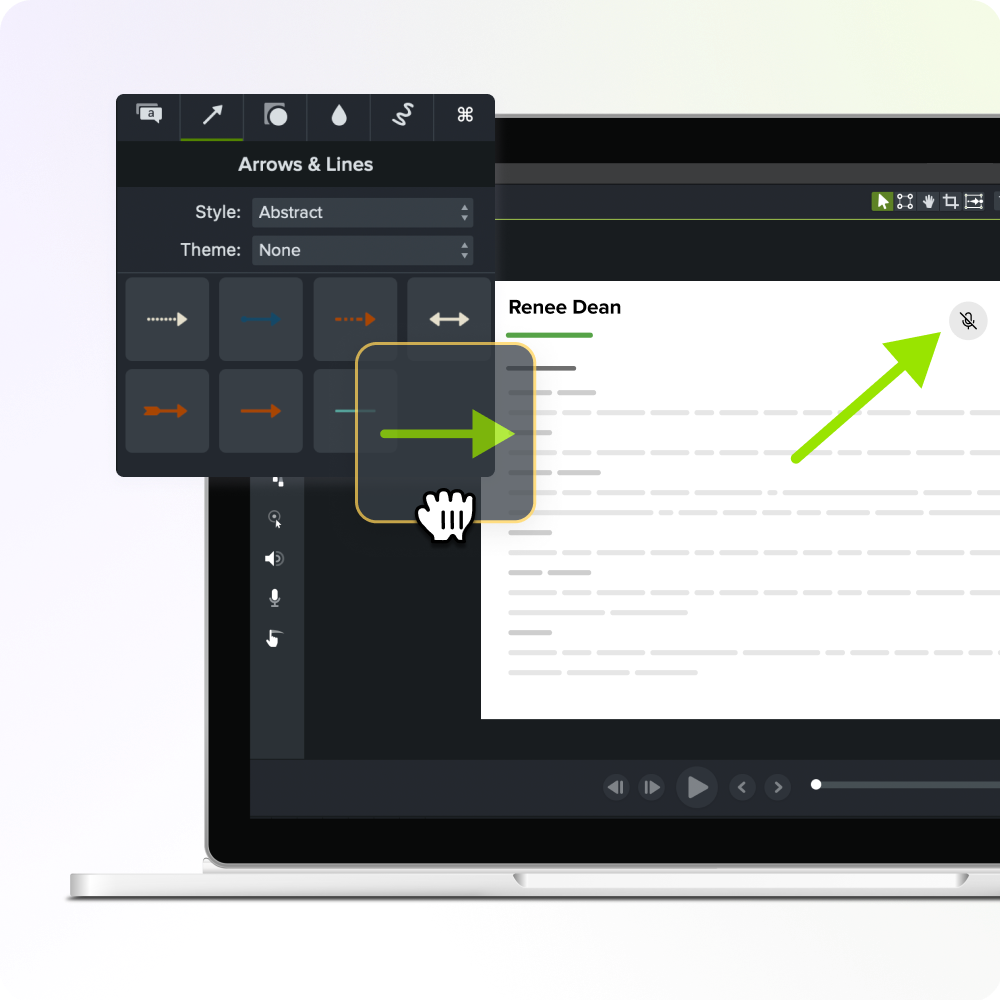
Frequently asked questions
Do I need to migrate old Premiere Pro project files when I switch tools?
Most teams skip migrating old Premiere Pro project files directly because video editors use incompatible project files. Export completed videos as MP4 files for reference or reuse, preserve the original Premiere project and source media in an archive, and begin new training projects in the replacement editor.
Can I keep using Premiere Pro for some projects while switching to a different tool for training videos?
Yes, many teams use Premiere Pro for marketing films, multicamera productions, or advanced post-production while using a dedicated screen-recording editor for tutorials and internal training. Assigning each tool to the work it handles best avoids forcing every project through the same workflow.
What’s the difference between a screen-recording editor and an AI avatar video tool for training content?
A screen-recording editor captures and edits real software demonstrations, webcam footage, cursor movement, and audio. An AI avatar video tool generates a synthetic presenter from a script, so it can support narration but does not replace authentic screen capture when learners need to see a real process.
Do Premiere Pro alternatives support SCORM export for learning management systems?
Most video editors do not export SCORM packages directly because SCORM is an e-learning authoring standard rather than a video format. Export the finished training video as an MP4, then add it to a SCORM package with an e-learning authoring tool or use the delivery and tracking options your LMS provides.
How much time should I budget to learn a new video editor after leaving Premiere Pro?
Most trainers can become productive in a purpose-built screen-recording editor within a few hours because the workflow follows familiar tasks such as recording, trimming, captioning, and publishing. A general-purpose editor such as DaVinci Resolve usually takes longer to learn because its interface and tools are designed for more in-depth post-production work.
Share