









According to the American Psychological Association, the human attention span has shrunk to about 47 seconds.
Yep — less than a minute. This is a tough reality for educators and instructional designers, as they have to figure out how to capture and keep learners’ attention.
Many have turned to educational videos. They became pretty common in the era of distance learning but have proven they’re here to stay, with teachers and trainers in K–12, higher ed, and corporate L&D believing that they promote higher engagement.
Is this always true, though? Not according to Ryan Eash, Senior Instructional Designer at TechSmith. Sure, videos can increase engagement, but only if done right.
Here, we look at how to create more engaging, purposeful, and human-centered videos.
What makes a video truly engaging for students?
There’s more to creating an engaging video than just hitting record. If you want students to pay attention to and engage with your videos, you need to be careful about how you craft them. The magic happens when you start with a clear purpose and focus on building a human connection through the screen.
Always start with a clear purpose
According to Ryan, “There should always be a purpose for creating and sharing a video for students.” Before you hit the record button, ask yourself: Why am I creating this video? What do I want my students to take away from it? Answer these questions, and you’ll have determined the purpose of your video.
A clear purpose prevents you from rambling on and on or overloading students with unnecessary information. This can help you capture their attention for longer and encourage engagement.
If you want to provide an assignment update, for example, your video should focus entirely on that. Learners are more likely to engage when a video’s purpose is clear.
Build your next training video with Camtasia
Record your screen or camera. Then, use the video editor to add polish and clarity.
Learn More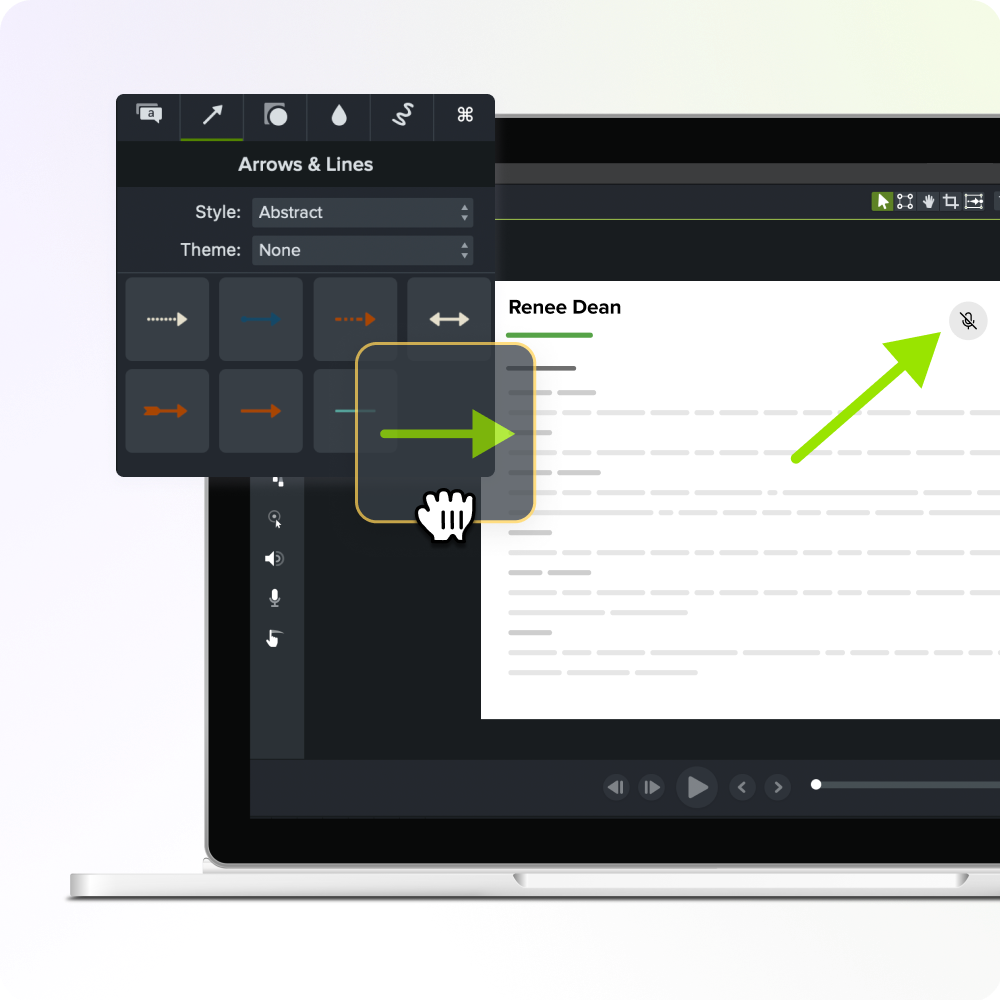
Personality and tone matter more than polish
A common misconception is that educational videos must be polished to encourage engagement. But that’s not the case. A Hollywood-level production may actually do more harm than good, as it could make your video unrelatable.
Students respond more to authenticity than polish. Record your video as though you’re recording for a friend who needs assistance on a topic, keeping your tone natural, light, and conversational. And don’t remove the small imperfections in tone or delivery when editing your video.
Together, this humanizes your content and helps students feel like you’re speaking directly to them, which could boost engagement.
Humor and human connection can help
Learning doesn’t have to be stiff and formal. In fact, it shouldn’t be, especially when using video as your delivery format.
Incorporate a little bit of humor, tell a short, relatable story (that aligns with your content, of course), and use a casual tone. This can transform you from a recording on the screen into a real person who feels like they’re in the room, increasing learners’ attention spans and making your video more memorable.
This isn’t to say that you should go overly casual. Just crack a joke or two and only tell relevant anecdotes, like you would in a real-life classroom. Otherwise, you risk alienating students.
Length is flexible — but only if the content earns it
Forget the “shorter is always better” rule. If this were true, Netflix, and frankly, all of Hollywood, would be out of business.
The truth is, video quality is more impactful than length. If your content is valuable, it doesn’t matter whether you record a ten-minute video or an hour-long one — students will stick around. As Ryan says, “A longer video can actually feel shorter if it’s engaging, and students can adjust playback speed.”
Now this doesn’t mean you should stretch 10 minutes of video into 30 minutes by adding unnecessary information or endlessly repeating yourself. But if you have more to say (that learners will find interesting and valuable), don’t be afraid to go longer.
When does video hurt student engagement?
A common belief is that adding videos to lessons, especially in the age of blended learning, automatically improves classes. But the reality is that poorly crafted and executed videos can have the opposite effect, resulting in boredom, frustration, and total disengagement from lessons — the last thing any educator wants.
Repetition and sameness breed boredom
Say you decide to take an online course on a topic you find interesting, like space. The first class is exciting, since you get to see visuals of different planets, stars, and black holes. What would happen if the professor used the same visuals for the second class, the third one, and so on? You’d get bored, and they’d just become background noise over time.
The same thing will happen with your students if your videos are all the same when it comes to tone, visuals, and structure. According to Ryan, “If videos are always the same each week, students may stop watching.”
To avoid this, bring a little variety into the mix. Use different visuals, change your background, adjust your format by starting videos with something different, and incorporate storytelling. Keeping learners guessing could make them look forward to your videos and maintain their attention for longer.
Lack of perceived value drives tune-out
If viewers don’t see the point of your videos from the start, chances are, they won’t engage with the next ones. So create online courses and educational videos with upfront value in mind.
To make your videos valuable, only focus on things that matter to your target audience. Avoid filler and use clear framing in both video content and the surrounding instructional context to let students know what to expect. In other words, give them the what, why, and how right up front to grab their attention before diving into the details.
Further, know when to create videos and when to go for simpler content formats, like infographics. As Ryan says, “Everything doesn’t have to be a video. Be selective and purposeful when using video as a teaching/learning tool.”
Poor audio quality can be a deal-breaker
While high polish isn’t necessary in educational videos, you can’t get away with issues like background noise, inconsistent audio volumes, flat narration, and lack of variation in tone. These issues are not only annoying for viewers but can also come across as unprofessional, resulting in disengagement.
Make great educational videos
Create engaging videos that drive student success with Camtasia’s easy drag-and-drop editing.
Free Download
What educators often get wrong about video
When they’re engaging, informative, and in line with the best practices we’ve discussed here, videos can be an excellent tool for education. Just make sure you avoid these common pitfalls that can impact their effectiveness.
Thinking video is only for lectures
Videos are great for lecture delivery, but that’s not all they’re good for. You can also use them to answer student questions, offer encouragement, or give assignment feedback.
And you don’t have to be formal. It’s even better when you aren’t, as this can humanize the videos and make them more interesting. For example, you could use effects to highlight important moments or content.
Ryan says that using callouts or annotations to provide tips and reminders for students can help them engage (or re-engage) when you’re sharing something especially important. A callout like “Remember this!” or “This might be on the exam!” that appears on the screen for several seconds would definitely get their attention.
Over-engineering videos instead of just being real
As mentioned, educational videos don’t need to be polished. Remember, your purpose for creating them is to enhance learning experiences and boost student engagement — things you won’t achieve if your videos are stiff and borderline lifeless.
Instead of focusing on getting the perfect angle or making your visuals look professionally edited, keep things real. When editing your content, maintain imperfections, like the occasional struggle with technology or a mistake you caught and corrected. This creates an authentic and engaging learning experience.
As Ryan puts it, “Production quality is important, but I don’t think it has to be perfectly edited. Leaving in mistakes (or corrected mistakes) can make it feel like a typical in-class lesson.”
Also, you don’t have to get your camera and tripod out for every type of content. You could make webcam-style videos for informal updates or check-ins and use your phone to record microlearning modules. Today’s students are deeply familiar with this type of informal, user-generated content, so they may have an easier time connecting with it.
Assuming engagement = required interaction
Another common mistake educators make is assuming that students must interact “physically” with video content for it to be effective. On the contrary, engagement isn’t about forcing students to respond to videos with mandatory discussion board posts or participate in polls. The real goal is to capture their attention.
“Discussions and interactions should be a natural thing and something that students want to do because they are interested in it,” says Ryan. When you focus only on student interactions to prove engagement, your videos may feel exhausting, ultimately impacting learners’ willingness to sit through even the shortest ones.
Use these insights to make video work for your students
Video can help increase student engagement, but only when you use it intentionally. Focus on purpose, tone, pacing, clarity, and variety rather than video length, production perfection, or “engagement metrics” like weekly discussion board posts.
And don’t be afraid to humanize your content by being yourself — imperfections and all. This can foster connection and trust, potentially encouraging engagement.
With TechSmith, you don’t need to be a video production and editing guru to create valuable and engaging educational videos. Whether you want to share long lecture videos explaining tricky topics or short ones answering student questions or highlighting vital details, our easy-to-use products, Camtasia and Snagit, can help.
Want to create genuinely engaging videos for your students? Explore TechSmith’s video capture, recording, and editing tools.
Share