









Starting a new job is exciting, but it can also be overwhelming. In the first few days (and weeks), everything feels new: people, culture, tools, and how work gets done. It can feel awkward or intimidating to dive in and ask questions when you’re new, but that’s where a video onboarding program can help.
Instead of relying only on busy teammates or trying to figure things out on their own, employee training videos give new hires easy, on-demand access to the guidance they need when they need it. It’s a simple way to help people feel more confident, more connected, and ready to hit the ground running.
Effective programs include a mix of content, from welcome messages to role-specific training modules, policies, and beyond. Together, they not only improve new hires’ onboarding experiences but also their productivity and how long they stay with the company.
But how do you create an effective video onboarding program? Read on to find out.
A video onboarding program is a structured set of videos that introduces new hires to your company, their role, and the tools and processes they need to do their job. It gives employees on-demand guidance they can watch, pause, and revisit throughout onboarding.
Key Takeaways
- Video onboarding helps teams deliver clear, consistent training at scale.
- A strong strategy includes culture and values content, role-specific training, accessibility, and a consistent tone.
- Short, focused modules are easier for new hires to follow and revisit.
- Clear learning goals, the right tools, and regular feedback help you build a program that improves over time.
- Camtasia Editor, Camtasia Snagit, Camtasia Audiate, and Screencast support recording, editing, accessibility, and updates without adding unnecessary complexity.
Why video onboarding drives better engagement
Video onboarding drives better engagement because it gives every new hire the same clear guidance, supports self-paced learning, and reduces the pressure of asking questions in real time.
Video onboarding meets employees’ expectations for accessible, flexible learning—and it consistently encourages higher engagement.
One of the biggest advantages of video onboarding is that it’s easy to scale and standardize. Whether you’re training five, 50, or 500 people, all you need to do is share recorded content. This means messaging is consistent even when different people are handling training. It also reduces the burden on trainers, freeing them up to focus on more strategic tasks like coaching and mentoring.
Beyond scalability and consistency, video onboarding supports engagement in several other ways:
- Clarity: Screen recordings reduce confusion and ambiguity by providing step-by-step visual guides.
- Emotional connections: Videos can feature real employees, allowing new hires to connect with more than just company processes.
- Self-paced learning: On-demand videos allow new employees to learn at their own pace and revisit content as many times as needed.
- Reduced anxiety: Video onboarding allows new hires to learn without performance pressure.
Key components of an effective onboarding video strategy
An effective onboarding video strategy usually includes four parts: culture and values content, role-specific training, accessibility and inclusivity practices, and a consistent brand voice.
A solid onboarding video strategy helps new hires feel more confident and supported from the start. It gives them the clarity they need, answers common questions early on, and makes it easier to connect with the team and company culture.
Here’s what to include:
Culture and values
While it might be tempting to get straight to job-specific training, starting with your culture and understanding how things work would be a better move.
Remember, new hires are in new territory. Help them feel comfortable and give them time to get to know who you are so they can build an emotional connection before anything else.
Consider including the following in your culture and values content:
- Introductions and welcome messages from management and other employees
- Employees’ day-in-the-life segments, featuring their typical workdays
- Growth stories, told by employees
- Real-life examples of your company’s values in action (for example, if you prioritize sustainability or charity, you could include short clips of your efforts)
- Unique company policies and traditions, like annual team-building exercises
- Company history content
- Virtual office tours
To make these videos feel more authentic, capture candid work moments and feature other employees and team members. Encourage them to share their unique experiences rather than read from a script.
Many organizations use Camtasia Editor to easily create employee-led “day in the life” clips or value spotlights without needing a whole production crew.
Go from screen recording to polished video
A screen recording is just the start. Camtasia’s editor helps you add the callouts, animations, and edits you need to create a truly professional video.
Free Download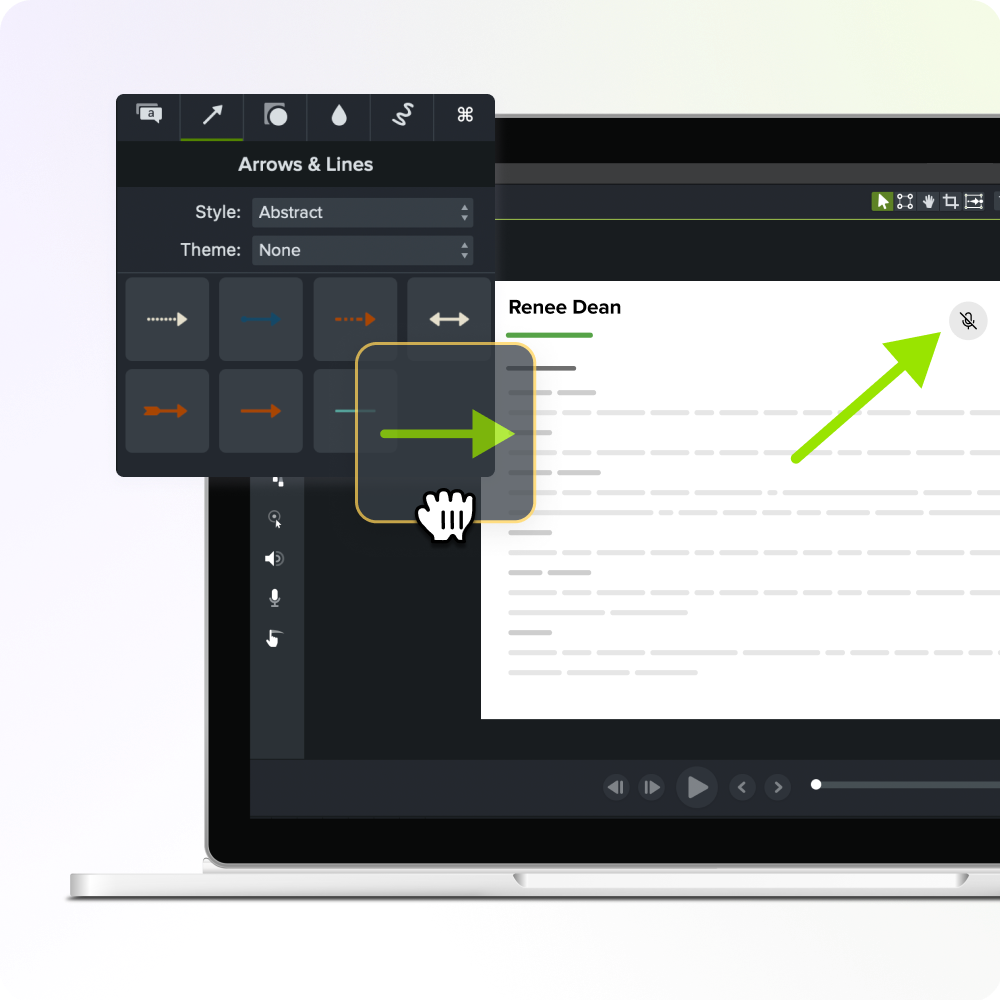
Role-specific training
Generic company training isn’t enough. To shorten employee ramp-up time, create targeted video content that explores practical, role-specific information. Think: how to use everyday tools, processes and best practices, software troubleshooting.
You can deliver this content in several video formats, including:
- Screen recordings: Can be suitable for software tutorials
- Scenario-based videos: Ideal for troubleshooting processes
- Over-the-shoulder: Great for best practices
- Peer-led videos: Ideal for insider tips and best practices
For best results, start with the basics before moving to more complex concepts. Get input from current employees to make sure your videos cover real potential pain points.
Some teams begin by capturing simple first-week tasks using Camtasia Snagit. These quick screen recordings are easy to create, and they can be organized into department-specific Collections for easy access. As onboarding needs grow, you can expand those clips into more structured training modules with Camtasia Editor for a modular, scalable way to maintain your training library over time.
Accessibility and inclusivity
Ensuring accessibility and inclusivity promotes legal compliance and enhances engagement. While these components may only seem important for learners with disabilities, they’re beneficial for everyone.
Skeptical? Videos containing subtitles have a 91% completion rate, while those without only have a 66% completion rate.
Beyond adding subtitles and captions to onboarding content, you can promote accessibility and inclusivity by:
- Using high color contrast that aligns with WCAG 2.1 standards
- Adding video descriptions and transcripts
- Providing keyboard navigation capabilities for interactive elements
- Maintaining a well-balanced pace to allow learners to process complex details
- Optimizing videos for desktop and mobile devices, as well as screen readers
With Camtasia Audiate and Screencast, it’s easy to bake accessibility into your workflow. Teams can automatically generate captions, translated scripts, and chapter summaries to support learners across different languages and abilities.
Consistent branding and tone
You’re probably thinking, “How are branding and tone relevant to onboarding…?” But it matters more than you think. Maintaining a cohesive image helps reinforce your brand identity with new hires, which can help them connect with your company. It also reduces cognitive load by providing clarity throughout the onboarding process.
Keep your branding and tone consistent by:
- Defining and communicating your brand’s voice: You could ask training teams to use a precise and professional tone for compliance training, a clear and patient tone for role-specific training, and a warm and enthusiastic tone for culture and values training.
- Developing brand-specific visual standards: Let video creators know which colors and fonts to use as well as where to add your logo.
- Providing a clear style guideline: Let all team members know how to explain concepts and provide demonstrations.
Crystal-clear screen recording
Why settle for blurry screen content? Camtasia Editor’s screen recorder captures everything at up to 4K!
Free Download
Steps to create engaging employee onboarding videos
To develop a video onboarding program, define what employees need to learn, choose tools that fit your workflow, organize each module, keep videos short, and improve the program with feedback before a full rollout.
Now that you know what to include in onboarding videos, how do you create them? Here’s a step-by-step guide:
1. Define clear learning goals
Without clear learning goals, there’s no way to determine whether your videos are hitting the mark. Start by identifying what new hires need to learn and when.
Ideally, your goals should be SMART (Specific, Measurable, Achievable, Relevant, and Time-bound). For example: “Make sure new hires understand how to automate invoicing using our system within their first week.”
To set SMART goals:
- Determine what new hires need to know within specific timeframes (like week one, day 30, day 60)
- Align knowledge requirements with video content. For instance, save tool training for role-specific videos.
- Define your success measurement criteria.
- Make sure your goals align with performance expectations.
Here’s a simple goal-mapping template to guide you:
| Video module | Learning Goal | Success metric | Timeline |
| Welcome video | Understand the company culture and learn about different teams | Can tell what your company does and who does what | Day one |
| Using helpdesk tools | Learn how to use the company’s ticketing system | Completes ticket simulation within 36 hours | Week 2 |
| Troubleshooting procedures | Know how to diagnose and resolve common problems, like login issues | Successfully completes a mock troubleshooting exercise | Weeks 2-4 |
2. Choose the right tools
You need a few tools to produce, distribute, and track employee onboarding videos: video editing software, screen recording tools, hosting solutions, and analytics platforms.
Your choices can determine your video production and distribution efficiency, content quality, and ease of measuring video training engagement. So, be careful before settling on any option. Consider:
- Ease of use: Should be intuitive enough for non-experts in video production to use
- Must-have features: Should have user-friendly editing features, provide annotation tools, and support different video formats
- Valuable add-ons: Should offer capabilities like automated translation and transcription, and support branching scenarios
- Integration capabilities: Should connect with existing communication, email, and human resource tools
- Collaboration features: Should centralize content, facilitate version control, and allow trainers and employees to leave feedback on videos
- Scalability: Should be able to handle your company’s expanding video needs and support more users as your teams grow
Camtasia Editor and Camtasia Snagit offer a complete set of features to do all of the above (and more). Record your screen, edit your clips, add transcripts or voiceovers, and publish everything from one place.
3. Outline content for each module
Jumping straight into recording without a plan can lead to scattered, unfocused videos. Before you hit record, map out your video’s focus and structure. Here’s an example of a short structure:
- Hook (under one minute): Explain how the video will benefit viewers.
- Overview (1 minute): Summarize what the video will explore.
- Core content (5-8 minutes): Dive into step-by-step content and include examples.
- Practice opportunity: Allow viewers to apply or practice what you’ve covered.
- Recap: Go over core points and briefly introduce the next module.
To help organize your modules, you can use Camtasia Snagit’s Step Capture to storyboard tasks. Then drop those visuals into Camtasia Editor to guide your video production team.
4. Keep videos short and interactive
With the average human attention span at 47 seconds and people increasingly getting used to short-form content on social media, lengthy videos may not be effective with new hires.
They’re bound to lose their attention, potentially impacting the effectiveness of your video training.
Aim for short, interactive videos to maintain new hires’ attention and allow flexible learning schedules. With short videos, they can easily learn concepts during breaks, commutes, or even while working, without disrupting their day-to-day activities.
5. Test and iterate before rollout
Before launching your onboarding videos to new hires, run a small test with current employees or team leads. Then, use their feedback to fine-tune your content.
Here’s a feedback matrix to help you:
| Feedback type | Collection method | Key questions | Action threshold |
| Content clarity | Post-video quiz | Were the concepts easy to understand?Was anything unclear? | <80% understanding score |
| Relevance to role | Survey | Was the content useful to your role?What felt useful? | <70% relevance rating |
| Engagement | Polls and Analytics | Did you watch the entire video?Did you find some parts too long or uninteresting? | ≥20% drop-off rate |
With Camtasia tools, it’s easy to adjust your videos based on feedback.
Camtasia Editor records your screen, mic, system audio, and cursor separately, so you can tweak just one part of the video without starting from scratch.
Future-proofing your video onboarding approach
Employee needs shift, technology evolves, and workplace values change. Your video onboarding content should keep up. To keep your approach future-ready:
- Break your videos into short, topic-specific modules that are easy to update.
- Collect feedback regularly to identify gaps or outdated content.
- Add video training accessibility features like captions and transcripts.
- Follow versioning and archiving best practices, like storing source files, documenting processes, and scheduling periodic audits.
Camtasia tools are built with adaptability in mind, offering features that can help you future-proof onboarding videos. For example, Screencast makes it easy for teams to update specific content by organizing videos into Collections.
Common pitfalls and how to avoid them
No program is perfect, and you may hit a few bumps as you fine-tune your onboarding strategy. Here are some common challenges and how to prevent (or fix) them:
| Common pitfall | Warning signs | Prevention strategy | Quick fix |
| Videos are too long | Low engagement and high drop-off rates | Keep videos short, focusing on a single concept in each one | Split long videos into smaller modules |
| Outdated content | Processes and tool guides no longer match current practices | Regularly review and update training materials | Add “last updated” dates and update content as quickly as possible |
| Inconsistent branding | Varying styles, branding elements, and tones | Develop an onboarding video template | Align videos with your guide |
| Lack of accessibility | Complaints from viewers with language barriers, hearing loss, or vision loss | Include accessibility features like captions and transcripts | Add relevant features |
Put your video onboarding plan into practice
A video onboarding program is a step up from traditional onboarding, as it promotes training consistency and scalability without overwhelming trainers—or new hires.
But how you develop and implement your program will determine how successful onboarding is. To boost employee productivity and retention, create videos that meet new hires’ immediate needs while building in flexibility for long-term optimization.
With Camtasia, you can build an effective video onboarding program, regardless of your video production or editing experience. Our video creation tools enable you to record screens, edit onboarding content, automatically generate accessibility elements, and tweak your content without redoing entire videos.
Try out Camtasia’s products today to elevate your video onboarding program!
Build your next training video with Camtasia
Record your screen or camera. Then, use the video editor to add polish and clarity.
Learn More
FAQs
What is a video onboarding program?
A video onboarding program is a structured set of videos that introduces new hires to your company, their role, and the tools and processes they need to do their job. It gives employees on-demand guidance they can watch, pause, and revisit throughout onboarding. In most cases, that program includes welcome videos, role-specific training, policy explainers, and content new hires can return to as questions come up.
Why do teams use video for onboarding?
Teams use video onboarding because it makes training easier to scale and easier to standardize. It gives every new hire the same guidance, even when different people are involved in training. It also lets employees learn at their own pace and revisit content without the pressure of asking questions in the moment.
What should an onboarding video strategy include?
A strong onboarding video strategy should include culture and values content, role-specific training, accessibility and inclusivity practices, and a consistent brand voice. That mix helps new hires understand how your company works and what they need to do in their role. It also makes the experience clearer, more supportive, and easier to maintain over time.
How long should onboarding videos be?
Onboarding videos should stay short and focused on one concept at a time. A simple structure is a short hook, a brief overview, five to eight minutes of core content, a practice opportunity, and a recap. Keeping modules short makes it easier for new hires to stay engaged and fit learning into their day.
Share