









Did you know that 84% of employees expect companies to provide learning and development (L&D) opportunities?
While this may seem costly, it can be a win-win for both parties, as employees can upskill and apply those new skills in their roles.
However, this means offering learning opportunities that stick.
For this, you may need to let go of traditional corporate training methods, like slide decks and in-person lectures. While they can still offer some value, they’re easy to tune out and may fail to support long-term retention.
Retention requires something more engaging and flexible. That’s where educational videos come in.
In training, knowledge retention means remembering what was taught and applying it over time. Video training improves retention when learners can see and hear information, pause when they need more time, replay key moments, and revisit content later.
Here, we explore the power of video in corporate training, drawing on valuable insights from Matt Pierce, Learning & Video Ambassador at Camtasia. Read on as Matt shares his thoughts on the effectiveness of video, its impact on retention, and how to design training videos to maximize long-term retention.
Key takeaways
- Video training supports retention because learners can pause, replay, and return to lessons as needed for a refresher.
- Short, focused videos are easier to fit into the workday and support microlearning.
- Narration plus visuals can make training easier to understand and remember.
- Searchable video libraries help teams find and review the exact topic they need.
- Quizzes, reflection prompts, and repeated key ideas can help training stick longer.
Why video is more effective than traditional formats
Traditional learning formats, like text-only materials, may not capture learners’ attention long enough to promote long-term knowledge retention. This is why it’s important to incorporate training videos into your L&D.
Video content is more engaging and, as Matt puts it, “easier to remember than just reading or listening,” and may therefore be more impactful in helping employees upskill.
Video content is typically easy to recall because it engages multiple senses at once. It taps into the dual coding theory, which suggests that the human memory processes and stores information using two systems: visual and verbal.
According to this theory, information that engages both systems (like video) is easier to remember than information presented to just one system.
Beyond being easier to remember, video is also available on demand. Unlike live training, where employees may not get opportunities to relearn concepts once trainers move on to other topics, your teams can replay video content when they need a refresher.
Build your next training video with Camtasia
Record your screen or camera. Then, use the video editor to add polish and clarity.
Learn More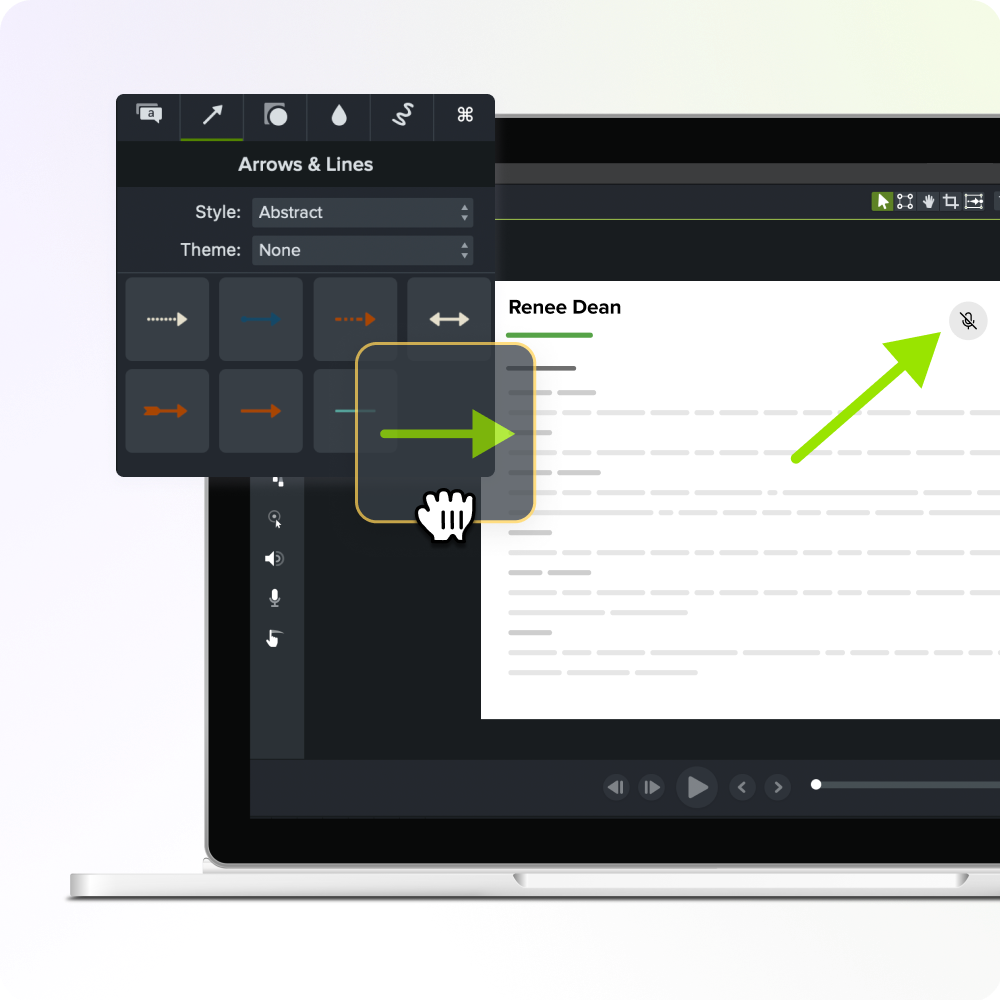
Why retention matters for training success
Knowledge retention is how well employees remember and apply what they have learned over time. Retention can translate to improved productivity and stronger returns on L&D efforts, making it easier for teams to justify their spending.
This is why modern trainers often incorporate video content into their sessions: it’s more engaging and offers real benefits for businesses — such as saving L&D teams from having to answer the same questions repeatedly. Rather than repeat concepts, they can point employees to recordings for additional support.
Let’s dive deeper into why video works so well for boosting knowledge retention.
Replay and pause support better comprehension
One of the biggest drawbacks of traditional training solutions is that they’re typically one-and-done. In a live training session, if an employee misses something crucial or fails to understand a concept, they may be out of luck unless they’re willing to seek immediate clarification — which may not be particularly appealing to introverted team members.
Video eliminates the need for that.
Learners can pause recordings if they need time to absorb information or if they simply want a break. They can also replay videos or specific sections of recordings as many times as it takes to grasp information. This level of control supports different learning preferences and attention spans, which is vital for understanding concepts.
Videos support microlearning moments
Employees may not have the time to read through lengthy texts or sit through hours-long lectures. In many scenarios, they often have to juggle learning and their work.
This is why video is so great for corporate training. It allows you to break down information into small, easily digestible chunks, supporting microlearning. This can encourage more employees to complete training, potentially boosting their comprehension.
Matt advises to “keep videos short and targeted on specific actions or tasks” instead of overwhelming learners with details. Videos that get to the “aha” moment quickly can capture employees’ attention throughout, which is great for knowledge retention.
Narration improves engagement and encoding
Narration activates the auditory cortex, a part of the temporal lobe. This region of the brain is responsible for memory and can support knowledge retention.
Narration, especially when delivered by a clear human voice and paired with visuals, also facilitates dual-channel processing, potentially improving information encoding and recall.
So, don’t hesitate to incorporate audio into your videos. Camtasia Editor makes this easy with voiceover capabilities. You can include narration in your videos without specialized equipment, and edit your audio for clarity with just a few clicks.
With Camtasia Audiate, you can also leverage AI tools for narration, including advanced text-to-speech voice overs, audio improvement tools, and 49 lifelike avatars to connect with global audiences.
Adding visuals strengthens encoding
Visual elements are more effective than text alone. This is because they engage roughly 60% of the brain, which can enhance information comprehension and retention.
When paired with audio, the dual coding theory applies, boosting learners’ chances of remembering training later.
With Camtasia Snagit and Camtasia Editor, you can incorporate visual elements like quick screenshots, arrows, highlights, and animations into your recordings to draw attention to specific concepts, further enhancing the effectiveness of video training.
Crystal-clear screen recording
Why settle for blurry screen content? Camtasia Editor’s screen recorder captures everything at up to 4K!
Free Download
Tactics to design for long-term retention
While video is no doubt a great medium, how you design it can determine whether information sticks. According to Matt, L&D teams need to create videos with retention in mind, not just instruction.
Here are some tips to help you do that:
Use quizzes or reflection prompts
Passive videos may fail to capture viewers’ attention throughout — especially if they’re lengthy.
To prevent a loss of connection when using video for training, incorporate quizzes into your videos that prompt employees to remember what they learned. Alternatively, you can ask viewers to jot down the key takeaways from the videos to encourage deeper information processing.
You can also weave in elements of live training by scheduling post-viewing Q&A sessions or “coffee chats” with other team members. This can reinforce learning and transform it from a passive activity into an active one, potentially boosting knowledge retention.
Organize content in searchable, modular libraries
Videos that are too long can be difficult to navigate and overwhelm learners, undermining L&D efforts. Rather than share every piece of information in a single video, break topics down into short, focused segments and store them in modular video libraries.
This can make it easy for employees to revisit specific topics and minimize the risk of mental overload, improving understanding and retention.
With Screencast, you can build Collections, upload short training videos, and share access links with employees so they can watch them on the platform at their convenience.
Screencast includes an AI feature that helps you generate titles and descriptions for each video, making it easier for learners to find what they need.
Repeat key ideas using visual and verbal cues
Repetition is one of the oldest tricks for retaining knowledge. And, it’s still as effective as ever.
Use verbal repetition by rephrasing important points a few times throughout your videos. However, be careful not to be overly repetitious, which can create unnecessarily lengthy recordings.
With Camtasia Editor, you can even include visual repetition by adding text overlays, animations, captions, and cursor effects over videos. This could reinforce the main points in learners’ minds.
Go from screen recording to polished video
A screen recording is just the start. Camtasia’s editor helps you add the callouts, animations, and edits you need to create a truly professional video.
Free Download
Use Camtasia tools to create retention-first training content
Knowledge retention can help improve employee ramp-up time and boost staff productivity.
To enhance retention, consider replacing traditional training formats with bite-sized video content that features reflection prompts and visual and verbal repetition cues.
Short, well-structured training videos can capture learners’ attention for longer, supporting understanding and recall.
With Camtasia, you can easily create retention-first employee training videos, regardless of your production or technical expertise:
- Camtasia and Snagit help you quickly capture screenshots to emphasize main points.
- Camtasia Editor lets you layer audio, visuals, cursor, and screen recordings into videos to improve the shelf life of training content without taking up too much time.
- Screencast allows you to build video libraries to streamline access to content.
Try Camtasia products today and start building retention-focused video content your team will actually use.
FAQs
What does knowledge retention mean in training?
In training, knowledge retention is how well people remember what they learned and apply it later. It matters because training only works when employees can use the information on the job. That is why replayable, searchable video content can be so useful over time.
Why does video training help knowledge retention?
Video training can be easier to remember because it combines visuals and narration. It also gives learners control, allowing them to pause, replay, and revisit important sections when they need a refresher. That mix of engagement and flexibility can support better comprehension and recall.
How should you design training videos for better recall?
Keep videos short and focused on specific actions or tasks. Use quizzes or reflection prompts, so viewers have to think about what they just learned. It also helps to organize videos in searchable libraries and repeat key ideas with both visual and verbal cues.
Share