









Customer experience optimization can be the difference between retaining the customers you’ve spent thousands of dollars to acquire and losing them to competitors.
One smart way to optimize the customer experience is to offer scalable support options that balance speed and quality. That’s where video shines — it’s certainly quicker than live support and a lot more convenient and engaging than lengthy FAQ pages.
But is it always the best choice? Not quite. According to Mike Spink, Technical Support Manager at TechSmith, video is an incredibly powerful support tool, but only when used wisely. Sometimes, live agents and written docs might be a better fit.
Here, we explore when to use video for self-service support and when other delivery formats may be better suited.
When is video better than live support? Setting up your processes
Video is a great way to scale and improve customer service. It’s often quicker than live support and relatively easier to follow than written instructions — but that doesn’t mean that it’s always the best option.
Here’s a look at when it would and wouldn’t be the ideal go-to solution for your company’s customer support.
Use video for simple, repeatable issues
According to Mike, video is best for “simple technical problem solving and how-to questions” that don’t require analysis. Think about answering questions about resetting passwords, installing your app, setting up customer accounts, or using standard features — basically things that don’t need diagnostic thinking or real-time back-and-forth. For such processes, record screen content using a tool like Snagit and share it with your target audience for quick support.
Going the video route for common support requests can significantly reduce support tickets, allowing your team to focus on more complex issues.
Video also helps you give the same clear instructions to each customer and is easier to follow than knowledge base articles, particularly for visual learners. Seeing as 65% of the world’s population are visual learners, this delivery format can be an excellent way to boost customer satisfaction.
Avoid video for nuanced or complex problems
While most people prefer video over written content, it’s not always the most suitable option, especially when dealing with complicated or unique problems. “Complex issues need the detective work of a live agent to quickly resolve, rather than being lost in an overly conditional video,” says Mike.
We know what you’re thinking: What exactly is considered a complex problem? Well, any issue that involves uncommon or multiple variables falls under the complex category.
For example, if a client gets an unusual error when using your software, you need live agents to ask clarifying questions, like what the customer was doing before getting the error and how long the issue has persisted, so that they can come up with a solution.
Video may also not be the best option in situations that require personalized service, like billing disputes. In such cases, customers would get better assistance by contacting your team.
Providing live support for such issues improves user satisfaction, which can improve customer retention. It’s also an efficient use of team resources, as it saves you from creating videos that ultimately result in escalation.
Don’t force video into every use case
Just because video is valuable in some instances doesn’t mean you should use it for everything. The truth is, not everyone wants to watch a video every time they run into an issue — some people like to read, and others prefer to talk to customer service agents.
So, don’t be rigid about using video. “Let’s be strategic, let’s use our brain, let’s pick and choose,” says Mike. If a live agent is better positioned to solve a customer issue than a video, don’t create a video addressing the situation. Instead, provide a direct route for customers to reach your support team and refocus your resources on other problems.
Even when video can solve problems, don’t offer this delivery format as the only solution — give customers a choice between video and something else. For example, you could create how-to videos and provide transcripts or text alternatives for the recordings. This way, customers get to choose between the two rather than having their choices dictated to them.
Break up long videos into short, titled segments
You’ve probably seen multiple reports saying the human attention span has been shrinking. In fact, the American Psychological Association reports that our attention span has reduced to roughly 47 seconds.
This isn’t to say your videos should be 47 seconds long; three minutes is a good rule of thumb, as it’s just short enough to capture your target audience’s attention and long enough to share valuable information. Mike reiterates, “Customers have a very short attention span. So if you have a video that’s over three minutes, it’s going to be hard for them to stay keyed in.”
Instead of creating lengthy videos, go for short, multi-part series and clearly label each part. Say you’re making a video on how to troubleshoot a specific error. You could cover step one in the first video, move to step two in the next one, and so on, instead of making a single long video.
Shorter videos are not just more digestible for your audience; they’re also easier to update or replace individually as processes evolve.
Here’s what most technical teams get wrong about video support
While video can improve support outcomes, poor execution can lead to frustration or inefficiency. Here are some common mistakes to keep in mind, especially when scaling to a new support system:
Agents can’t easily reference videos during live support
Let’s be honest. Nobody remembers every single thing about everything. So, it’s normal for a live agent to reference company knowledge bases when helping clients.
Unfortunately, videos don’t cut it for this. As Mike puts it, “It is very difficult for that agent to take information from that video and relay it to the customer in real time.” Videos are hard to scan or quote from quickly in a live chat, so they shouldn’t be your only source of knowledge.
Combine them with searchable content, like written documentation, to make work easier for agents who are in real-time conversations with customers.
Some customers just want to talk to someone
“Some clients will never want to use video, no matter what, which is part of the reason why live support is going to be necessary for every technical support team. Even if it’s three minutes, they’ll be like, ‘No, I don’t have time to watch a video. Just tell me the answer,’” says Mike.
Don’t get us wrong. This isn’t to say that you shouldn’t create self-service videos, but rather that you should use them to enhance (not eliminate) the option for real-time, personal support. This way, you meet the needs of different types of clients — those who prefer the convenience of quickly watching a video and those who trust real-time agent support more.
Go from screen recording to polished video
A screen recording is just the start. Camtasia’s editor helps you add the callouts, animations, and edits you need to create a truly professional video.
Free Download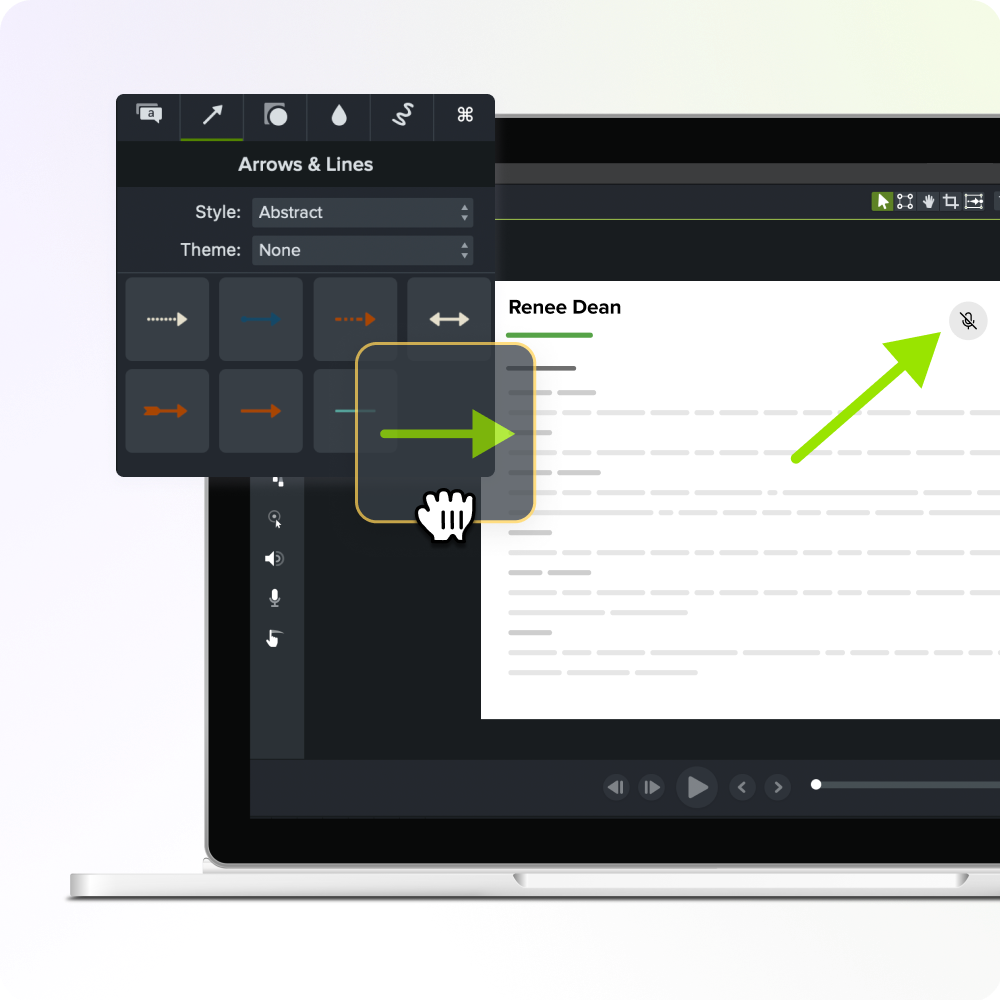
Not every audience prefers the same support format
Different demographics have varying learning styles and different comfort levels with tech. Some people prefer visual walk-throughs, others would rather scan articles, and others prefer jumping on calls with customer support for real-time guidance.
For example, quick video walkthroughs would be enough to help tech-savvy customers solve their issues, but they could be overwhelming for non-tech-savvy groups. Similarly, younger audiences may be comfortable with self-service videos, but older ones may prefer live support, especially when dealing with complex issues.
Identify your user segments early in the planning process and create content based on preference and need.
Our tips on creating technical support video content that builds trust
As with any content format, you need to create videos that customers can trust to boost engagement. This means prioritizing quality, tone, authenticity, and accessibility during production and editing.
Here are our top tips for creating effective video content:
Keep it human, not overproduced
Contrary to common belief, polished videos are not the best for customer support. Leaving some imperfections, like changes in tone, in your production can actually improve relatability and, consequently, customer engagement. As Mike puts it, “It adds a little bit of that humanness, where the customer may feel more connected to either that person or that company.”
So, don’t pour your resources into top-tier production and editing for every video. Sometimes, shooting content from your phone is enough. In fact, quick one-take videos from your phone camera can feel more human and relatable, especially when you leave in the small mistakes.
Of course, this doesn’t mean that you should release low-quality videos. Use phones with decent cameras and only keep the kind of slip-ups you can get away with, like a couple of seconds of blurry footage before the focus kicks in.
Alternatively, you could record your screen using Snagit (to show quick processes) and then send the video to users via a link. This could work when customers contact your support team for help using a specific feature.
You can also use Snagit to record screen content and then add a webcam picture-in-picture window to make support feel less robotic and more personal. Seeing a friendly face instead of just a screen recording can humanize your content and boost engagement.
Record your screen with Snagit
Snagit makes it easy to share quick updates and how-to’s by capturing exactly what’s happening on your screen.
Get Snagit
Pick your moments to show your face
While you don’t need to show your face in self-service videos, it can help humanize your brand and de-escalate tense situations with clients.
Mike recommends using your voice and relevant visuals in public videos and showing your face in personalized 1:1 replies, especially when helping angry customers or rude clients. Recording yourself shows that you care and reminds customers that they’re talking to a real person behind the screen, which could help them calm down.
Build videos for your technical support system with flexibility in mind
Self-service videos are a game-changer for customer support teams. They not only help them deliver consistent customer service but also reduce the number of support tickets received, allowing agents to focus on complex matters.
However, video is only effective when used in the right situations, when you maintain authenticity, and when you prioritize the human connection.
With TechSmith tools like Camtasia and Snagit, you can create high-quality, authentic support videos that help you maintain a connection with your customers. Our tools are pretty easy to use, so it doesn’t matter whether you’re a video production expert or a novice simply trying to improve your company’s customer service; we’ve got you covered.
Want to elevate your support system with self-service videos? Get started with TechSmith today!
Share