








As a trainer, you already know videos work. And training videos are even more effective when the content is engaging, consistent, and easy to produce at scale.
The best employee training videos deliver clear learning outcomes without wasting time or resources. They help teams onboard faster, standardize knowledge across the organization, and make training easier to update as processes change.
This guide explains how to create time-saving training videos that are efficient to produce, effective for learners, and built to deliver measurable results.
Key takeaways
- Choosing the right video format before recording, such as screen capture for software training or scenario-based for compliance, directly affects learner retention.
- Editing narration by deleting words in a transcript can remove the biggest bottleneck in employee training video production.
- Accessibility in training videos, including captions, readable on-screen text, and color contrast, is a production standard, not a final checklist item.
- L&D teams producing at scale may benefit from shared templates, brand asset libraries, and AI voiceover to keep output consistent across creators.
- Measuring training video effectiveness goes beyond completion rates and can include knowledge checks and on-the-job behavior change.
Simplify HR workflows with visual tools
Create clear, engaging training and documentation that helps your teams better understand company policies and processes.
Learn More
Why training videos work at scale
As organizations hire, expand, and update their processes, L&D teams need a reliable way to deliver consistent instruction. Effective training can help employees onboard faster and improve retention. But employees who lack adequate training often feel less confident and supported in their roles. Video helps organizations address that gap by making knowledge easier to access and review as needed.
Training videos help organizations deliver consistent instruction across teams, locations, and hiring cohorts. Unlike live sessions, they ensure every employee receives the same information, regardless of who’s facilitating the training or when the employee completes it.
They’re also well-suited to learning habits. Sixty-seven percent of people watch instructional or informational videos at least weekly, and 83% prefer video over other formats when learning something new. Employees also benefit from training that’s personalized to their needs, available on demand, in a format they can revisit whenever they need a refresher.
Consistent, accessible training can translate into better learning outcomes. TechSmith’s research found that employees completed tasks more effectively and absorbed information faster when training included video and other visual content rather than relying on text alone. For L&D teams, one video can support onboarding programs, compliance, process training, and ongoing development while maintaining quality at scale.
Choose the right format first
Not every training topic calls for the same video format. Choosing the right format upfront helps you create content faster, improve learner engagement, and avoid unnecessary production work.
A simple rule: Match the format to the learning objective. If employees need to learn a workflow, show the process. If they need to understand company values, put people on camera. If they need to grasp a complex concept, explain it visually.
Screen recordings for software and process training
Screen recordings are often the fastest way to create effective training content because they show employees what to do in the tools they use every day. Rather than describing a process, you can demonstrate it step by step.
Camtasia Editor’s multitrack screen recorder captures screen activity, camera footage, microphone audio, and system audio on separate tracks for easier editing. During software walkthroughs, Screentelligence-powered cursor effects can highlight clicks and cursor movements, so learners can follow each step more easily.
Screen captures for detailed explanations
Unlike screen recordings, which show actions over time, screen captures focus attention on a specific moment. They’re ideal when learners need to examine details rather than watch a complete process unfold.
Many training teams start with screenshots captured in Snagit and then bring those assets into Camtasia Editor. For example, a trainer might capture screenshots of a new software dashboard. They can then use zooms, callouts, animations, and narration to explain each feature without recording a full live demonstration.
Talking head videos for culture and leadership content
When trust, connection, or credibility matters, bring in human presence. Employees are more likely to engage with messages about organizational changes, company values, or strategic priorities when they can see and hear the people delivering them.
Keep production simple: focus on clear audio, good lighting, and concise messaging. For this type of training, authenticity is usually more important than elaborate editing.
Scenario-based videos for soft skills and compliance
Policies and compliance requirements are often easier to understand when employees can see how they apply. Scenario-based videos place learners in realistic workplace situations where they observe decisions, actions, and consequences.
This format is particularly effective for compliance training because employees can see how regulations and policies affect their day-to-day responsibilities. Compliance training is most effective when it is role-specific, relevant to employees’ work, and delivered through engaging formats rather than generic, one-time instruction.
Animated explainers for concepts and onboarding
Some topics are difficult to capture on screen because they involve ideas rather than actions. By combining motion, graphics, and narration, animated explainers can simplify complex concepts, relationships, and processes.
During onboarding, animated explainers can introduce company structure, explain how departments interact, or provide high-level product overviews.
Build your next training video with Camtasia
Record your screen or camera. Then, use the video editor to add polish and clarity.
Learn More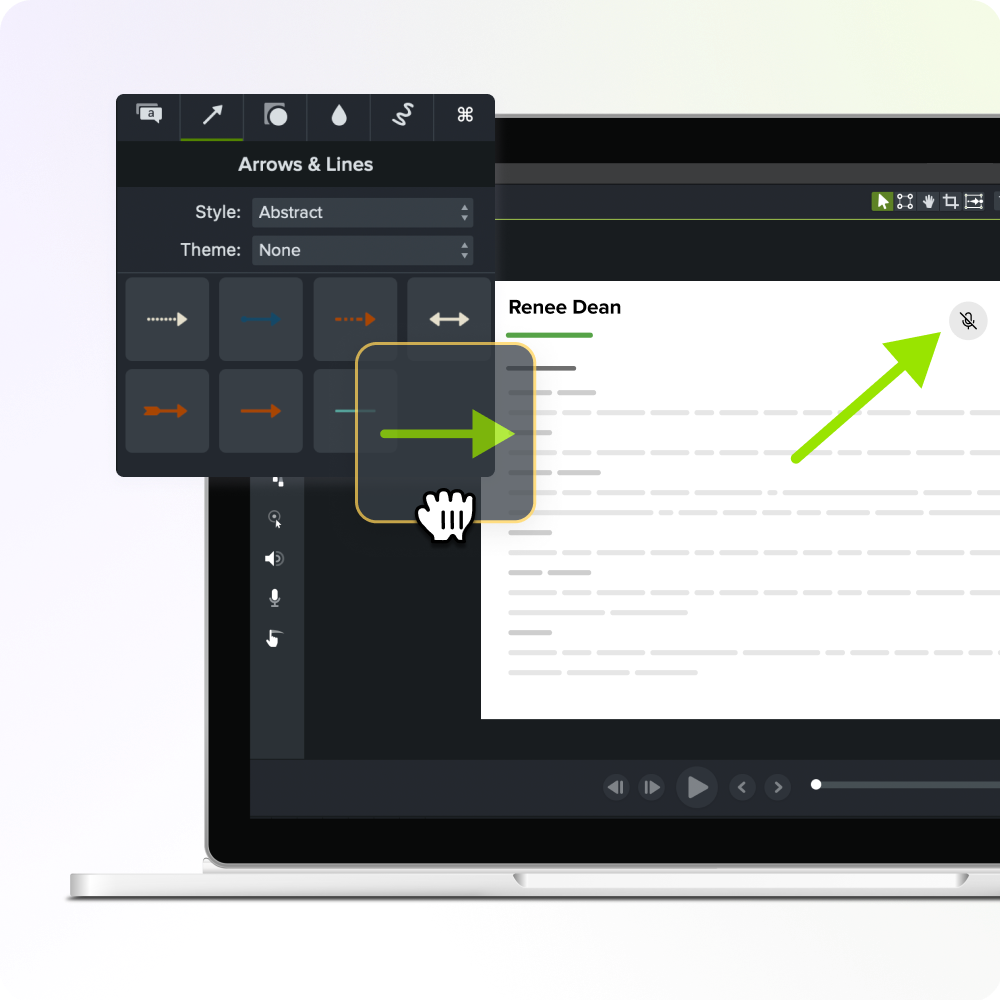
How to create a training video
Follow these six steps to create a finished, accessible video. Each step maps to a specific decision or action in Camtasia Editor or Camtasia Audiate.
Step 1: Translate training needs into format decisions
Before you start recording, determine which format best fits your training objective.
For example, use a screen recording to show employees how to complete key tasks in a software platform. For harassment prevention training, use scenarios that show appropriate and inappropriate workplace behaviors in context.
Step 2: Script for narration, not for reading
A well-written script ensures clarity and flow. Use simple language and include a clear next step at the end.
Camtasia Audiate can generate a first-draft script from a simple topic prompt. From there, review and refine the content, then move directly into recording.
As you edit, remember that employees will hear this content, not read it. Use short sentences, active voice, and a natural speaking rhythm that sounds conversational when read aloud. This approach makes training easier to follow and reduces filler words and retakes during production.
Step 3: Record your screen or camera
You don’t need a studio setup or expensive equipment to record a professional training video. With Camtasia, you can capture your screen, camera, microphone, and system audio from your computer.
Start by clearing your desktop of any unnecessary clutter. Next, open any software, presentations, or documents you’ll need during the training.
In Camtasia Editor, click New Recording and select the monitor, window, or full screen you want to capture. Then choose your microphone and webcam and decide whether you’d like to include system audio.
One of Camtasia Editor’s biggest advantages is its multitrack recording capability. Camtasia Editor records your screen activity, camera footage, microphone audio, and system audio on separate tracks, which gives you more flexibility during editing. You can adjust narration without affecting the screen footage, replace a webcam clip without re-recording the entire presentation, or independently remove unwanted system sounds.
When you’re ready, click Start Recording, wait for the three-second countdown, and begin your walkthrough. Don’t worry about getting through the recording perfectly. If you make a mistake, pause briefly and restart from just before the error. You can clean it up later during editing.
Pro tip: Clap twice after making a mistake so you can easily find it in the soundwaves. You can also say a keyword, which you can quickly find in Camtasia Audiate.
When you’re finished, click Stop Recording. Camtasia Editor automatically adds your recordings to a new project timeline, so you can start editing directly.
Step 4: Edit audio by editing text
After importing your recording, Camtasia Audiate automatically generates a transcript. You can delete words, sentences, or entire sections directly from the transcript, and Camtasia Audiate automatically removes the corresponding audio.
This workflow is especially useful for training videos because it makes revisions faster and easier. Audiate can also identify and remove filler words with a single click.
When you need narration but don’t want to record it yourself, Camtasia Audiate can generate AI voiceovers from your script and send the finished audio directly to Camtasia Editor.
Step 5: Add annotations, callouts, and transitions
After you edit the core content, add your visual elements to make the training easier to follow and understand.
Annotations and arrows highlight buttons, menus, and actions employees need to follow. Callouts can reinforce key information, summarize a process step, or emphasize a compliance requirement before learners move forward.
Transitions can signal a new topic or section, while zoom effects can draw attention to small details that might otherwise be missed.
Step 6: Share for review and stakeholder feedback
Before publishing, send your draft to stakeholders for review.
Screencast gives reviewers a chance to watch the video and leave feedback in a centralized location. This is especially helpful for HR, compliance, legal, and operations teams that need to approve training content before it goes live.
After you receive feedback and approval, make the revisions and complete a final quality check before publishing the video on your learning platform.
Make great educational videos
Create engaging videos that drive student success with Camtasia’s easy drag-and-drop editing.
Free Download
Scaling production across your L&D team
Most training video advice is written for a single creator. L&D teams need a production system that keeps content consistent across multiple creators, training programs, and publishing schedules.
Camtasia Editor features shared templates and brand asset libraries that help standardize visual elements such as title screens, callouts, logos, and lower thirds. This way, employees have a consistent learning experience regardless of who creates the video.
Narration is another common challenge at scale. When multiple team members record voiceovers, audio quality and delivery can vary. Camtasia Audiate’s AI voice generation helps teams maintain a consistent narration style across courses while making it easier to update content without scheduling new recording sessions.
Common mistakes that reduce training effectiveness
A few common production habits can make a well-planned training video harder to complete. These three mistakes are the most common — and the easiest to fix before you publish.
- Creating videos that are too long or unfocused. Employees are more likely to complete training and retain information when each video focuses on a single task or objective. Break longer topics into shorter modules and use Camtasia Editor’s timeline tools to trim unnecessary content and keep lessons focused.
- Overcomplicating the content. New employees rarely need every detail in a single video. Avoid excessive jargon and technical language, and write scripts for listening rather than reading. In Audiate, you can revise scripts, remove filler words, and tighten explanations before publishing.
- Neglecting accessibility. Build accessibility into the production process, rather than adding it at the end. Use captions, transcripts, and clear visual cues to support different learning needs. Camtasia can automatically generate closed captions from your audio, making it easier to create training videos that are accessible to all employees.
Measure if your training videos work
A published training video is only useful if employees understand the material and apply it to their work.
Start with employee engagement and completion metrics. These tell you whether employees watched the training and where they stopped. Next, use quizzes or knowledge checks to measure whether learners understood and retained the content.
The more meaningful metrics come after employees complete the training. Look for behavior changes such as improved process adoption, fewer errors, higher compliance rates, or faster onboarding. Then connect those outcomes to broader business goals.
AIHR’s training measurement framework emphasizes moving beyond completion rates to evaluate knowledge gain, behavior change, and business impact. Together, these metrics provide a more complete picture of training effectiveness than view counts or completion rates alone.
Start making training videos that stick
Effective training videos start with three decisions: which format fits the learning objective, how the team will produce the video, and how it will measure results.
This workflow gives L&D teams a repeatable system for creating training videos that are clear, accessible, and scalable. Camtasia Audiate helps with script generation and narration editing, while Camtasia Editor handles recording, editing, and review. Together, they help teams reduce production friction without sacrificing quality.
Whether you’re building onboarding programs, compliance training, software tutorials, or leadership communications, Camtasia can help your team produce consistent training content more efficiently. Get started now.
FAQs
What type of training video should I use for onboarding, compliance, or software training?
Match the format to the training goal before you start recording. Screen recordings work best for software onboarding and process walkthroughs, while scenario-based videos are more effective for compliance topics where learners need to see realistic decisions and consequences. Animated explainers suit abstract concepts and general onboarding content where screen capture isn’t practical.
How long should an employee training video be?
Keep each video focused on a single learning objective, and let that scope determine the length. In practice, most effective training videos cover one task or concept rather than bundling multiple topics into a single session. Shorter, focused videos are easier to update, easier to reuse, and more likely to hold learner attention through to completion.
What makes a training video effective for adult learners?
Effective training videos tie every piece of content to a single clear outcome, use high-quality audio as a baseline, and guide learners’ attention with on-screen elements such as callouts and annotations. Poor audio is one of the fastest ways to lose a learner’s attention, regardless of how strong the visual content is. On-screen text, arrows, and zoom effects may help reinforce the steps that matter most without adding cognitive load.
How do you make training videos accessible for all employees?
Accessibility in training videos includes captions, transcripts, readable on-screen text, sufficient color contrast, and clear audio — not just captions alone. Treating these as production standards rather than post-publish fixes saves significant rework time and keeps your content usable for employees with hearing, vision, cognitive, or situational limitations. Camtasia Editor includes automated caption generation to help teams build accessibility into the workflow from the start.
What metrics should you track to know whether a training video is working?
Start with engagement and completion rates as baseline signals, but don’t stop there. Knowledge checks built into or following the video can confirm whether learners retained the key concepts. The strongest indicator of effectiveness is on-the-job behavior change, connecting what employees watched to how they actually perform the task afterward.
Build your next training video with Camtasia
Record your screen or camera. Then, use the video editor to add polish and clarity.
Learn More
Share